
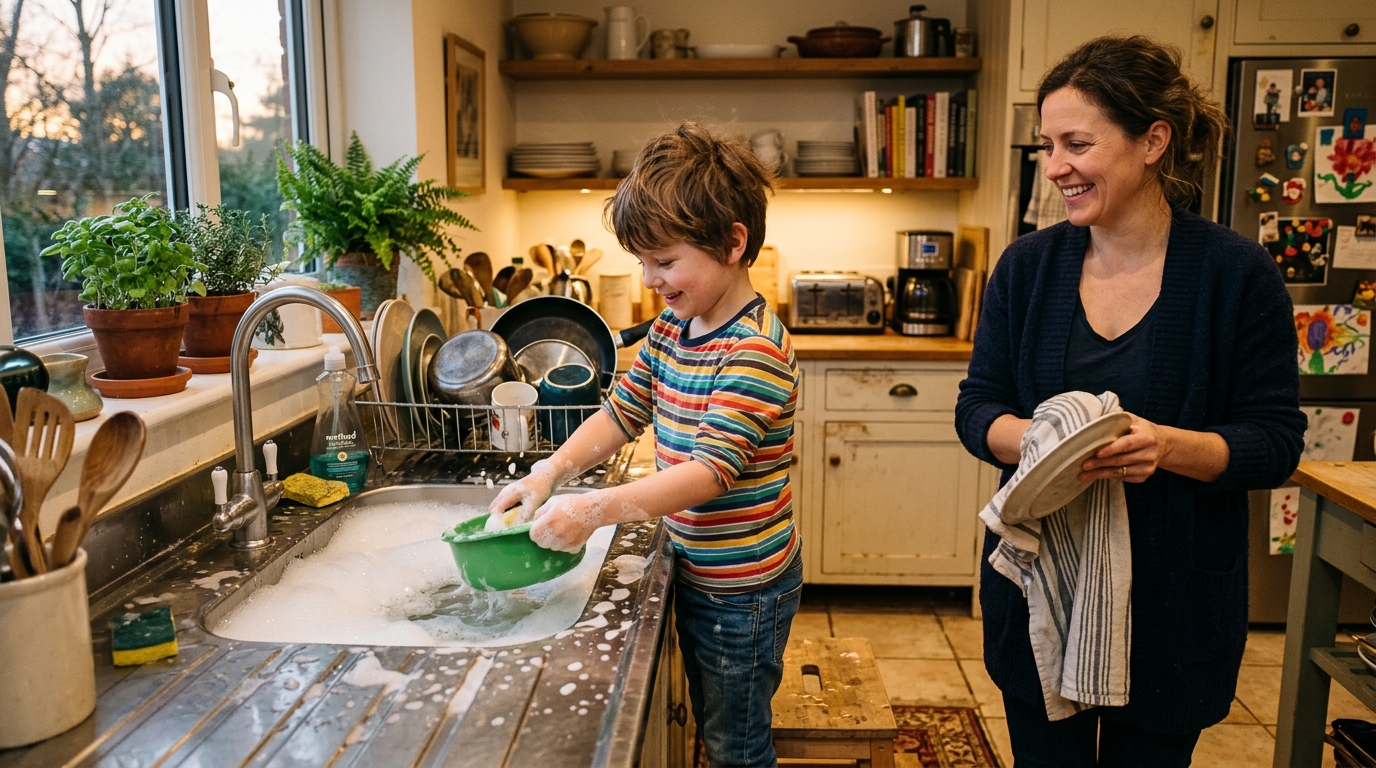
The first time my oldest washed dishes, I found half an inch of water on the counter, a soaked kitchen rug, and a four-year-old grinning like he had just invented soap. He had used most of a bottle of dish liquid on three plastic cups. The sponge was floating. His socks were wet, which I still cannot explain.
The funny part is that I had looked up what age can kids wash dishes about a week earlier and decided he was too young. Then he dragged a chair to the sink and decided for both of us. He held up a dripping cup and said, "I did it myself." That sentence is the whole reason I kept letting him do it. The mess is the tuition fee for a capable kid, and at our house, tuition was due.
Three kids later, my sink has seen a lot. Here is what I have learned about when dishes become a kid job, how to set it up so nobody cries, and how to get through the first few weeks without regretting everything.
So what age can kids wash dishes?
Steadiness matters more than birthdays, so treat these as ranges, not deadlines. But after three kids and a lot of reading, this progression lines up with what child development sources recommend and with what actually happened at my sink.
Around 2 to 3. This is not washing. This is standing on a stool next to you, swishing a plastic cup in warm water while you do the real work. They can also carry their own plate from the table to the counter, and they are surprisingly proud of it. Montessori teachers start even younger with unloading silverware from the dishwasher, no knives, sometimes before 18 months. At this stage the goal is that the kitchen feels like a place where they belong, not a place they get shooed out of.
Around 4 to 5. Now they can genuinely wash unbreakable things with you right there. Plastic plates, cups, spoons, the lunchbox. My eldest started a few months past four, and his cups came out cleaner than I expected, though his definition of "rinsed" was loose for a while.
Around 5 to 6. Loading and unloading the dishwasher becomes realistic, minus anything sharp. Plates in the rack, cups on top, silverware sorted into the basket. My seven-year-old niece does this most nights at my sister's place, and yes, the bowls are stacked in a way that defies physics.
Around 6 to 8. This is when a kid can wash an actual sink of dinner dishes with you nearby. Most chore guides put washing dishes with assistance at age 6 or 7. Nearby matters. You are folding laundry at the table, not hovering, but you are there when the greasy pan shows up.
Around 10 and up. Full independence. The commonly cited range for doing dishes or running the dishwasher completely unassisted is 10 to 13. That gap between 8 and 10 is not wasted time. It is years of practice with a safety net.
So when someone asks me what age can kids wash dishes, my short version is: start the pretend version at two, hand over real washing around six, and expect true independence around ten. If you want the bigger picture beyond the sink, I keep a full list of age-appropriate chores by age that follows the same logic: hand over the job a little before you think they are ready, then stay close.
Setting up the sink so it actually works
You cannot just point a five-year-old at a pile of dishes and walk away. The setup does most of the work.
Get a step stool that does not wobble. Not a chair. A chair at a wet sink is how you end up in urgent care. A wide two-step stool with grippy feet lets them lean into the sink without tipping. This one purchase changed everything for us.
Plastic first, for months. Everything they touch early on should bounce when dropped. Plastic cups, melamine plates, silicone spatulas. Breakables come later, one item at a time, once their hands have proven themselves. A broken glass in week one convinces everyone, including the kid, that this was a bad idea.
Give one-item jobs. "Wash the dishes" overwhelms a small kid the same way "clean your room" does. "Wash these four cups" is a job with a visible finish line. When the cups are done, they are done. Success feels concrete, and concrete success is what makes them ask to do it again tomorrow.
Control the soap. Put a small squirt in the water yourself, or hand them a pre-soaped sponge. A full bottle within reach of a preschooler is a foam machine. Ask me how I know.
Set up a drying spot. A towel laid flat on the counter where clean dishes go. It gives the job an ending and keeps wet dishes from wandering back into the dirty pile, which happens more than you would think.
What the first month actually looks like
I want to be honest here, because the first month is where most parents quit.
Week one is a flood. Water travels farther than seems possible. Your kid will use ten minutes to wash one bowl and feel like a hero. Let them. Do not fix their technique on day two. A kid who gets corrected constantly at the sink learns that the sink is where they fail, and they stop volunteering.
Week two, the novelty dips. They wander off mid-job with three cups still in the water. Call them back once, calmly, and have them finish the small job you assigned. This is why one-item jobs matter. Finishing four cups is doable. Finishing "the dishes" is not.
Somewhere in weeks three and four, something shifts. The water mostly stays in the sink. They start narrating their system to you, very seriously. My daughter announced that cups go first "because they are the thirstiest," and I did not argue with the logic because the cups were clean.
You will still re-wash things. Do it quietly, later, out of sight. The point of this month is not clean dishes. The point is a kid who believes they are the kind of person who does dishes. Clean dishes come later, and they do come.
A kid who is allowed to do a job badly right now is a kid who is learning to do it well.
One more thing about the first month: expect pushback on random days. A kid who loved the sink on Tuesday may refuse on Thursday. That is normal and usually has nothing to do with dishes. If refusal is the bigger battle in your house, I wrote about why your 4-year-old won't listen and what finally worked for us, and most of it applies at the sink too.
What stays an adult job, and why
Handing over the sink does not mean handing over everything in it. A few things stayed mine for years, and I said so out loud, because kids handle limits better when they come with reasons.
Sharp knives. Not in their wash pile, not in their dishwasher basket, not until age 10 or later depending on the kid. A knife hidden under soapy water is dangerous for adults, let alone a seven-year-old feeling around the bottom of the sink. When my kids load the dishwasher, I handle every knife myself, every time.
Delicate glassware. Thin glasses and anything sentimental. A wet glass is slippery, small hands are still calibrating grip, and a shattered glass in a sink full of suds means the whole sink has to be emptied and checked. Sturdy drinking glasses came into rotation around 8 for us. Grandma's serving bowl still has not.
Heavy and hot things. Cast iron, the big stockpot, anything that just came off the stove. Weight plus water is a dropped-pot injury waiting to happen.
Raw meat dishes. The cutting board and bowl that touched raw chicken get washed by an adult, hot and thorough. Kids do not have the judgment yet to know when "looks clean" is not clean enough, and this is not the place to learn by trial and error.
Everything else is fair game, and the list of adult-only items shrinks every year. That is the whole design. The same thing happened with when kids can brush their own teeth: you supervise long past the point where they technically can, then one day you realize you have not checked in weeks.
My kitchen floor has been wet more often in the last four years than in my whole life before kids. I have also watched my niece go from a four-year-old who could barely reach the faucet to a seven-year-old who does the dinner dishes while telling my sister about her day, unprompted, like it is nothing. So if you are staring at a small person dragging a chair toward your sink, wondering what age can kids wash dishes, my answer is: probably this one. Put down a towel and let them ruin your evening a little. It is the cheapest tuition you will ever pay.