
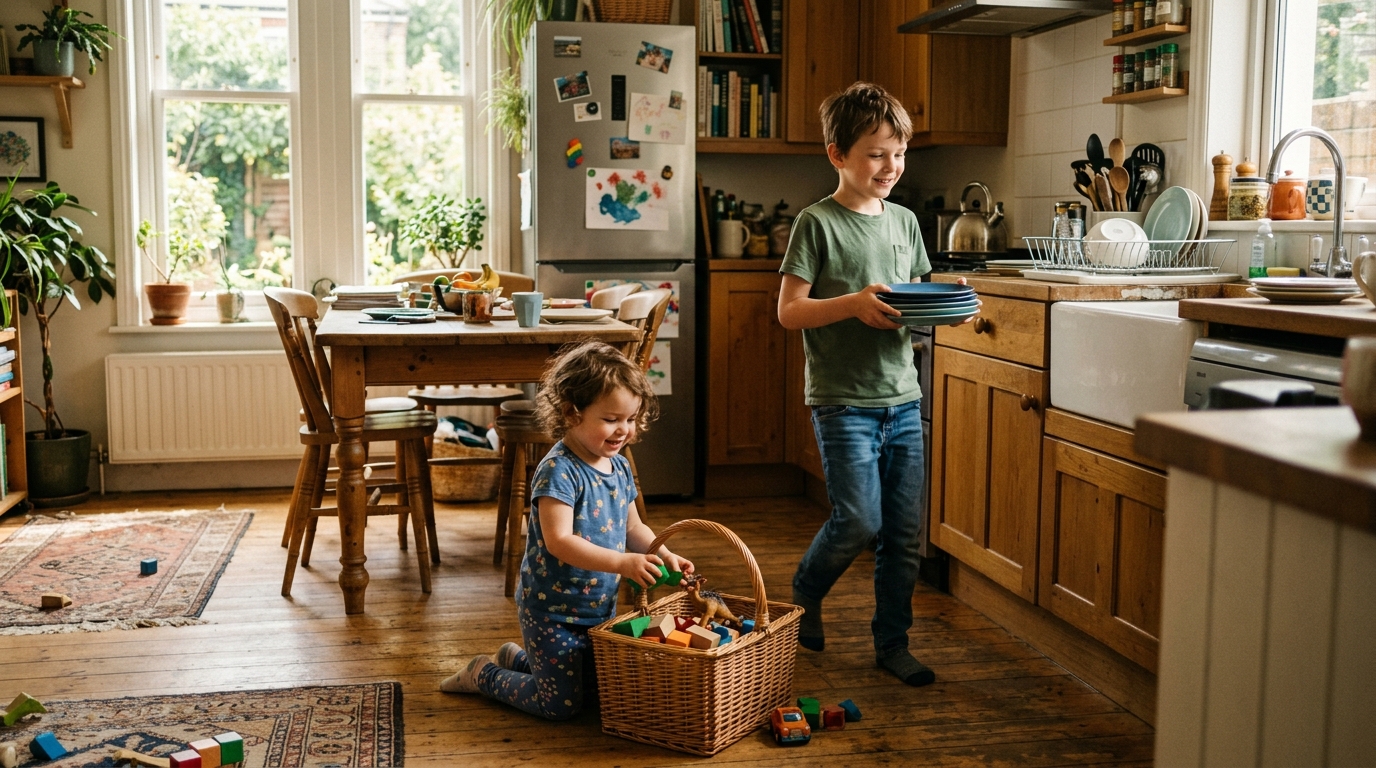
Last Tuesday I watched my 2-year-old carry a single spoon from the dishwasher to the drawer like she was transporting a crown jewel. It took her four minutes. She dropped it twice. She put it in the wrong slot. And when she finally shut the drawer, she turned around with a face so proud you would think she had paid off our mortgage.
Two years ago I would have done it myself in three seconds and handed her a toy to keep her busy. I know this because that is exactly what I did with my oldest, who is now 6, and by the time he was 4 he would stand next to a mess and wait for me to fix it. That was my wake-up call. So if you have been wondering about age appropriate chores for kids, what a 2-year-old can genuinely handle versus what needs to wait until 8 or 10, this is the breakdown I wish someone had handed me before I trained my firstborn to be a tiny hotel guest.
Why I stopped doing everything myself
Here is the uncomfortable thing I had to admit. I was not doing everything for my kids because they could not do it. I was doing it because I was faster, and because part of me liked feeling needed. Meanwhile I was exhausted, resentful by 7pm, and raising kids who saw the household as something that happened to them rather than something they belonged to.
The research backs up what I stumbled into. Marty Rossmann, an emeritus professor at the University of Minnesota, analyzed data that followed 84 people from preschool into their mid-20s. Her finding, published in 2002, still stops me in my tracks: young adults who started doing chores at age 3 or 4 were more likely to be self-sufficient, do well academically and in early careers, and have strong relationships than people who started chores as teens or never had them. Starting late was almost worse than not starting at all, because a teenager handed a chore list out of nowhere reads it as punishment.
Julie Lythcott-Haims, the former Stanford dean who wrote How to Raise an Adult, points to the Harvard Grant Study, one of the longest-running longitudinal studies ever conducted, and draws the same line. In her words, professional success in life comes from having done chores as a kid, and the earlier you started, the better. The American Academy of Pediatrics says chores build responsibility and a sense of belonging in the family, and that kids do best when tasks match their actual abilities.
A child who helps run the house grows up believing she can run her own life.
That belief is the whole point. The clean counters are a side effect.
Age appropriate chores for kids: the full list by age
One warning before the list. Any list of age appropriate chores for kids is a starting point, not a contract, because a cautious 6-year-old and a bold 6-year-old are different workers. Every band below assumes you teach the chore first, do it together a dozen times, and accept a wobbly version of done. A 4-year-old's made bed looks like a lumpy dog slept in it. Praise it anyway.
Ages 2 to 3
This is my youngest right now, so I can tell you exactly what works. Toddlers this age want to help. It is a developmental window, and if you wave them off now, you will be begging them to help at 9.
- Put toys into a labeled bin or basket
- Carry their plastic dishes to the counter after meals
- Put dirty clothes in the hamper
- Wipe up their own small spills with a cloth you hand them
- Help feed the pet by scooping one cup of food
- Put books back on a low shelf
The trick at this age is one instruction at a time. "Put the blocks in the bin" works. "Clean up the playroom" does not.
Ages 4 to 5
My middle child is 4, and this age is where real capability shows up if you let it. Preschoolers can follow two-step instructions and remember a routine that repeats daily. This is also the age Rossmann's research flags as the sweet spot for starting daily chores, and it lines up with the independence skills on any school readiness checklist.
- Make their bed, lumpy version accepted
- Set the table with napkins, forks and unbreakable cups
- Clear their own plate and scrape it into the trash
- Water plants with a small can
- Match socks from the clean laundry pile
- Get dressed fully on their own
- Help carry light groceries in from the car
If your 4-year-old fights you on all of this, the chore usually is not the problem. I wrote about what actually helps in why your 4-year-old won't listen, and most of it applies straight to chores.
Ages 6 to 7
My niece is seven, and watching her these past two years, the jump around six shocked me. Kids this age can hold a multi-step task in their head and finish it without you standing there.
- Make their bed properly and tidy their room with a checklist
- Empty small trash cans into the big one
- Sort laundry into lights and darks
- Fold towels and washcloths
- Pack their own school snack from options you set out
- Sweep with a kid-sized broom
- Wipe the table after dinner
- Brush their own teeth with a quick parent check, and if you are unsure when that handoff happens, here is my honest take on when kids can brush their own teeth
Ages 8 to 9
I am not there yet with my own kids, so this band comes from watching my closest friend run her house with her 8-year-old and from what I am deliberately building toward. Her daughter does things that would have amazed me before I saw them done consistently.
- Load and unload the dishwasher
- Fold and put away their own laundry
- Vacuum a room from start to finish
- Make a simple breakfast like toast, cereal or scrambled eggs with supervision at the stove
- Take the trash bins to the curb
- Pack their own school bag and check it against a list
- Walk the dog around the block in a safe area
This is also the window where a lot of self-care goes fully independent, including bathing. I dug into the safety side of that in what age a child can bathe alone.
Ages 10 and up
By 10, a kid can run real household systems, not just tasks. My friend's 11-year-old owns dinner one night a week. Owns it. Plans the meal, adds items to the grocery list, cooks it with an adult nearby. The first month was rough. Now it is the best meal of their week, partly because everyone eats it without complaining, including the cook.
- Do a full load of laundry, start to finish
- Cook one simple meal per week
- Clean a bathroom, sink and mirror and toilet
- Mow the lawn with training and supervision
- Babysit a sibling for short stretches while a parent is home
- Manage their own homework schedule and morning routine
- Help with grocery budgeting for their meal night
How to start without a fight
Knowing the age appropriate chores for kids at each stage is the easy half. Getting a child who has never lifted a finger to actually do them is the half that ruins dinners. If your kids are past toddlerhood and have never had chores, do not post a chore chart with six new jobs on Monday morning. That is how you get a mutiny. Here is what worked for us and for every family I know who made this stick.
Start with one chore, done together, every day for two weeks. Together is the part people skip. You are not assigning, you are training, the same way a new employee shadows someone before working alone.
Tie chores to belonging, not payment. The AAP and most child development experts draw the same line I do at home: family chores are unpaid because we all live here. Extra jobs beyond the basics can earn money. My 6-year-old does not get paid to clear his plate for the same reason I do not get paid to make dinner.
Lower your standard and keep it lowered. If you redo the towels your kid folded while they watch, you have taught them their work is worthless and yours is the only version that counts. Crooked towels stay crooked.
Expect the whining and hold the line anyway. The first week of any new chore is loud in my house. The third week is silent. Kids protest change, not chores.
Never use chores as punishment. The moment scrubbing the table becomes what happens when you hit your brother, every chore becomes a sentence to be served instead of a normal part of family life.
My spoon-carrying 2-year-old will not remember that Tuesday. But somewhere in her head, a quiet idea got laid down: I am someone who helps. I do things. That idea, repeated a few thousand times between now and 18, is the thing Rossmann was measuring in those thriving mid-20s adults. The house gets cleaner too, eventually. Mostly, though, you get a kid who walks into her own life already knowing how to run it, and you get to stop being the only person in your home who knows where the spoons go.