
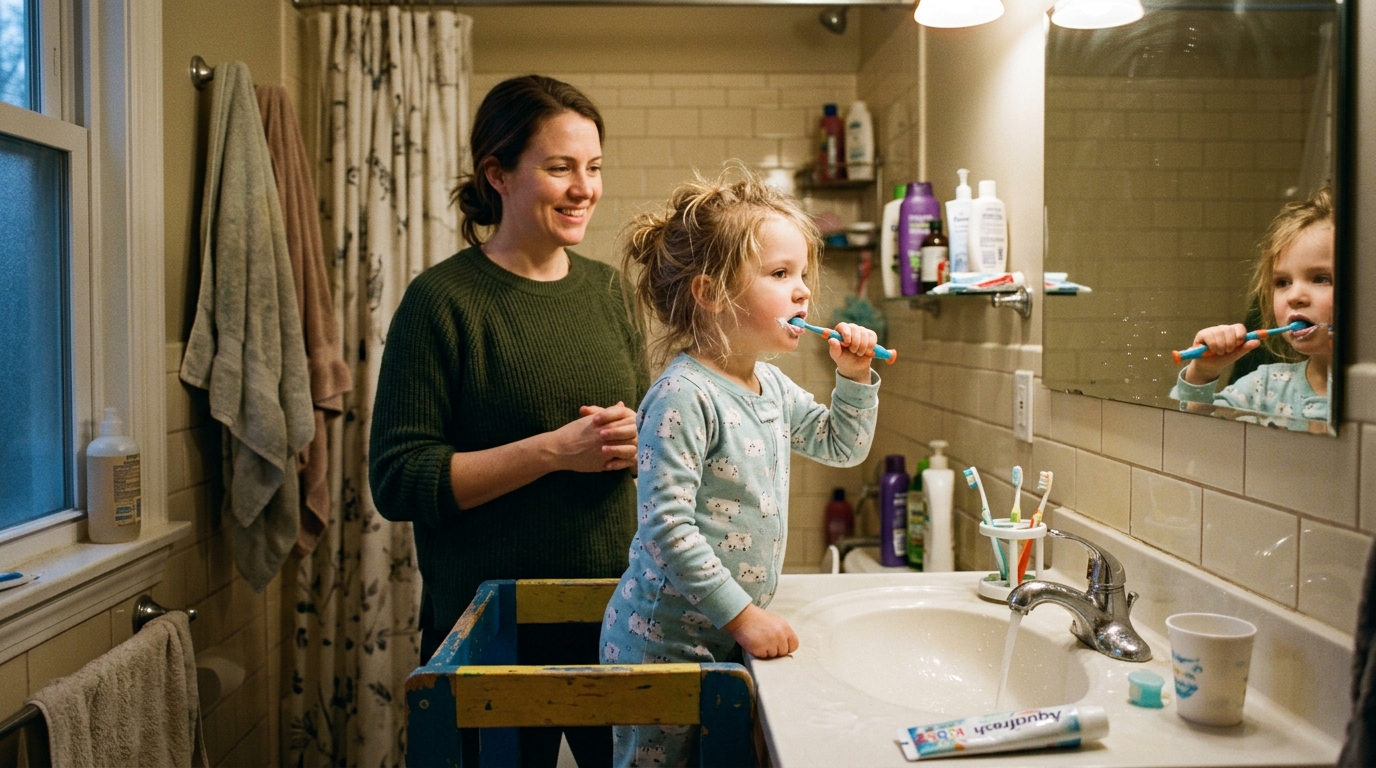
I have three children under five, so my bathroom at 7pm is basically a small production line. And somewhere between child number one and child number three, I worked out a system for toothbrushing that I wish someone had handed me at the start: from age two, we take turns. In the morning they brush themselves, at night I do it. Some weeks we flip it, they get today and I get tomorrow. The point is that every single day, they get a real turn with the brush, and every single day, an adult still gets in there properly.
I assumed I invented this out of tiredness. Turns out I had accidentally landed on almost exactly what pediatric dentists recommend. But when I sat down to check the actual ages, one thing surprised me, and it is probably the most useful thing in this whole post: kids can hold a brush and copy you from age two, but genuinely brushing well, alone, with no adult check afterwards, does not arrive until somewhere between six and eight. That is years later than most of us assume, and knowing it changes how you run the handover.
The short answer, ages first
Every dental body I checked lands on roughly the same timeline, which was a relief, because it means there is an actual answer here and not just opinions.
- Around age 2: they start having a go themselves, and you still brush their teeth properly at least once a day. Their turn is practice, not cleaning.
- Ages 3 to 5: they do more and more of the brushing, but an adult still finishes or checks every session. The night brush especially should get adult hands or adult eyes on it.
- Ages 6 to 8: this is the window where most kids become able to brush properly on their own. The American Dental Association's position is blunt about it: very few children do an adequate job before age seven, and most are ready to fully take over around eight.
- Until at least 7: the NHS tells parents to supervise brushing up to age seven at a minimum. Supervise means watching and checking, not necessarily doing.
So the honest answer to "when can kids brush their own teeth" is: they can start at two, and they can finish the job alone at around seven, give or take a year for the child in front of you. Everything in between is the handover, and the handover is where parents like us either build the skill or accidentally hold onto the job for years too long.
Why so late? It is about hands, not attitude
Four- and five-year-olds can be surprisingly capable people. Mine can dress themselves, tidy their toys, and negotiate like tiny lawyers. So why can't they brush their own teeth properly until six or seven?
Because brushing well is a fine motor skill, not a knowledge problem. Getting the bristles angled at the gum line, doing small circles instead of wild sawing, reaching the backs of the molars on both sides, keeping it going for two full minutes. That takes wrist control and coordination that simply is not finished developing in a four-year-old, no matter how clever they are.
Pediatric dentists have a rule of thumb I love because it takes the guessing out: if your child can tie their own shoelaces, they have the coordination to brush their own teeth. Shoe tying uses the same finger and wrist control as proper brushing, so it works as an honest measurement. My eldest is nowhere near laces yet, which tells me exactly where we are on brushing too.
The turn-taking system that does the handover
Here is the system I run with my three, and why each piece is there. It costs nothing and it fits in the routine you already have.
Age 2: introduce the turn. From their second birthday, brushing has two parts, their go and your go. Hand the brush over first, let them chew it, wave it, do their version. Then you say something like "my turn to find the sugar bugs" and do the real clean. Morning can be their solo practice run; night is yours. At this age their turn achieves nothing dental. It achieves something bigger: they believe brushing is something they do, not something done to them. That belief is what you cash in for the next five years.
Ages 3 to 4: alternate for real. Now they brush first, properly attempting it, and you finish. Or you split sessions: they own the morning brush, you own the night one. In our house we sometimes alternate whole days, today is Mummy's day, tomorrow is yours. It keeps them proud and keeps at least one properly adult-cleaned session in every 24 hours. If you only keep one, keep the night one. The night brush is the one that matters most because whatever is left on the teeth sits there all night.
Ages 5 to 6: they brush, you inspect. They now do the full two minutes themselves most sessions. Your job shifts from brushing to checking: have a look, run their brush over anything they missed, make a game of finding the "hiding spots". This is also the age to teach spitting without rinsing, small circles, and not scrubbing like they are cleaning a pot.
Ages 7 to 8: solo, with spot checks. Once they pass the shoelace test and their checkups are clean, let go. Stay on reminders, twice a day does not happen by itself for years yet, and do a casual spot check a couple of times a week. Most kids are fully independent brushers by eight.
If your child fights every stage of this and brushing is already a nightly wrestling match, that is a different problem, and it is usually about control rather than teeth. I wrote about ending the toothbrushing battle separately, and about why toddlers say no to everything, because a child who screams "I do it MYSELF" is actually volunteering for this exact handover. Take the volunteer.
The rules that do not change with age
Whoever is holding the brush, some things stay fixed. These are the ones dentists and the NHS repeat until they are hoarse:
- Twice a day, two minutes. One of those times is last thing before bed, after which only water passes their lips.
- The right amount of fluoride toothpaste. A smear the size of a grain of rice for under-threes, a pea-sized blob from three to six. More than that is not more protection, it is just swallowed paste.
- Spit, don't rinse. Rinsing with water washes the fluoride away before it can do its work. This one shocked me because I was raised to rinse. We were all doing it wrong, apparently.
- An adult owns the outcome until at least seven. Their independence is the goal, but their molars are your responsibility in the meantime.
Letting them brush is how they learn. You finishing the job is how their teeth survive the lessons.
Why I bother with the handover at all
It would be faster to just brush all three of my children's teeth myself until they are seven. Faster today, anyway. But a five-year-old who has been having her turn since age two does not fight me at the sink, because the sink is partly hers. And a seven-year-old who has done five years of supervised practice takes over the job smoothly, instead of being handed a skill he never got to rehearse.
That is the quiet pattern behind most of the independence stuff we do in this house, whether it is getting ready for school or putting on their own shoes. Kids do not become capable on their birthday. They become capable because someone let them practise badly, a hundred times, while quietly making sure the important bits still got done.
So start the turns at two and keep your hands in the game until around seven. Somewhere in the middle, on a night you will not even notice, the job becomes theirs.