
It was a Tuesday around 5:40pm, dinner half made, and I had asked my daughter to put her shoes by the door four times. Not three. Four. By the fourth time my voice had that tight, scraped edge to it, and she still stood in the middle of the living room holding a plastic dinosaur like she had never heard a word I said. I remember thinking, very clearly, "She is doing this on purpose." And then I yelled. And then I felt like garbage for the rest of the night.
If you have a 4 year old not listening to a single thing you say, I want you to know two things before we go any further. You are not a bad parent, and she is not a bad kid. Something specific is happening in that little brain, and once I understood it, the shoes-by-the-door war got a whole lot quieter. This post covers why a 4 year old is not listening in the first place, and the exact things that got cooperation in my house without the yelling I hated.
A 4 year old not listening is development, not defiance
Here is the part nobody told me. At four, the part of the brain that handles impulse control and switching tasks is still very much under construction. Your child is not weighing your request and deciding to ignore it. She is deep inside her own world, and her brain genuinely struggles to stop one thing and start another on command.
Think about how you feel when you are three paragraphs into a text and someone starts talking at you. You hear a voice. You do not process the words. That is your four year old roughly forty times a day.
There is also the plain fact that four year olds are testing where the edges are. That is their job right now. They push to find out if the rule holds. When you see a 4 year old not listening, you are usually looking at a normal brain doing normal four-year-old things, not a character flaw you need to correct out of them.
Once I stopped reading it as disrespect, I stopped taking it personally. And that single shift lowered my voice more than any technique on this list.
Get down to their level and use their name first
I used to fire instructions across the room while chopping onions. Zero eye contact. Zero connection. Just a voice from the kitchen expecting a small person to drop everything.
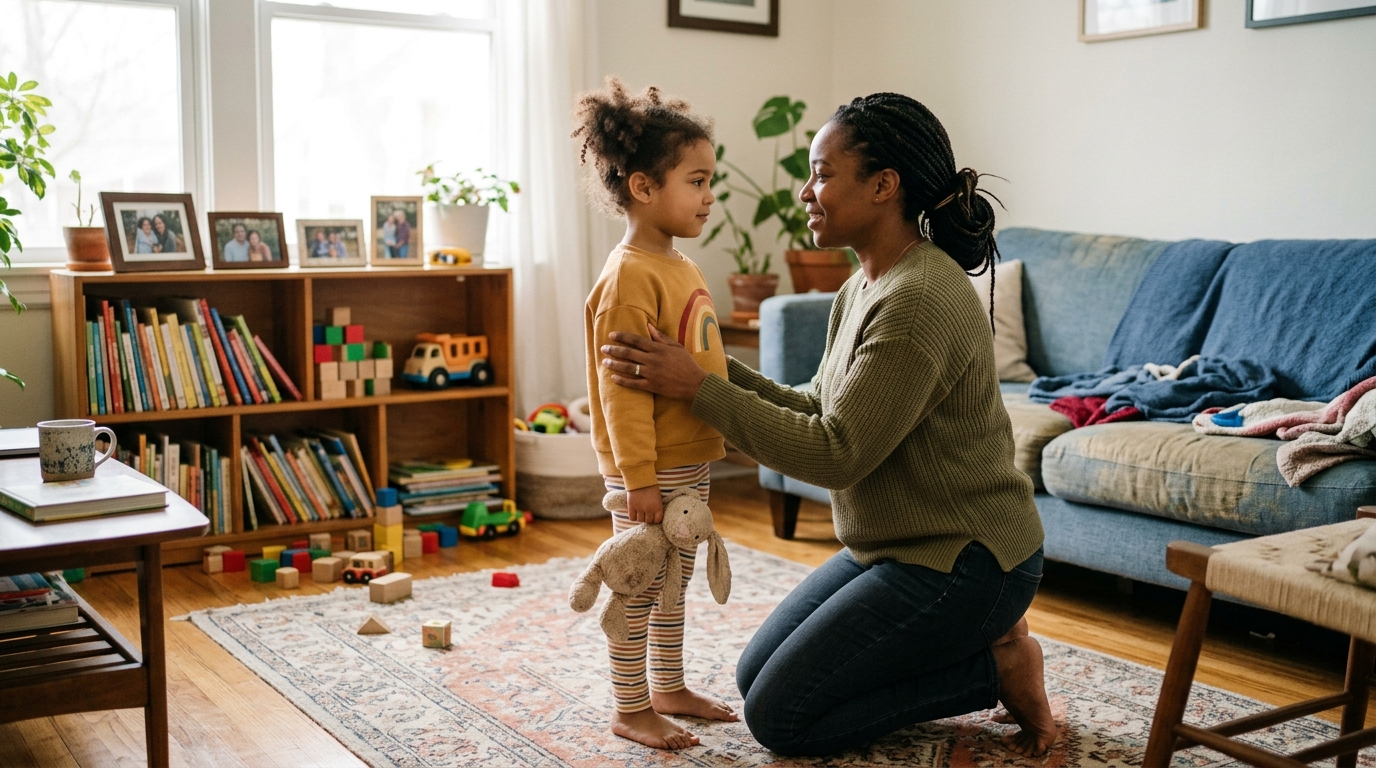
Now I walk over, crouch down to her eye level, put a hand gently on her shoulder, and say her name first. Then I wait for her eyes to actually meet mine before I say anything else. That pause is the whole trick. You are giving her brain the two seconds it needs to switch channels from dinosaur world to mom world.
- Stop what you are doing and go to the child
- Get down so your eyes are at their height
- Say their name, then wait for eye contact
- Keep your voice low and slow, not loud
If they cannot see your face, they are not really hearing your words.
The physical act of getting low also softens you. It is very hard to loom and yell when you are kneeling on the floor next to a four year old.
Give one instruction, not a speech
This one embarrassed me when I caught myself doing it. I would say, "Okay, put your shoes by the door and then wash your hands and come sit at the table and stop touching your brother." That is four commands stacked in one breath. A four year old can hold maybe one, sometimes two.
So now it is one thing. "Shoes by the door." That is it. I wait. When the shoes are by the door, then I give the next one. It feels slower in the moment, but it is faster than repeating a four-part speech eight times.
Keep it short and concrete. "Please stop being wild" means nothing to a four year old. "Feet on the floor" they can actually do. Tell them what TO do instead of what to stop doing, because their brain grabs the action word and runs with it.
Connection before correction
The days my daughter listened worst were almost always the days we had connected least. A rushed morning, me on my phone, back to back errands. By evening she was basically waving a flag that said "I need you and I do not know how to ask."
A 4 year old not listening is very often a 4 year old running low on connection. So before I correct anything now, I try to connect first. Two minutes of getting on the floor and doing what she is doing. A quick hug. Naming what she is feeling out loud. "You are having so much fun with those dinosaurs. It is hard to stop." That sentence alone dissolves half the standoffs, because she feels seen instead of managed.
This is not the same as giving in. I still hold the limit. The shoes still go by the door. But I meet her as a person first, and the limit lands so much softer. I wrote more about reading what is under the behavior in the real reason your toddler says no, and honestly the same thing is running underneath a lot of four-year-old stonewalling.
Natural consequences that actually teach
Punishments that have nothing to do with the problem never worked for us. Taking away a toy because she would not put her shoes on just made her cry about the toy. She learned nothing about shoes.
Natural and logical consequences work because they connect. If she dawdles and will not put her shoes on, we leave later, and that means less time at the park. I say it calmly and once. "We can leave when shoes are on. The longer that takes, the less park time we have." Then I stop talking and let reality do the teaching.
- Match the consequence to the behavior so the lesson is obvious
- Say it once, calmly, then follow through every single time
- No lecture afterward, the experience is the lesson
- Follow-through matters more than the size of the consequence
The calm follow-through is what makes this work. If you threaten and cave, you teach her that your words are negotiable. If your yes means yes and your no means no, she stops testing so hard because the edges are finally solid.
How to actually stop yelling
I want to be honest here. I still slip. But I yell a fraction of what I used to, and here is what got me there.
I learned my own warning signs. That jaw clench, the heat up the back of my neck. When I feel it, I say out loud, "Mommy needs a second," and I get a glass of water or just breathe by the sink for ten seconds. Naming it in front of her also models exactly what I want her to do when she is overwhelmed.
I also stopped repeating myself more than twice. The third time I used to repeat, I was really just building up to a yell. Now the second time is my cue to walk over, get low, and physically help her start the task instead of shouting the instruction a third time from across the room. Hitting is a whole separate storm, and if that is in your mix too, what actually works when your toddler hits covers the calm-body approach that carried over well into the preschool years.
The yelling was never really about her. It was about me feeling out of control and out of options. Give yourself more options and the volume drops on its own.
When to check in with a professional
Most of the time a 4 year old not listening is ordinary development, and it eases as their brain matures. But there are times it is worth a conversation with your pediatrician, and there is no shame in asking.
- Your child does not respond to their name or seems not to hear you, even when it is quiet, which is worth a hearing check
- Speech is very limited for their age or they do not seem to understand simple instructions at all
- The not-listening comes with frequent, intense meltdowns that last a long time and are hard to recover from
- You notice your child struggling far more than same-age kids at preschool, and teachers are raising it too
- The stress in your home feels constant and you are yelling more than you can live with
A pediatrician can rule out hearing issues, look at development, and point you to support if you need it. Asking early is not overreacting. It is just good parenting.
Four is loud and messy and testing and wonderful. The listening comes, slowly, as their brain grows and as they feel more connected to you. Get low, keep it short, connect first, and be kinder to yourself than you were yesterday. You are doing better than you think.