
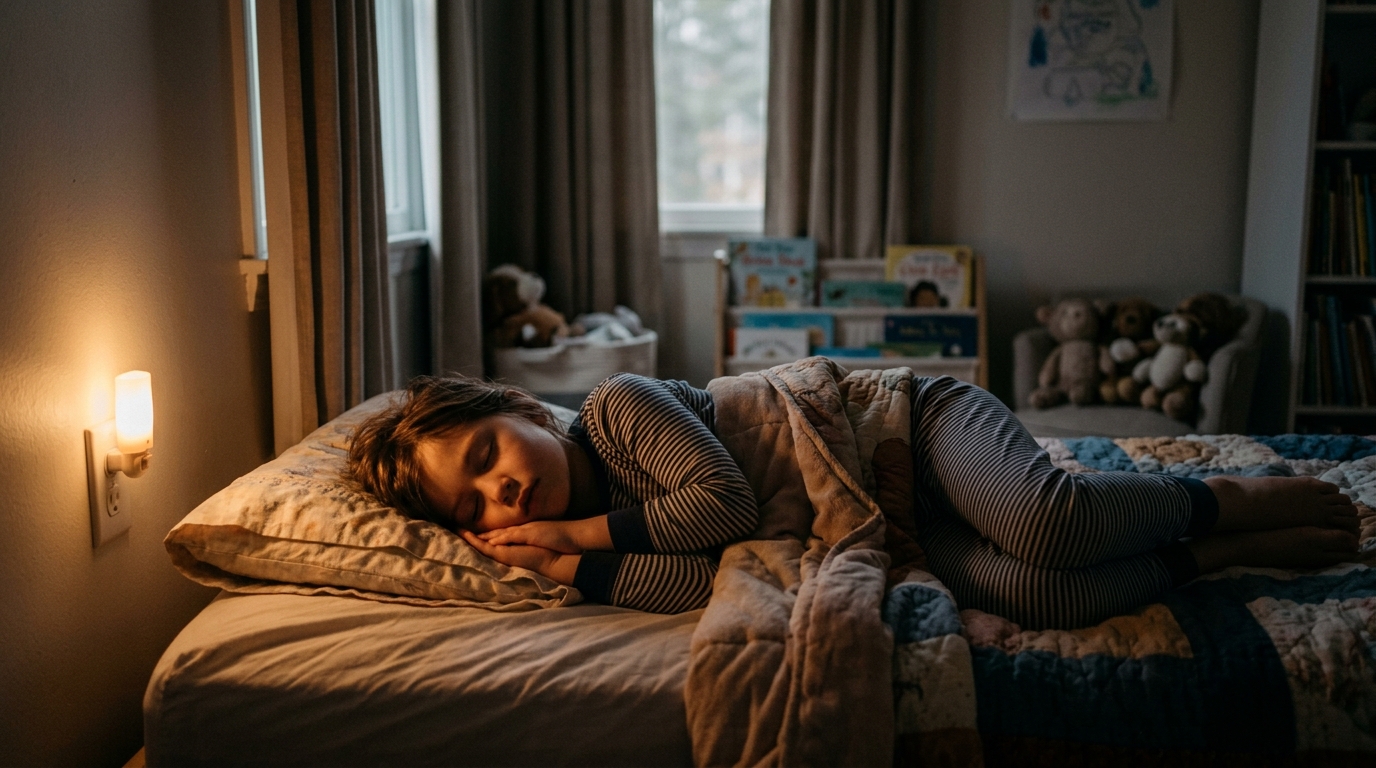
The Tuesday it all clicked for me, my six-year-old melted down over the wrong colour cup at 7:15 in the morning. Not a whine. A full, red-faced, sliding-down-the-cabinet sob about a cup. I stood there in my dressing gown with the school bags half packed and thought, who is this child and what did they do with mine.
It took me an embarrassingly long time to connect the morning battles, the after-school crankiness, and the teacher's note that he was struggling to focus. He was not being difficult. He was wrecked. If your mornings feel like you are negotiating with a tiny hungover stranger, this is for you. I want to walk you through how much sleep a 6 year old actually needs, the signs your child is running short, a bedtime routine that works for older kids, what screens are doing to all of it, and when a stubborn sleep problem is worth raising with your GP.
How much sleep does a 6 year old need, really
So let's answer the question straight. How much sleep does a 6 year old need? Somewhere between 9 and 12 hours in a 24-hour period. That is the range the American Academy of Sleep Medicine and the NHS both land on for kids aged 6 to 12, and most children this age sit comfortably in the 10 to 11 hour zone.
I know that range feels wide. Here is how I think about it. Your child has their own number inside that window, and your job is to find it. A well-rested kid wakes up on their own most mornings, close to the same time, without you peeling them off the mattress. If you are dragging them out of bed every single day, they are almost certainly at the low end and need more.
Here is the rough map by age, because the number shifts as they grow:
- Ages 3 to 5: 10 to 13 hours, often still with a rest or quiet time
- Ages 6 to 8: 10 to 11 hours is the sweet spot inside the 9 to 12 range
- Ages 9 to 12: 9 to 11 hours, and yes they still need this much even when they insist they do not
- Early teens: 8 to 10 hours, though that is a different battle for another post
Do the maths backwards from wake-up. If school means a 7am start and your six-year-old needs 11 hours, lights genuinely out by 8pm. Not starting the bedtime routine at 8. Asleep by 8. That gap is where a lot of us, me included, quietly lose an hour without noticing.
A well-rested kid wakes up close to the same time on their own. If you are dragging them out every day, they need more.
The signs your child is not getting enough
This is the part I wish someone had spelled out for me, because overtired kids almost never look sleepy. They look like a behaviour problem.
An adult who is short on sleep gets slow and yawny. A child does the opposite. They get wired, wound up, and emotional. Their body pumps out more cortisol to keep going, and that shows up as a kid who cannot settle, cannot cope with small frustrations, and falls apart over a cup.
Watch for these:
- Morning battles that feel out of proportion, real struggle to wake and get moving
- Meltdowns over tiny things, especially the late-afternoon 4 to 6pm crash
- Trouble focusing at school, or a teacher mentioning they seem distracted or fidgety
- Hyperactivity that ramps up in the evening instead of winding down
- Falling asleep the second they hit the car seat or the sofa after school
- Needing to be woken every morning without fail
That focus one matters more than people realise. Sleep-deprived kids can look a lot like they have attention issues, when really they just need another hour in bed. Before anyone reaches for a bigger label, sleep is the first thing worth ruling out.
A realistic bedtime routine for older kids
Toddlers get bath, book, bed. Nobody hands you the older-kid version, so we all just wing it until bedtime becomes a two-hour saga. A school-age routine can be shorter than the toddler one, but it has to be consistent, because their bodies still run on rhythm.
Mine runs about 30 minutes and looks like this:
- A set start time, same every school night, so their body starts winding down before you even say a word
- Pyjamas, teeth, wee, all the boring admin done in one go
- Fifteen minutes of something calm together, reading, a quiet chat about the day, a bit of back-scratching
- Lights out and a short predictable goodnight, the same few words every night
The two things that make or break it are the fixed time and the wind-down before it. A child cannot slam from a wrestling match on the landing straight into sleep. They need a runway. That means the loud, active, exciting stuff wraps up a good half hour before lights out.
Keep weekends within about an hour of the school schedule. A massive Saturday lie-in followed by a midnight bedtime gives them a mini jet-lag that hits like a train on Monday. I learned that the hard way after one glorious lazy weekend and one truly grim Monday morning.
If your child fights sleep because their room feels scary or they wake in the night frightened, that is a slightly different problem worth sorting first, and my posts on night terrors in toddlers and nightmares in children go deeper on those. A frightened brain will not settle no matter how tidy your routine is.
Screens, and why they wreck all of it
I hate being the screen-police mum, so let me keep this honest rather than preachy. Screens hurt sleep in two separate ways, and both are real.
First, the light. The blue-ish light from tablets, phones, and TVs tells the brain it is still daytime and slows down melatonin, the hormone that makes us sleepy. A child watching YouTube at 7:45 has a brain that thinks it is mid-afternoon.
Second, and honestly the bigger one in my house, is the content. Games and videos are built to be exciting. They wind a child up right when you are trying to wind them down. Even a "calm" show ends on a cliffhanger that has them buzzing.
What actually worked for us was a hard screen curfew about an hour before bed. Screens off, then the calm routine begins. No devices in the bedroom overnight, because the temptation to sneak one is real and so is the ping of a notification at 6am. If your child uses a tablet to fall asleep, swap it slowly for an audiobook or a story podcast. Same comfort, none of the light, none of the wired-up buzz.
When a sleep problem is worth seeing the GP
Most sleep struggles at this age are habit and routine, and they sort out at home with a few weeks of consistency. But some things are worth a conversation with your GP, because they point to something a bedtime routine cannot fix.
Book an appointment if you notice:
- Loud snoring most nights, gasping, long pauses in breathing, or a lot of restless thrashing. This can point to sleep apnoea and is very treatable, but it needs a doctor to spot
- Your child sleeps a full 10 or 11 hours and is still exhausted and struggling to function in the day
- Sleep problems that have lasted more than a few weeks despite a steady, consistent routine at home
- Regular bedwetting past the age you would expect, or waking in pain
- Big daytime symptoms, like real trouble concentrating, low mood, or falling asleep in class, that do not shift once sleep improves
- Your gut telling you something is off, even if you cannot put it into words
Ongoing snoring is the one I would flag hardest. A lot of parents assume snoring is cute or harmless in kids, but persistent snoring with pauses is worth getting checked, because broken breathing means broken sleep no matter how early you do lights out.
Going to the GP is not you failing at bedtime. It is you gathering information. Most of the time you will get reassurance and a couple of tweaks. Occasionally you will catch something worth catching, and your child gets the rest they have been missing.
The bottom line
How much sleep does a 6 year old need? Nine to 12 hours, usually landing around 10 or 11, and the surest sign they are getting it is a kid who wakes up on their own in a decent mood. The morning battles and the meltdowns are so often just tiredness wearing a disguise.
My son is calmer now, and the wrong-cup meltdowns are mostly behind us. Nothing clever fixed it. Just an earlier, steadier bedtime, screens off before bed, and a boring little routine repeated every night. Give your child that runway to sleep, and watch how much of the hard stuff quietly melts away.