
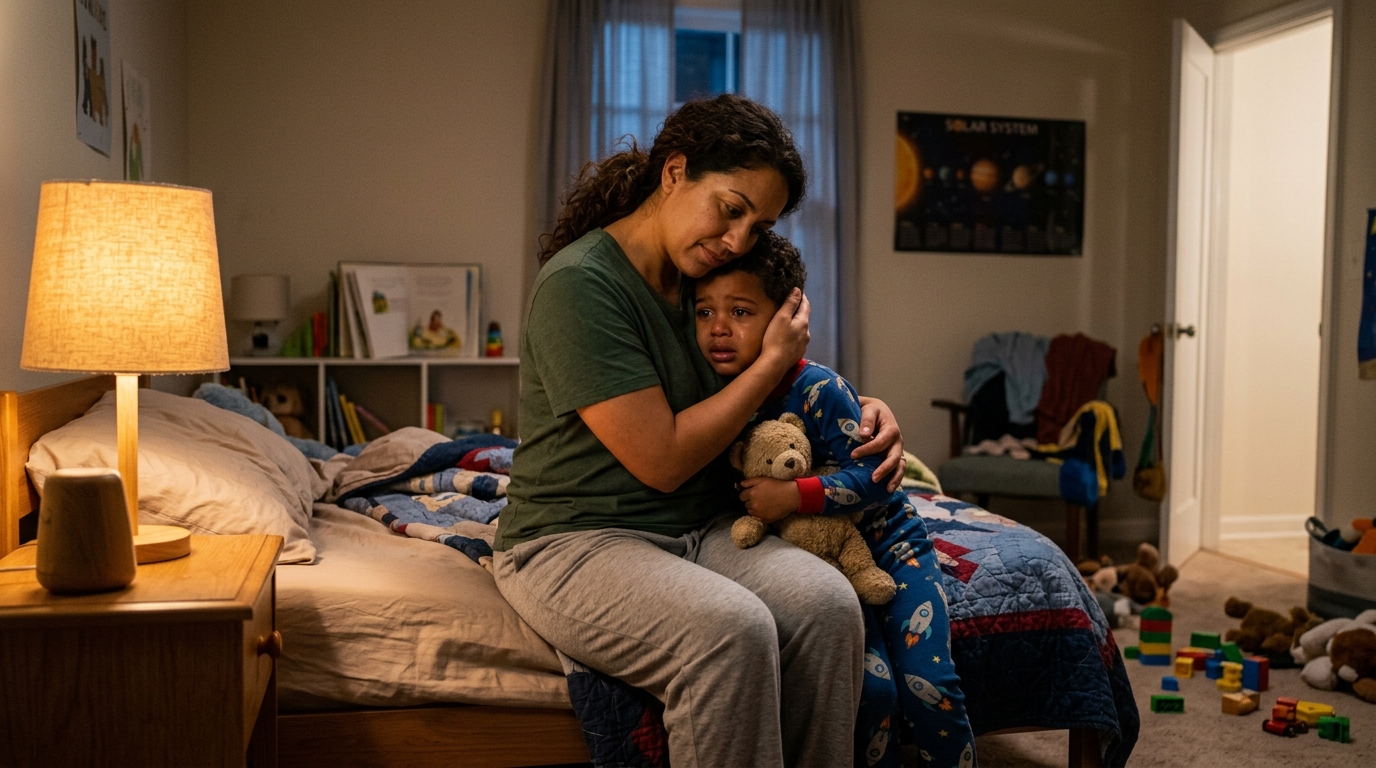
It was around 2:40am when my daughter, who was four at the time, started calling for me down the hallway. Not the sleepy half-cry she does when her blanket slips off. This was her fully awake, sitting up against the headboard with her knees pulled to her chest, telling me there was a dog under the bed that wanted to bite her feet. There was no dog. There has never been a dog in our house. But she was pointing at the floor with her whole hand shaking, and she would not put her feet down.
I sat on the edge of her bed and she grabbed my sleeve like she was drowning. It took me a good twenty minutes to talk her down, and even then she wanted the hall light on and my hand on her back until she drifted off. In the morning she remembered all of it and described the dog again over her cereal. If your kid has done some version of this, you already know the specific tired that comes after. This post is about the difference between child nightmares vs night terrors, why bad dreams get more intense around ages 3 to 6, what to actually do standing in that dark room, and how to make them happen less often.
Child nightmares vs night terrors: they are not the same thing
Here is the part most parents get wrong, and I got wrong too. A nightmare and a night terror look similar from the doorway, but they are two completely separate events, and they need opposite responses.
A nightmare is a scary dream. Your child wakes up from it, fully, and they are frightened but present. They know who you are. They want you close. They can often tell you what happened, and they remember it the next day.
A night terror is not a dream at all. It happens during deep sleep, usually in the first couple of hours after your child goes down. Their eyes may be open, they may be screaming or thrashing, but they are not actually awake and they are not seeing you. You cannot comfort them because there is no one home to comfort yet. It ends on its own, they lie back down, and in the morning they have zero memory of it.
The quickest way to tell which one you are dealing with is the clock and the recognition. A nightmare tends to come in the back half of the night and your child knows you. A night terror comes early and your child looks right through you. We went deep on the second one in the night terrors post, so if the early-evening screaming is your situation, start there instead.
If your child is looking at you and reaching for you, it is a nightmare. If they are looking through you, it is something else.
Why nightmares spike between ages 3 and 6
Nightmares can start as early as age 2, but they get louder and more frequent between 3 and 6. This caught me off guard because I assumed a bigger kid would have fewer fears, not more.
The reason is imagination. Somewhere around age 3, your child's brain gets powerful enough to invent things that are not in the room. That is wonderful in the daytime when they are running a pretend bakery out of the couch cushions. At night it means their mind can build a dog under the bed out of nothing. They are also old enough now to hold onto a fear, so a scary bit from a show or a story sticks around and shows up again at 2am.
A few real-life things push the numbers up:
- Being overtired. A child who skipped a nap or went to bed late has more bad dreams, not fewer.
- Big changes. A new sibling, a house move, starting school, a grandparent in the hospital.
- Scary or fast content before bed, even the cartoon stuff that looks harmless.
- Being sick or running a fever.
- Daytime worries they have not had a chance to say out loud.
None of this means you did something wrong. This is a normal stage of a developing mind, and for most kids it settles down as they get older and learn that a dream is just a dream.
What to do at 2am during a nightmare
When your child wakes up scared, your job is to be the calm in the room. You do not need a script, but having a rough order helps when you are the one running on four hours of sleep.
- Go in quickly and keep your voice low and slow.
- Sit close. Let them hold onto you if they want to.
- Name the safe truth simply. "You are safe. I am right here. It was a dream."
- Acknowledge the scary thing without feeding it. "That dog in the dream was scary. There is no dog. Your feet are safe under this blanket."
- Do a quick reset of their comfort cues. Blanket back on, soft toy in place, night light on if that helps.
- Stay until they are calm, then tuck them in and step out while they are still drowsy but settled.
I try hard not to climb into the bed and stay all night, because once I do that a few times my daughter starts needing it every night. Comfort, yes. New permanent roommate, no.
How to reduce nightmares in the first place
You will not stop every bad dream, and you do not need to. But you can move the odds. Most of what works happens during the day and the hour before bed, not at 2am.
Guard the wind-down
The 60 to 90 minutes before sleep set the tone. Turn off fast, loud, or even mildly spooky shows. What looks tame to you can read as intense to a 4-year-old with a fresh imagination. Swap in something slow. Books, a bath, quiet play on the floor.
Protect sleep itself
An overtired child dreams worse. Most kids between 3 and 6 need an earlier bedtime than parents expect, often asleep by 7:30 or 8pm. A steady routine in the same order every night tells the brain it is safe to let go.
Deal with the daytime stuff
If the nightmares clustered around a specific change, name it in the daylight. A new baby, a move, a hard week at preschool. Sometimes a bit of separation worry is driving the night wakings, and we talked through what is normal there in this post on separation anxiety. Giving the fear airtime while the sun is up often quiets it at night.
Give them a little control
Kids feel powerless in a nightmare. Handing back some control helps. A "monster spray" bottle of water they mist around the room, a special guard toy that keeps watch, a flashlight they are allowed to click on themselves. Silly? A bit. But it works because it puts them in charge of the dark instead of at its mercy.
When to talk to your doctor
For the vast majority of kids, nightmares are a normal part of growing up and they fade with age. You are not looking at a problem, just a phase that is loud for a while. Still, a handful of things are worth a conversation with your pediatrician.
- Nightmares happening most nights of the week for more than a few weeks and wearing your child down.
- Bad dreams that keep circling the same event, especially after something frightening or traumatic happened.
- Your child becoming genuinely afraid to go to sleep or fighting bedtime hard because of the fear.
- Daytime signs alongside the night stuff: real anxiety, mood changes, or new trouble at school.
- Snoring, gasping, or pauses in breathing during sleep, which can disturb sleep and stir up bad dreams.
- Any nightmare that comes with the early-evening, unreachable, no-memory pattern of a night terror often enough to worry you.
A doctor can help you sort out whether something like anxiety, poor-quality sleep, or a breathing issue is underneath the dreams, and none of those are things you are expected to figure out alone.
The short version to tell yourself in the dark
When you are standing in your kid's room at 2am with a shaking little hand gripping your shirt, you do not need to be perfect. You need to be there and steady. Go in, get low, say the safe words, hold on until the fear lets go, then tuck them back in.
Nightmares peak for a reason, and that reason is a brain that is growing exactly the way it should. My daughter is older now and the dog under the bed hasn't visited in a long time. Yours will move through it too. Until then, you are the proof in the room that the dream was not real, and that is enough.