
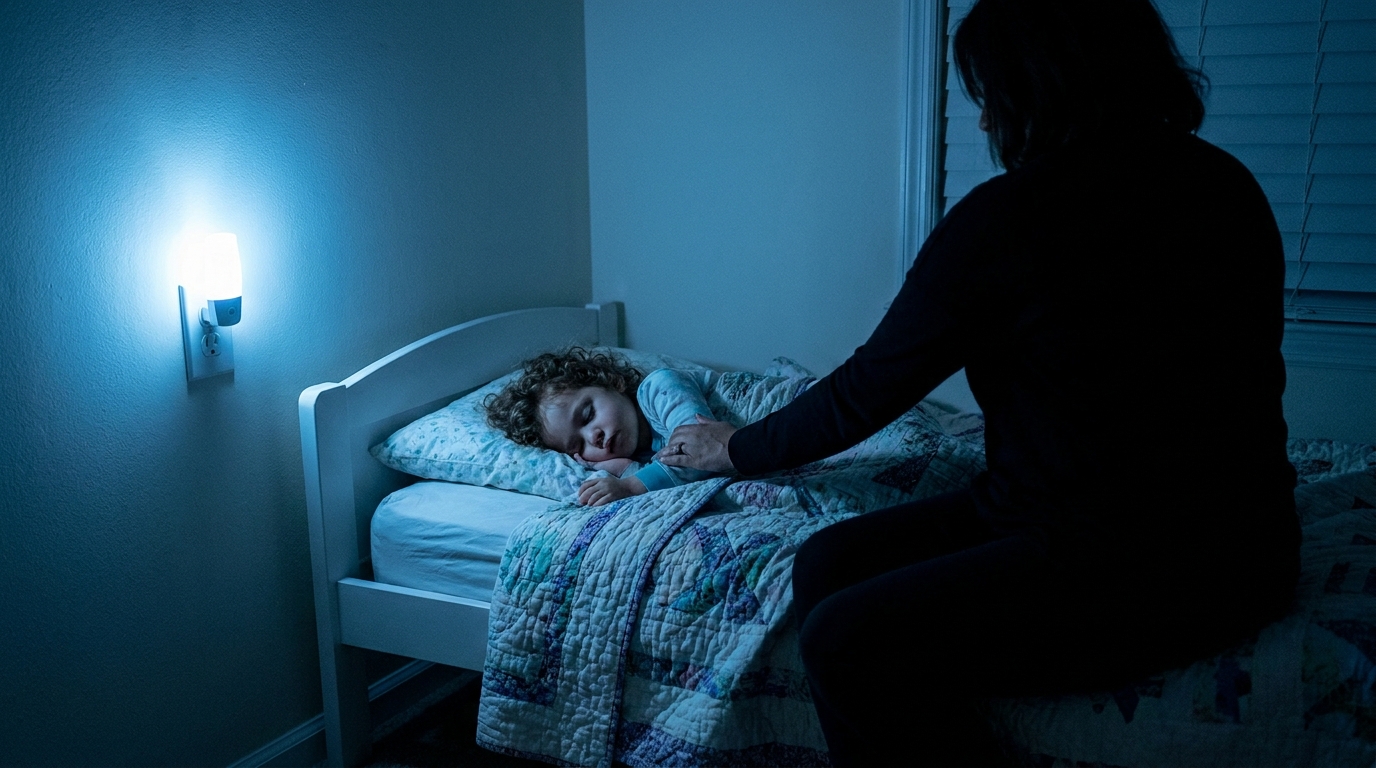
The first time my son had a night terror I genuinely thought something was wrong with him. It was 10:30pm. He had been asleep since 7pm. Suddenly the most awful scream I had ever heard came through the monitor. I ran in. He was sitting up in bed, eyes open, sweating, looking right past me, screaming a word that was not quite a word.
I tried to pick him up. He pushed me away. I said his name. He did not hear me. I switched the light on. He screamed harder. Three minutes later he just lay back down, closed his eyes, and went back to sleep. In the morning he had no memory of any of it.
That was my introduction to night terrors. They are completely different from nightmares, and the worst thing you can do for one is to do what works for the other. Here is how to tell which one is happening in your toddler's room.
Why this matters: they need opposite responses
Most toddler night-waking is a nightmare, which is essentially a bad dream the child wakes from upset. The right response is comfort, presence, reassurance.
A small percentage is a night terror, a different sleep phenomenon entirely where the child is not actually awake even though their eyes are open and they are screaming. The right response is to do almost nothing. Sit nearby, keep them safe, do not try to wake them, wait it out.
Get those two responses mixed up and you make things worse. A child being woken from a night terror is more confused and distressed than one left alone. A child having a nightmare without a parent feels abandoned.
So the diagnosis matters before the response.
The 7 ways to tell them apart
You usually do not need formal medical input to figure out which one is happening. The signs are clear once you know what to look for.
Signs it is a nightmare
1. It happens in the second half of the night, usually between 2am and 5am 2. The child fully wakes up and is upset 3. The child recognises you when you come in 4. The child wants you to stay, calms down with comfort, often wants to talk about what happened 5. The child often remembers it in the morning and can describe the scary dream 6. The child can fall back to sleep within 10 to 30 minutes once calm 7. Nightmares are most common from age 2 to 4 when imagination is developing fast
Signs it is a night terror
1. It happens in the first 1 to 3 hours after falling asleep, usually between 10pm and midnight 2. The child appears awake (eyes open, sitting up, talking, screaming) but is actually still asleep 3. The child does not recognise you, looks through you, may push you away 4. The child cannot be comforted, calmed, or reasoned with 5. The child often shows physical signs of distress: sweating, racing heart, dilated pupils, flushed face 6. The episode lasts 5 to 20 minutes then ends suddenly 7. The child falls straight back to sleep with no awareness of what happened 8. In the morning, no memory of the event at all 9. Night terrors are most common from age 3 to 7
The single most useful diagnostic is the timing. Nightmares in the early hours of the morning. Night terrors in the first hours after bedtime. If you are not sure, look at the clock.
What to do during a nightmare
Your role is presence and reassurance. The standard sequence:
- Go in quickly and calmly
- Sit on the edge of the bed or kneel at the cot
- Use a low calm voice: "You are safe. I am here. It was a dream. Mummy is here."
- Cuddle if they want it
- Briefly acknowledge the scary thing without dwelling: "That was a scary dream about the monster. It is not real. You are safe in your bed."
- Stay until they are calm but try not to get into bed with them or stay all night (it sets a precedent)
- Tuck them back in, do the usual goodnight cue (lamp off, soft toy in place, song or kiss)
- Leave the room while they are still awake but calm
If nightmares are frequent and the child is anxious, check three things during the day:
- Are they exposed to anything frightening on screens (TV, YouTube, even apparently child-friendly content can be intense)?
- Has anything stressful happened recently (new sibling, house move, starting nursery, illness)?
- Are they overtired? Overtired children have more nightmares.
What to do during a night terror
Your role is almost the opposite. Less is more.
- Go in and check the child is physically safe (not about to fall off the bed, not tangled in bedding)
- Stay nearby but do not try to wake them, do not try to comfort, do not pick them up
- Speak quietly only if needed for safety
- Do not shake them, splash water, shout their name, or do anything dramatic to bring them out of it (this prolongs and intensifies the terror)
- Wait. Most night terrors end on their own within 5 to 15 minutes
- When the episode ends, gently lay them back down. They will sleep through to morning
- Do not mention it the next day. They have no memory of it and discussing it can cause unnecessary worry
The most useful thing to do during a night terror is to sit on the floor of their room reading something on your phone, ready to redirect them if they try to get out of bed, otherwise hands off.
What causes night terrors
Night terrors are not psychological. They are a quirk of deep sleep. During the deepest stage of sleep (slow-wave sleep), the brain can have a partial arousal where the body becomes active but the conscious mind does not wake. The child looks awake but the part of the brain that processes input, recognises faces, and forms memory is offline.
The common triggers:
- Genetics. Night terrors run in families. If a parent had them, the child often does too.
- Sleep deprivation. Children who are over-tired have more night terrors than well-rested ones.
- Disrupted sleep schedule. Holidays, travel, time changes, illness.
- Fever or illness.
- A very full bladder during the deep sleep period.
- Major life changes or stress (occasionally).
What does not cause night terrors: anything you did wrong as a parent. They are a developmental glitch and the child grows out of them, almost always by age 12.
What helps prevent both
A few things help reduce both nightmares and night terrors:
- Earlier bedtime. Overtired children have more of both. Most 2 to 4 year olds need to be asleep by 7:30 to 8pm.
- Consistent routine. Bath, books, song, bed, same order every night. (We covered this in detail in Toddler Bedtime Battles.)
- Limit stimulating content in the 90 minutes before bed (no fast-paced shows, no screens within the hour before sleep)
- Empty the bladder right before sleep
- Cooler bedroom (around 18 degrees C / 65 F): children sleep more deeply at slightly cooler temperatures
- Address daytime worries. A 5-minute "any worries today?" chat at bedtime sometimes clears anxious dreams.
If night terrors are consistent enough that you can predict the time they happen (and many follow a clockwork pattern), there is one intervention that often works: scheduled awakening. Wake the child very gently about 15 to 30 minutes before the usual night terror time. Just enough to disrupt the deep sleep stage. Do this for a week. It often breaks the pattern.
When to talk to your GP
For most children, both nightmares and night terrors resolve on their own. The pattern is harmless even when it is frightening to witness.
A few situations are worth a GP appointment:
- Night terrors happening more than twice a week for more than a month
- Episodes lasting more than 30 minutes
- The child injuring themselves during episodes (sleepwalking off beds, hitting walls)
- Episodes happening with extreme physical signs (very heavy sweating, vomiting, breathing problems)
- Daytime sleepiness, behaviour changes, or learning concerns alongside the night episodes
- Snoring, gasping, or pauses in breathing during sleep (could indicate sleep apnoea, which can trigger night terrors)
- Persistent nightmares after a traumatic event (worth talking through with a paediatric professional)
These are not common but worth knowing.
Related reading
- Toddler Bedtime Battles: The 3-Step Routine That Ends Them in a Week
- The 24 Month Sleep Regression: Why Your Good Sleeper Just Quit
- Toddler Refusing Nap: The Real Reason and What to Do
What to tell yourself at 11pm with a screaming child
If the child is sitting up screaming and not seeing you, this is a night terror. Sit on the floor. Stay quiet. Wait. It will pass in 10 to 15 minutes. Tomorrow they will not remember.
If the child is calling for you, crying because something scared them, holding their arms out, that is a nightmare. Go in, hold them, reassure, settle, leave.
Both are normal. Both pass. Your child is not damaged, not haunted, not unwell. Their brain is doing the same complicated work it does in the daytime, just in the dark, while you stand in the doorway waiting to know which response to use.
You will get good at telling them apart. Most parents can spot the difference within the first 30 seconds of being in the room. Until then, the clock is the easiest tell.