
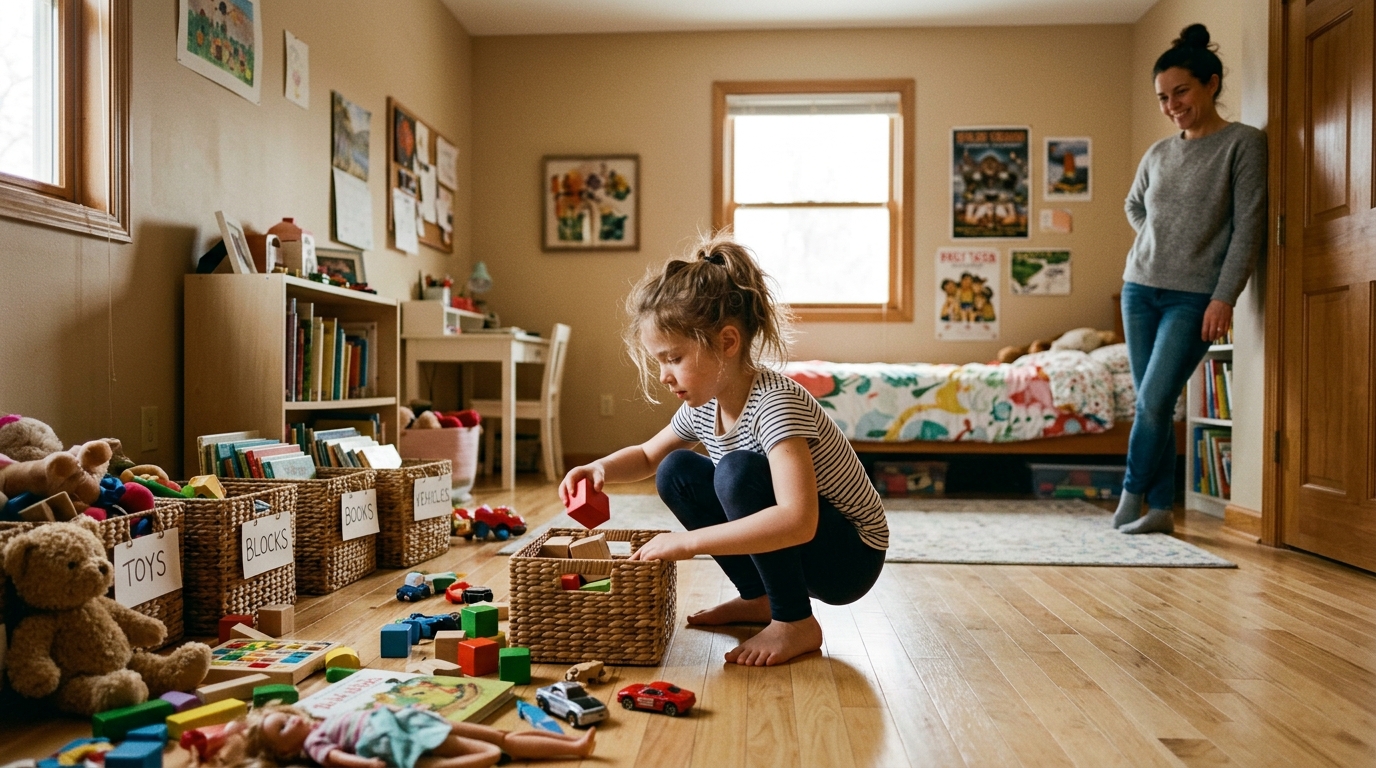
At 6:12 this morning I stepped on a Lego brick in my daughter's room. Barefoot, in the dark, with a laundry basket on my hip. This was the same room I personally cleaned at nine o'clock last night. Every bin I filled had been dumped back onto the rug, a doll shoe was wedged in the heating vent, and my three-year-old slept peacefully in the middle of the wreckage like a dragon on a pile of gold.
For about two years, that was our whole system. I'd tell the kids to clean up, they wouldn't, I'd get frustrated, and then after bedtime I'd quietly do it myself because it was faster and nobody cried. It felt like a favor to everyone. It wasn't. I had three kids who believed a magic fairy reset their rooms every night, and one exhausted fairy who resented it. So I stopped, and I went looking for how to get kids to clean their room in a way that actually sticks. Here's what I found, and what has honestly worked in my house.
Why "clean your room" fails as an instruction
Here's the thing nobody told me: when I said "clean your room," my four-year-old heard roughly nothing. Not because he was ignoring me (well, sometimes he was ignoring me), but because "clean your room" is not one task. It's forty tasks wearing a trench coat.
Kids' executive function, the mental machinery that breaks a big job into steps and keeps you on track through them, is still under construction well into the elementary years. The Child Mind Institute points out that a messy room usually isn't defiance or laziness. The child looks at the chaos, has no idea where to start, feels a wave of overwhelm, and does the most sensible thing available: starts playing with the first toy they pick up.
I watched this happen in real time once I knew to look for it. I'd send my son in to clean. Ten minutes later he'd be on the floor running a train around a track he'd built out of the mess. He wasn't being defiant. He'd picked up the train to put it away, and the train won.
A kid staring at a messy floor isn't refusing to start. Most of the time, they genuinely can't find the start.
If your child also seems to tune out your voice entirely, that's a related but separate battle, and I wrote about it in why your 4-year-old won't listen.
What each age can actually do
Half my frustration disappeared when I matched my expectations to my kids' ages instead of my Pinterest board. Rough guide, based on what pediatric occupational therapists and the child psychiatry folks recommend, cross-checked against my own three test subjects:
Ages 2 to 3: they tidy with you, not for you. A toddler can put blocks in a bin and books on a shelf, but only side by side with an adult, one item type at a time, for about five minutes before the wheels come off. You're not outsourcing labor here. You're teaching a skill, the same way you'd teach tooth brushing.
Ages 4 to 5: they can do short, specific tasks alone. "Put all the stuffed animals in the green basket" is doable. "Clean up" is not. Expect to stay nearby and hand out the next task when the first one's done. My middle kid could handle exactly one instruction at this age. Two instructions and the second one evaporated on the walk across the room.
Ages 6 to 8: they can chain a few steps and start owning the routine. Around six, kids can hold a short sequence, something like "blocks, then books, then dirty clothes in the hamper." They still need the job broken down. They still need you to check in. But this is the age where the room genuinely starts becoming theirs to manage, which is the whole point.
Ages 9 and up: they can own the room, on their standard. Which will not be your standard. I'm told by moms further down this road that you close the door a lot.
If you want the fuller picture beyond bedrooms, I keep a running list in age-appropriate chores by age.
Set up the room so small hands can win
Most advice on how to get kids to clean their room skips this part, and it's the foundation. Before I changed anything about how I asked, I had to admit something uncomfortable: my kids' rooms were set up for an adult to clean. Deep toy boxes where everything sank to the bottom. Shelves they couldn't reach. Bins with no logic to them. Then I'd get annoyed that a five-year-old couldn't maintain a system I hadn't actually built for a five-year-old.
Three changes made tidying physically possible for them:
Everything gets one home. If a toy has no designated spot, a child cannot put it away, full stop. They'll stand there holding it, then set it down somewhere random, and honestly, fair. We went through each room together and decided where things live. The kids helped choose, which mattered more than I expected, because now they defend the system instead of fighting it.
Labels they can read, or pictures if they can't. Every bin in my four-year-old's room has a photo taped to the front: cars, animals, dress-up. He can't read "miscellaneous," but he can match a toy dinosaur to a picture of a toy dinosaur. My seven-year-old niece has word labels on hers because she's proud she can read them. Professional organizers push labeled bins for kids constantly, and having watched it work, I get it. It turns "cleaning" into sorting, and little kids are shockingly good at sorting.
Fewer toys out at once. This was the big one. We rotate. Roughly two-thirds of the toys live in a closet in labeled boxes, and every few weeks we swap some out. Less stuff on the floor means a mess that takes eight minutes to fix instead of forty, and a kid can see the finish line from the start. Bonus I didn't predict: the returning toys feel new, so they actually get played with.
How to get kids to clean their room, one instruction at a time
Here's the method itself, and it's almost embarrassingly simple. You give one instruction. They complete it. You give the next one.
Not "clean your room." Instead: "Put every book on the bookshelf. Come tell me when the books are done." Then, when they report back: "Now all the stuffed animals in the basket." One category, one home, one instruction.
The first week, this felt slower than doing it myself, because it was. I was standing in the hallway folding towels between instructions like some kind of tidiness dispatcher. But by week three, my four-year-old was giving himself the instructions. I'd hear him in there muttering "okay, books first" and I'd have to walk away so he didn't see my face.
A few things that make it work better:
Use a timer, but as a game, not a threat. "Can you beat the song?" turns three minutes of tidying into a race. We put on one loud song and everyone attacks their own floor. When the music stops, we stop. Some nights the room is done. Some nights it's half done, and half done is still better than the fight.
Say what you see, not what they are. "I see a lot of cars still on the rug" lands better than "you never finish anything." The first one is a task. The second one is a verdict, and kids down tools when they hear a verdict.
Let the standard be theirs, at their level. A six-year-old's made bed looks like a topographical map. Leave it. If you remake it in front of them, the lesson they learn is that their effort wasn't good enough, so why bother next time.
What to do when they refuse
Some days everything above works and some days my son lies face-down on the carpet and declares his legs are broken. Refusal is part of the deal, so here's my actual escalation path.
First, shrink the ask. Full-body carpet protest usually means the job still looks too big. "Just the five cars by the door" is an ask so small it's hard to argue with, and starting is most of the battle.
Second, offer a real choice inside a firm boundary. "The blocks get picked up before dinner. Do you want to do blocks or books first?" The tidying isn't negotiable. The order is. Kids who feel like they have some control fight the rest a lot less.
Third, let the natural consequence do the talking. In our house, toys left on the floor after cleanup time go into a box on top of the wardrobe until the weekend. No lecture, no anger. The floor toys took a little vacation. My kids find this fair in a way they never found my yelling fair.
And if refusal tips into a full meltdown, I stop treating it as a chore problem at all, because at that point it's a big-feelings problem. Cleaning resumes after the feelings pass, not during.
My daughter's room this evening is not going to make it into a catalog. There's a sock on the lampshade and I have decided not to ask why. But she picked up her own floor tonight, with two instructions and one loud song, while I leaned on the doorframe and did absolutely nothing. Two years ago I was the bedtime cleaning fairy. Now I'm mostly a spectator, and the room is slowly, genuinely becoming hers. That handover, messy as it looks, is the real job, and it's the same reason why chores build confident kids in the first place.