
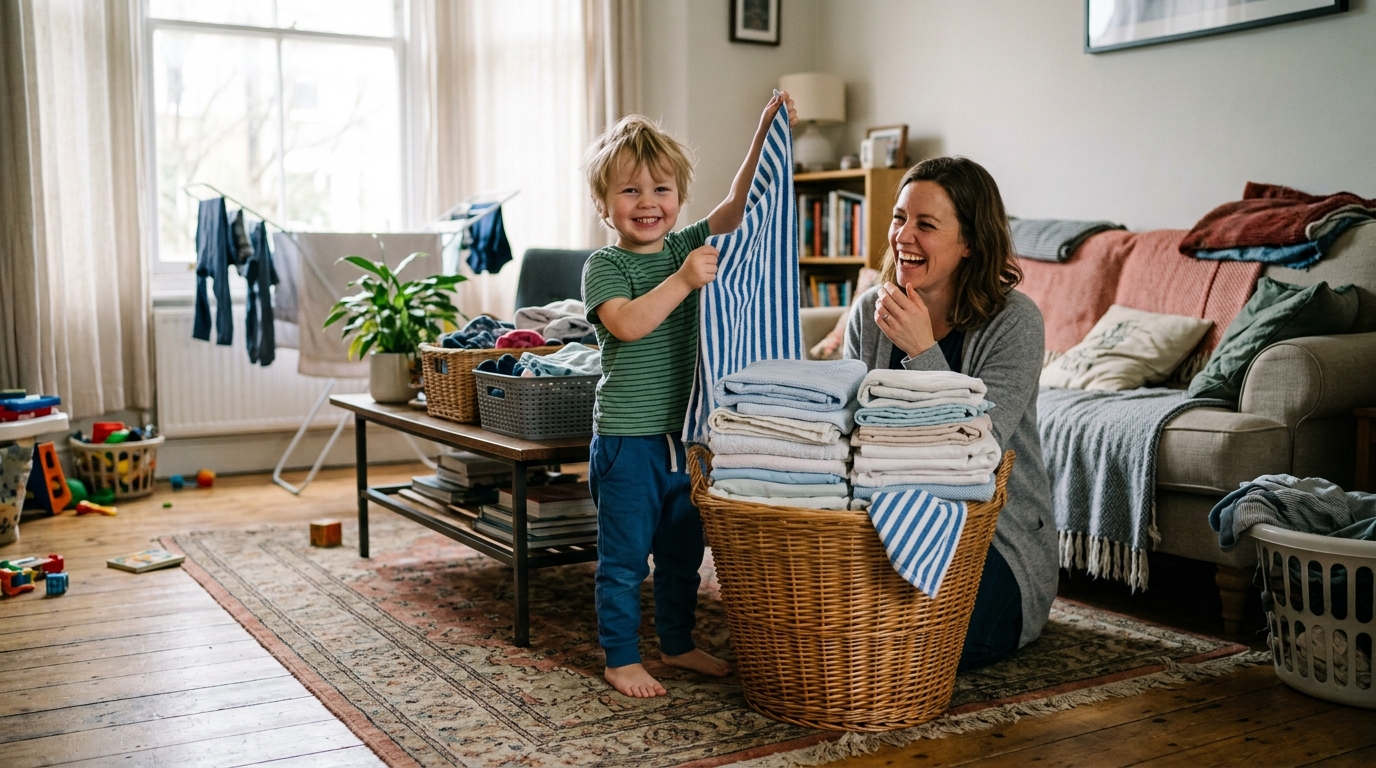
Last Tuesday my three-year-old carried one plate from the table to the sink. It had a smear of ketchup on it, and she held it in front of her like the crown jewels. She set it down, turned around, and strutted back across the kitchen with her chest puffed out so far I thought she might tip over backwards. Her big brother barely looked up. To him, clearing plates is just what happens after dinner in our house.
But I looked up. That strut is the reason I went digging into the benefits of chores for kids in the first place. Somewhere along the way I stopped seeing chores as a way to get help around the house and started seeing them as one of the cheapest confidence-building tools I have. The research backs that up in a way that genuinely surprised me.
I want to walk you through what the studies actually say, why I think chores work the way they do, why so many of us skip them anyway, and how to start this week without turning your kitchen into a battleground.
What the research says about the benefits of chores for kids
Let me tell you about the study that changed my mind, because I was a skeptic. I assumed the "chores make successful adults" thing was one of those internet claims that falls apart when you look for the source.
It doesn't. The source is Marty Rossmann, a professor emeritus at the University of Minnesota. In 2002 she analyzed data from a longitudinal study that followed 84 children at four points in their lives: preschool, around age 10, around age 15, and again in their mid-twenties. The finding that gets quoted everywhere is real. The young adults who started doing chores at ages 3 and 4 were more likely to have good relationships with family and friends and to be self-sufficient than the ones who started chores as teenagers or never did them at all. They did better in school and early careers too.
Read that again. Ages 3 and 4. Not the age when a child is actually useful. The age when "helping" means a plate carried at a worrying angle and a towel folded into a crumpled ball.
Rossmann's data had another detail I found fascinating. When parents introduced chores at 15 or 16, it often backfired. The teenagers experienced it as an unwanted demand out of nowhere. They had never absorbed the idea that everyone in a family pitches in, so the request felt like punishment instead of belonging.
Then there is the Harvard angle, and I want to be honest with you about it because most articles are not. The Harvard Grant Study, formally the Harvard Study of Adult Development, has been following men since 1938. It is the longest study of adult life ever run. Julie Lythcott-Haims, the former Stanford dean who wrote How to Raise an Adult, drew on that study when she argued that professional success in life comes from having done chores as a kid, and the earlier you started, the better. Her phrase for it is a "roll up your sleeves and pitch in" mindset. The caveat: there is no standalone Harvard paper titled anything like "chores predict success." The Grant Study found that a childhood work ethic, including part-time jobs and household work, predicted adult wellbeing, and Lythcott-Haims is the one who connected those dots for parents. I still find it persuasive. I just refuse to pretend it is something it isn't.
The newest piece of the puzzle is my favorite, though. A 2022 study out of La Trobe University in Australia, published in the Australian Occupational Therapy Journal, looked at 207 kids aged 5 to 13. Kids who regularly did chores, both self-care chores like making their own snack and family-care chores like making a snack for someone else, scored better on working memory and inhibition. Those are executive function skills, the same mental muscles kids use to follow instructions at school and to stop themselves from shoving a sibling. The researchers were careful to say the link is correlational. Chores might build those skills, or kids with those skills might do more chores. Either way, a chore is basically a tiny project. You have to remember the steps and do them in order without wandering off halfway through. That is executive function practice hiding in plain sight.
So when someone asks me about the benefits of chores for kids, I no longer answer with "responsibility" in a vague hand-wavy voice. I say: better adult relationships and real self-sufficiency in Rossmann's data, plus measurable executive function practice in the La Trobe study.
Why chores build confidence when praise doesn't
Here is my theory on why this works, after watching it play out three times in my own house.
Kids can smell the difference between being praised and being needed. Praise is nice. Being needed is oxygen. When I tell my daughter she is smart, she shrugs. When I hand her the basket and say the towels have to be folded before Grandma arrives and she is the towel person in this family, she stands up straighter. The job is real. The deadline is real. Her contribution is real, and she knows it because the towels do not fold themselves.
Psychologists call this "mattering," the sense that you are significant to the people around you. Chores are the most concrete proof of mattering a small child can get. Confidence built on compliments collapses the first time the compliments stop. Confidence built on competence does not, because the child has evidence. I did this. It worked. The family used the thing I made.
A child who is needed at home grows up believing they will be needed in the world.
This is why I keep saying that chores are not really about housework. Nobody's four-year-old is meaningfully reducing the family workload. Mine slows it down, honestly. The point is that a child who contributes learns to see herself as a contributor, and she carries that identity into classrooms and, eventually, jobs.
If you want the flip side of this argument, I wrote about why doing everything for your child backfires, and it is basically this post in a mirror. Every job I do for my kids that they could do themselves quietly tells them I do not believe they can.
Why we skip chores anyway (I did too)
I want to be fair to past me, because past me had reasons.
Reason one: it is faster to do it yourself. This is not a myth. It is completely true. I can unload the dishwasher in four minutes. My four-year-old needs eleven, and one glass will be put away wet. If I judge chores by tonight's efficiency, I lose every time. I only started winning when I judged them by who my kids will be at 25. Rossmann's study measured outcomes in the mid-twenties for a reason. This is slow cooking.
Reason two: the guilt. Somewhere we absorbed the idea that childhood is for playing and adding work to it steals something precious. I felt this hard with my firstborn. But watch a toddler who has just been allowed to spray the table and wipe it. That is not a child being robbed of play. That is a child playing the best game available: being a real person who does real things. The guilt says chores take something from our kids. The evidence, and every puffed-out little chest in my kitchen, says the opposite.
Reason three, the quiet one: the whining. Getting a reluctant kid to do a chore takes emotional energy, and by 6pm most of us are running on fumes. If your resistance is mostly meltdown-shaped, my post on why your 5-year-old is so emotional pairs well with this one, because a kid who feels needed melts down less over time, not more.
How to start this week
You do not need a chore chart with laminated stars. Here is what actually worked in my house.
Start with one job, done with you, not for you. Pick something visible and finishable. Napkins on the table, or spoons from the dishwasher. One job, done at the same time every day, for at least two weeks, because ownership is the point and ownership needs repetition.
Match the job to the kid. A two-year-old can put toys in a bin. A four-year-old can feed the cat with supervision. A seven-year-old can genuinely make sandwiches. If you are not sure what fits, I keep a full list in my post on age-appropriate chores by age.
Then, and this is the hard part, let it be done badly. The crumpled towel goes in the cupboard crumpled. If you refold it in front of your child, you have just taught them their work was not good enough, and you have undone the entire benefit. Standards can rise later. Belonging comes first.
And skip the payment, at least for the family basics. The research on the benefits of chores for kids points at belonging as the engine, and paying a child to belong muddles the message. In our house you get paid for extras, never for being part of the team.
My son does not remember carrying that ketchup-smeared plate last Tuesday. But he carried one again on Wednesday without being asked, and another on Thursday, and somewhere in that repetition a kid is quietly deciding what kind of person he is. That is the actual benefit of chores for kids. Not cleaner counters. A child who walks through the world like someone who has a job to do and knows he can do it.