
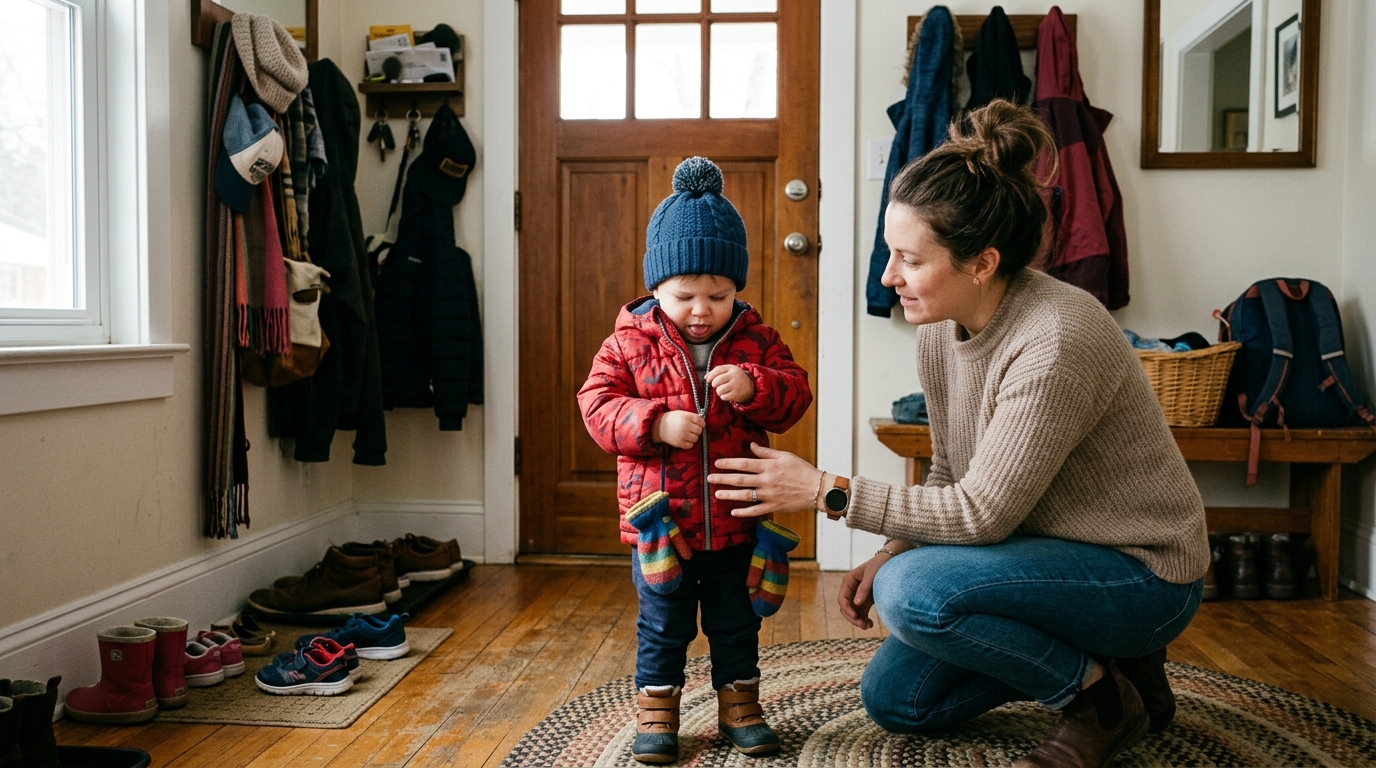
Last winter, just after my eldest turned four, his preschool teacher pulled me aside at pickup. She was gentle about it, which somehow made it worse. She told me that at outside time, while nineteen other kids wrestled their own boots on, my son sat on the bench, lifted one foot into the air, and waited. He was not upset. He was not confused. He simply held his foot up and looked around for an adult, because in his entire life, an adult had always come.
I drove home with my face burning, because she was right and I knew exactly how it had happened. I had been doing everything for my child since the day he was born and I never once stopped to ask why. I zipped his coat. I put on his shoes. I opened his banana, buttered his toast, carried his backpack, cleaned up his blocks, poured his water, and pulled up his pants after the potty long past the age he could manage it himself. Not because he demanded it. Because I was faster, and because watching him struggle felt like a small cruelty when I could fix the problem in two seconds flat.
That bench moment cracked something open for me. I have three kids, and since that day the younger two have been getting a noticeably different mother. This post is the honest version of why. It covers what the research told me when I finally went looking, the one insight that stung more than anything a teacher could say, and the five things I would hand over first if I could sit down with the mom I was that winter.
What doing everything for your child actually looks like
Nobody wakes up and decides to raise a kid who cannot put on a boot. You slide into it one tiny rescue at a time, and every single rescue has a perfectly reasonable excuse attached.
It looks like brushing a five-year-old's teeth because she misses spots, years after she could have taken over most of the job. If you are wondering where that line actually falls, I wrote about when kids can brush their own teeth after I got it wrong myself. It looks like dressing a capable three-year-old head to toe because the shirt takes him nine minutes and you have a meeting at nine. It looks like spoon-feeding a toddler who can feed herself because the floor stays cleaner. It looks like answering the questions that grown-ups ask your child directly, before your child has taken a breath to answer. It looks like sliding the puzzle piece into place after four seconds of watching him try.
My personal excuse was almost always speed. We were late, we were always late, and the fastest hands in the house were mine. Other parents I know do it out of perfectionism, or because a younger sibling arrived and the toddler suddenly seemed like a baby again, or because the whining that comes with "do it yourself" is genuinely hard to survive at 7:40 in the morning.
None of it feels like a problem in the moment. One zipped coat is not a parenting philosophy. The problem is that a thousand zipped coats quietly become one.
What the research says happens next
After the bench incident I went looking for actual evidence, half hoping to find out that this was fine and every four-year-old holds a foot in the air. That is not what I found.
A 2022 systematic review published in Frontiers in Psychology pulled together the research on so-called helicopter parenting and found it consistently linked with higher anxiety and depression in kids, with high parental control also tied to lower self-efficacy, which is the belief that you are capable of handling things. A 2024 meta-analysis in the Journal of Adult Development reached a similar place from a different angle: across many studies of young adults, overparenting was associated with more anxiety, weaker coping, and a shakier sense of their own competence. These were not kids whose parents ignored them. These were kids whose parents did too much.
Then there is Julie Lythcott-Haims, who spent a decade as Stanford's dean of freshmen before writing How to Raise an Adult. She watched wave after wave of eighteen-year-olds arrive with spectacular resumes and no idea how to function without a parent on call. She calls it the checklisted childhood: parents managing every task and decision so thoroughly that the child never builds the machinery to manage anything alone. Her fix is a simple four-step handoff for any skill. First you do it for them. Then you do it with them. Then you watch them do it. Then they do it alone. I had been stuck on step one with my son for four straight years.
The psychology underneath all of this has a name too. Self-determination theory, developed by researchers Edward Deci and Richard Ryan, holds that autonomy is a basic psychological need, right alongside feeling competent and feeling connected. Kids need to do things themselves the way they need sleep. A 2024 study in the journal Acta Psychologica found that overparenting predicted higher trait anxiety in adolescents partly because it frustrates exactly those needs. Every time we take over, we save two minutes and quietly withhold something a child's brain requires.
The part that stung: "I'll do it" means "you can't"
Here is the piece that kept me up at night, and it is counterintuitive, because rescuing your child feels like the purest possible expression of love.
Kids do not hear "I'll do it" as love. They hear it as a verdict.
Every time I swooped in on the zipper, I believed I was saying "I've got you." What my son actually absorbed, at four years old, with no words exchanged, was "this is beyond you." Do that often enough and a child stops trying, not out of laziness but out of accurate pattern recognition. Trying was never his job. Waiting was. Psychologists call the far end of that road learned helplessness, and I got to watch a miniature version of it sit on a preschool bench with its foot in the air.
Help is a message. Rescue a child often enough and the message becomes: you are not able.
The cruel irony is that I would have marched into battle for that kid's confidence. I told him he was capable a dozen times a day. But children believe what we do far more than what we say, and what I did, hundreds of times a week, said the opposite.
What to hand over first: five easy wins for this week
You do not fix this by handing a preschooler the car keys. You fix it by picking small, winnable jobs and genuinely letting go of them. These five are where I started with my younger two, roughly in order of easiest first.
1. The coat zipper. You connect the bottom of the zipper, they pull it up. That split makes it winnable from about age three, and pulling that tab themselves is weirdly powerful for a small kid. Full independent dressing comes later, and I broke down how we got there in teaching a toddler to dress themselves.
2. Shoes on their own feet. Velcro only, to start. Draw half a smiley face inside each shoe so the halves line up when the shoes are on the correct feet. Expect wrong feet for a while, and let them walk around that way. Nothing bad happens.
3. Carrying their own stuff. The backpack, the water bottle, the library book. A child who carries her own things learns, in her body, that her things are her job. I retired from pack mule duty the same month as the bench incident.
4. Pouring their own water. Small pitcher, small cup, a towel nearby. Yes, there will be spills. Wiping up a spill is its own skill, so keep a rag they can reach and hand the cleanup over too.
5. One real chore. Feeding the cat, putting napkins on the table, sorting socks. Pick one job that the family actually relies on, because kids can smell fake work. If you want ideas matched to your kid's age, my list of age-appropriate chores by age starts at eighteen months.
Fair warning: if you have spent years doing everything for your child, the first week of handing things back gets loud. Mine wailed "you do it" at me like I had canceled his birthday. Holding that line felt a lot like the work I had to do around setting boundaries with a clingy toddler, and the same rule applied. Stay warm, and do not take the task back. The protest faded in about two weeks. The pride did not.
My eldest is four and a half now. He makes his own snack, badly, with a truly upsetting amount of peanut butter, and I say nothing, because the snack is his. It has taken months to start undoing what I built in four years, and some days I still catch my hands moving toward a problem that belongs to him. I pull them back. If you saw yourself in the mom zipping the coat, please hear me: you are not a bad parent, you are a fast one who loves hard, and the fix is not to love less. It is to stand there, hands in your pockets, and let a small determined person find out what they can do.