
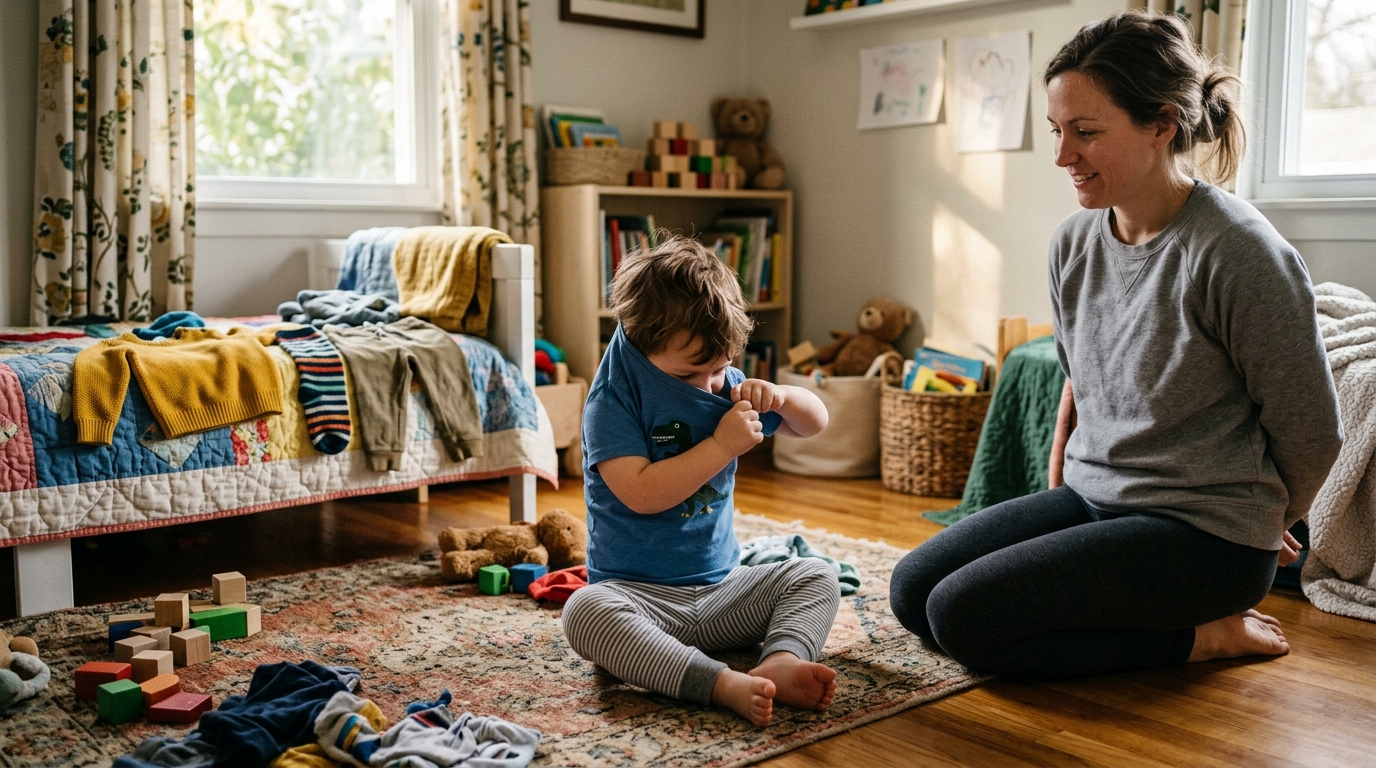
Last Tuesday, 7:42am. Preschool drop-off is at 8:15 and it takes eleven minutes to drive there. My three-year-old, Nora, is standing in the hallway wearing one sock and a swimsuit. Not the outfit I laid out. The swimsuit. She has been "getting dressed by herself" for nineteen minutes, and if I so much as touch the swimsuit strap she screams like I've betrayed her at a cellular level. Meanwhile the baby has pulled every wipe out of the packet and my four-year-old is asking, calmly, why we're always late.
That morning broke me a little, and it's also the reason I finally sat down and figured out how to teach a toddler to dress themselves properly, instead of just hoping it would happen by osmosis. Because here's the trap I was stuck in: Nora wanted to do it herself, she couldn't actually do most of it yet, and I kept trying to teach her mid-crisis at 7:40am. That's like teaching someone to parallel park during a car chase. Once I separated the teaching from the mornings, everything changed. Not overnight. But genuinely changed.
What toddlers can actually do at each age
Before you can fix the morning chaos, you need an honest picture of what your kid is capable of. I spent a while cross-checking pediatric occupational therapy sources on this, because I suspected I was expecting too much from Nora, and I was right.
Here's the rough progression:
Around age 1: They cooperate. They push an arm through a sleeve you're holding, lift a foot for a shoe, hold still-ish. That's it, and that counts. This is participation, and it matters more than it looks.
Around age 2: Taking clothes off comes way before putting them on. A two-year-old can usually pull off socks, shove down elastic-waist pants, wriggle out of an unzipped coat, and find the armholes in a shirt. Many can unzip a zipper and undo a large button. Undressing skills always lead dressing skills by months, which explains a lot about the naked toddler in your living room.
Around age 3: This is the big year. Most three-year-olds can pull on a t-shirt with minimal help, get elastic-waist trousers up and down on their own, manage large buttons, and zip a zipper once you've connected the bottom for them. Socks and shoes go on too, though frequently on the wrong feet, backwards, or both.
Around age 4: They can tell the front of a shirt from the back (most of the time), hook a zipper themselves and pull it up, and work regular buttons with visible effort and some muttering.
Ages 5 to 6: Most kids can dress fully independently except for shoelaces and fiddly fastenings behind their back. OT sources put complete mastery, laces included, somewhere between 6 and 8, and a range of a year or two in either direction is completely normal.
Reading that list was humbling. I had been irritated with a three-year-old for not doing four-and-a-half-year-old things. She wasn't being difficult about the coat zipper. She literally could not connect the hook yet. If your toddler melts down over clothes constantly, it's worth checking whether the task is actually within reach, because a lot of what looks like defiance is a kid drowning in a job that's too big. There's more on that in the real reason your toddler says no, which changed how I read half of Nora's refusals.
How to teach a toddler to dress themselves: start with the last step
The single best thing I learned is a technique occupational therapists use called backward chaining, and it flipped my whole approach.
Here's the idea. Any dressing task is a chain of steps. Putting on pants is: hold the waistband, sit down, foot in one leg, foot in the other leg, stand up, pull to the waist. Instead of asking your toddler to do the whole chain and watching them fail at step two, you do everything except the last step. They pull the pants that final stretch from knees to waist. Done. They finished it. In their head, they put their pants on.
Then, once that last step is easy, you hand over the last two steps. They stand up and pull. Then three steps. You keep retreating backwards through the chain until one day you're not in it at all.
The genius of this is that the child always ends on success. Every single practice ends with them completing the task, which is the exact opposite of the usual pattern where they start strong, get stuck with a shirt over their face, and end in tears. Nora went from "I CAN'T DO IT" sobbing to strutting around announcing she dressed herself, and technically she'd done about 20 percent of the work. I did not correct the record. Her confidence did the rest of the teaching for me.
We used the same approach with her coat, her socks (last step: pulling the heel up), and eventually buttons. My four-year-old, who I'd never explicitly taught, actually got faster too once I started narrating the steps out loud for his sister. Turns out nobody had ever told him pants have a front.
Small setups that do half the work
Backward chaining is the engine, but a few staging tricks make everything smoother.
Lay the clothes out flat, in position. The night before, I lay each outfit on the floor like a flat paper doll: shirt face-down with the hem toward her, pants with the waistband toward her, socks on top. Face-down matters. A shirt lying face-down means when she pulls it over her head, the tag ends up at the back where it belongs. That one detail eliminated the daily backwards-shirt redo.
The coat flip trick. If you've never seen this, it feels like a magic trick. Lay the coat on the floor, open, lining facing up, with the hood or collar at your toddler's toes. They bend down, push both arms into the sleeves, then flip the whole thing up and over their head. The coat lands on their shoulders, right way round. Nora learned it in two tries and now performs it for strangers. It's the only reliable way I've found to get a coat on a kid who refuses help, and if the hallway standoffs run deeper than coats, the same cooperation tricks in why your 4-year-old won't listen work on the hallway floor too.
Two outfits, one choice. Toddlers fight clothes partly because they have no say in anything. So I give a say, but a contained one. Two outfits on the dresser the night before, she picks one. Not the whole wardrobe, not the swimsuit drawer. Two. If she rejects both, I pick, and that's the natural consequence of not choosing. It took about a week of testing before she believed me, and now the choosing part is her favorite bit of the evening.
Buy forgiving clothes while they learn. Elastic waists, roomy necklines, big buttons, zippers with chunky pulls. Skinny jeans with a snap closure are an advanced-level garment. Save them for later.
Practice on the days that don't matter, so it holds up on the days that do.
That line is basically our family motto now, and it applies to way more than clothes. We do dressing practice after bath, on weekends, on lazy Sunday mornings when nobody cares if it takes twelve minutes. Rushed mornings are for using skills, never for teaching them. The same logic runs through everything from age-appropriate chores by age to getting ready for school; it's all one big pattern of letting kids do what they genuinely can, and quietly doing the rest yourself without commentary.
The mornings, honestly
Now for the part nobody wants to hear. Even after you teach a toddler to dress themselves, they are slow. A three-year-old dressing independently takes five to ten times longer than you dressing them. That's not a flaw in the method. That's the price, and you pay it in time.
So the lateness fix is not a dressing fix. It's a schedule fix. Here's what actually works at our house:
I wake the kids twenty minutes earlier than the math says we need. I hate it too. But those twenty minutes are the difference between "take your time, buddy" and me hissing "we have to GO" while forcing an arm into a sleeve, which undoes weeks of confidence in about forty seconds. The buffer isn't for them. It's for me, so I can afford to be patient.
I also decide, every morning, which parts are hers and which are mine. On a normal day, Nora does everything she's mastered and I do the rest without making it a lesson. On a day when we're genuinely up against it, I'll say "today is a helping day, I'm going to be your dressing machine" and do most of it fast, with zero guilt. Independence is a long game. One rushed Tuesday doesn't set it back, but a screaming standoff might.
And when we're still late anyway, because a sock seam felt wrong or the green shirt was suddenly unbearable, I try to remember that a preschool teacher has never once asked me why we arrived at 8:19 instead of 8:15. The stakes in my head were always higher than the real ones.
Six months on from the swimsuit incident, Nora dresses herself top to bottom most mornings, wrong-footed shoes and all, and my four-year-old ties precisely zero shoelaces but does everything else, which for his age is right on track according to every checklist I've seen, including the school readiness checklist I obsessed over last spring. The mornings are not calm, exactly. Three kids under five, calm was never on the table. But nobody is fighting about pants, we mostly leave on time, and there's a small person in my hallway every morning who's deeply proud of a job she couldn't do half a year ago. I'll take it.