
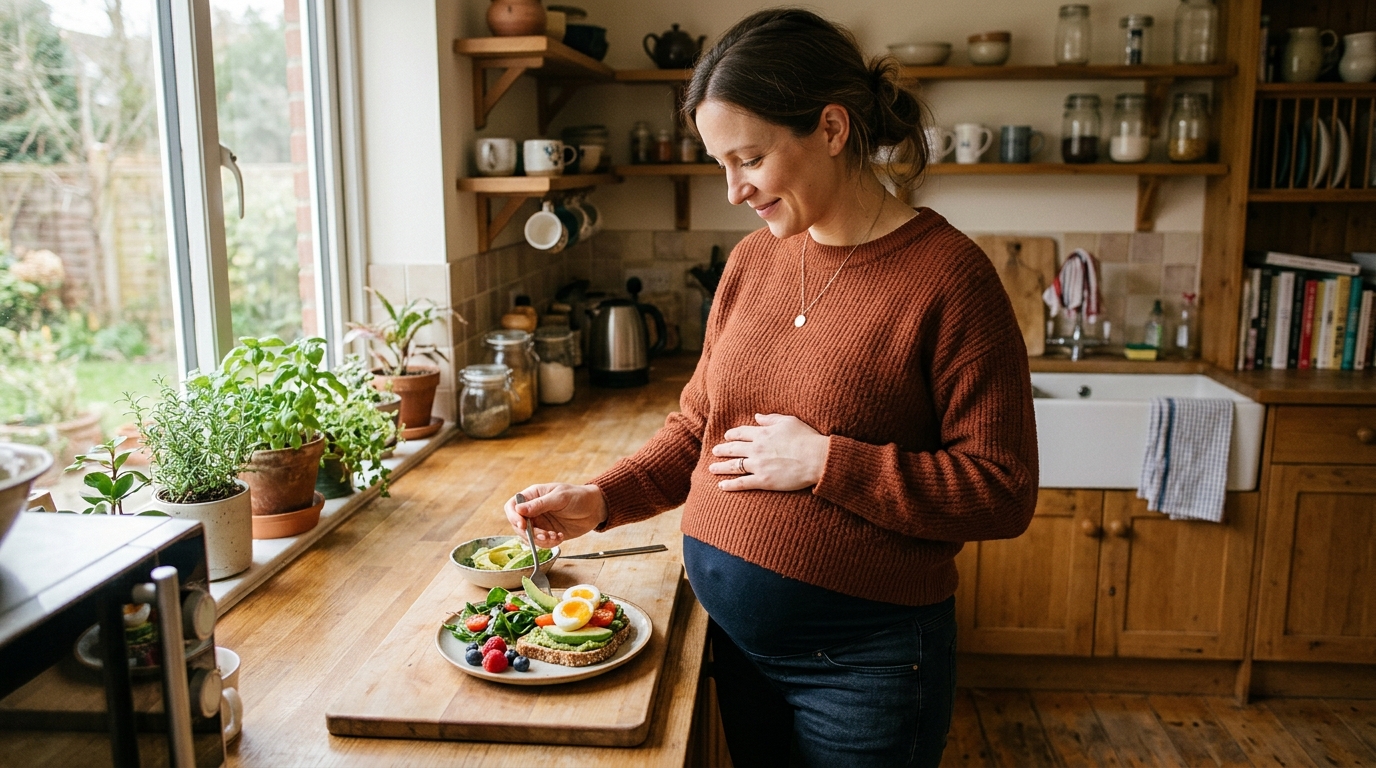
At 34 weeks I made myself a proper dinner for the first time in a week, sat down feeling virtuous, and managed about six forkfuls before I had to stop. Not because it was bad. Because there was physically nowhere for it to go. My stomach had been squashed up somewhere near my ribs, and half a plate of pasta felt like I had eaten a Christmas dinner. Then the heartburn arrived like an old friend who overstays.
If you are in the home stretch and finding that eating well now means eating strangely, tiny amounts, weird timing, dodging the foods that set your chest on fire, you are not doing it wrong. Your baby is having a growth spurt and your stomach is the thing being evicted. I want to walk you through what to eat in the third trimester when there is genuinely no room left, the nutrients that matter most right now, how to eat around heartburn and constipation, a simple day of eating you can actually manage, and the signs worth flagging to your midwife.
Why there's suddenly no room for food
Let me explain the thing nobody quite prepares you for. By the third trimester your uterus has grown up and out, and it is pressing your stomach and intestines into a much smaller space. A meal that felt normal at 20 weeks now feels enormous at 34, because your stomach simply cannot expand the way it used to.
So the whole game of what to eat in the third trimester changes. It stops being about big balanced plates and starts being about getting the good stuff into small packages. You are not eating less because you need less. Your baby needs plenty right now. You are eating smaller and more often because the container shrank.
The fix that saved me was giving up on three big meals entirely. I switched to small, frequent eating, roughly five or six little meals across the day instead of three that defeated me. Once I stopped trying to force down a full plate, both the fullness and the heartburn eased up.
You are not eating less because your baby needs less. You are eating smaller because your stomach has nowhere left to expand.
The nutrients that matter most right now
Your baby does a lot of building in these final weeks, laying down fat, finishing the brain and lungs, and stocking up on iron for their first few months of life. That means a few specific nutrients earn their place in every small meal.
Iron, because you are both storing it
Iron is the big one in the third trimester. Your blood volume is way up, and your baby is banking iron to carry them through their early months. Low iron here leaves you shattered in a way sleep does not fix, and it matters for delivery too.
- Lean red meat, chicken, and fish
- Beans, lentils, and chickpeas
- Spinach and other dark leafy greens
- Fortified breakfast cereals
Pair the plant sources with a bit of vitamin C, a few strawberries, some pepper, a squeeze of orange, because it helps your body absorb the iron. And keep your big cup of tea or coffee away from your iron-rich meals, since the tannins block absorption. That one small change made a real difference to how I felt.
Calcium and protein for the growth spurt
Your baby is pulling calcium to harden those bones, and if you are short, they take it from you. Protein is the raw material for all that final growth.
- Calcium: milk, yogurt, cheese, fortified plant milks, tinned salmon with the soft bones
- Protein: eggs, chicken, fish, Greek yogurt, beans, nut butters, tofu
Greek yogurt became my desert-island food in the third trimester. It is small in the stomach but big on both protein and calcium, and it goes down easily even when nothing else appeals.
If you want the full picture on which foods are genuinely off the menu while you are loading up on all this, my post on foods to avoid in pregnancy walks through the real list, which is a lot shorter than the internet would have you believe.
Eating around the heartburn and the constipation
Two things conspire against you in the final weeks, and both are about that same squashed digestive system. Here is what actually helped me eat around them.
For heartburn, the enemy is a full stomach and certain trigger foods lying against a valve that pregnancy hormones have already loosened. Small meals help a lot on their own. Beyond that:
- Ease off the classic triggers: fried and greasy food, spicy dishes, citrus, tomato-heavy sauces, chocolate, and fizzy drinks
- Stop eating a good two to three hours before you lie down, and prop yourself up with an extra pillow
- Sip fluids between meals rather than drowning your food, since a full sloshing stomach pushes acid up
- Try milk, yogurt, oatmeal, bananas, and other gentle foods that tend to sit calmly
For constipation, which is grim and extremely common now, the answer is fibre and water working together. One without the other can actually make it worse.
- Fibre: whole grains, oats, fruit with the skin on, veg, beans, and a few prunes if you are brave
- Water: keep a bottle with you and sip steadily all day, aiming for pale-straw wee as your rough gauge
- Keep moving, even a gentle daily walk gets a sluggish system going again
A simple day of eating in the third trimester
When you are this tired, decisions are the hardest part, so here is a plain day that hits iron, calcium, protein, and fibre without ever asking your stomach to take on too much at once. This is roughly what mine looked like.
- Breakfast: a bowl of fortified oats with milk, sliced banana, and a spoon of nut butter
- Mid-morning: Greek yogurt with a few berries
- Lunch: a small wholegrain wrap with chicken or hummus, plus some spinach and grated carrot
- Afternoon: an apple with a handful of almonds, or cheese and a few oatcakes
- Dinner: a small portion of fish or lentils, a scoop of brown rice or a small potato, and some greens
- Evening: a warm milk or a small pot of yogurt, finished a couple of hours before bed
None of these are big. That is the whole point. Six small, useful meals get more into you across a day than three large ones you cannot finish. And by keeping dinner modest and early, you give the heartburn less to work with overnight.
If you are managing gestational diabetes on top of all this, the small-and-frequent approach still holds, but the balance of what goes into each meal shifts, and my post on the gestational diabetes diet covers how to pair carbs with protein to keep things steady.
The nutrition signs worth flagging to your midwife
Most third-trimester eating struggles are just the normal squeeze of a big baby in a small space. But a few things are worth raising at your next appointment rather than pushing through, because your midwife would genuinely want to know.
Mention it if you notice:
- Feeling breathless, dizzy, unusually exhausted, or looking pale, which can point to low iron worth checking with a blood test
- Barely eating for a day or two, or losing weight in the third trimester when you should be slowly gaining
- Heartburn so severe it stops you sleeping or eating, since there are pregnancy-safe options your midwife or GP can suggest
- Constipation that will not budge despite fibre and water, before you try any laxative on your own
- Strong cravings for non-food things like ice, chalk, or soil, which can be a sign of a deficiency
- A lot of swelling in your face or hands, a bad headache, or vision changes, which need a same-day call rather than a wait
That last group is not really about food, but they matter enough that I want them on your radar. Sudden swelling with a headache and vision changes can be a sign of pre-eclampsia, and that is one to ring your maternity unit about straight away rather than sleeping on.
Raising a nutrition worry with your midwife is not fussing. It is exactly what they are there for, and a quick iron check or a safe heartburn remedy can make these last weeks a great deal more comfortable.
The bottom line
What to eat in the third trimester comes down to this: smaller, more often, and packed with the good stuff, because your baby needs plenty while your stomach has almost no room to hold it. Lean into iron, calcium, and protein, respect the heartburn and the constipation instead of fighting them, and let go of the idea that a proper meal has to be a big one.
I got through those last weeks on Greek yogurt, boiled eggs, tiny early dinners, and a lot of grazing. It felt like a strange way to eat, and it absolutely worked. You are in the final stretch. Feed yourself in little useful bites, and be kind to that squashed stomach. It has one very big job left to do.