
My four-year-old wiped down the kitchen table last Tuesday without being asked. I was halfway through telling him how proud I was when he held out his hand and said, "That's one dollar, right?" His best friend gets paid per chore, it turns out. A dollar for the table. Two for taking out the bins. There is apparently a laminated chart on their fridge, and my son had priced out our entire kitchen before I found any words at all.
I stood there holding a dishcloth and realized I had no policy. None. We have three kids aged six and under, and until that moment chores in our house were just things we did because we live here. Suddenly there was a price list. So I did what I always do when parenting catches me flat: I put the kids to bed and went digging. Two weeks of reading later, I can tell you that the question of whether kids should get paid for chores has two serious camps, both full of parents who love their children, and I have finally worked out where our family sits.
The camp that says never pay for chores
The best-known voice here is Ron Lieber, the New York Times money columnist who wrote The Opposite of Spoiled. His position is easy to state and surprisingly hard to argue with. Chores are what you do because you belong to a family. Money lessons matter too, but they should come through an allowance that has nothing to do with the dishwasher.
"Allowance ought to stand on its own, not as a wage but as a teaching tool." Ron Lieber, The Opposite of Spoiled
One of his warnings stuck with me for days. If every chore has a price, a child can look at the dollar, decide the table is not worth it, and walk away. Lieber puts it bluntly: at some point they're going to get wise to the whole system. I have a four-year-old. He would get wise to the system by Thursday.
Psychologist Wendy Mogel makes the same case from a different angle. She calls chores an essential aspect of family citizenship. Nobody pays me to make dinner. Nobody pays my husband to fix the gate latch he has been promising to fix since March. The work of a home is shared because the home is shared, and kids who grow up inside that logic get something better than pocket money. They get the feeling of being needed, which matters more than it sounds. I went deep on that side of things in why chores build confident kids, and I still believe every word of it.
This camp carries a risk, though, and the honest writers in it admit as much. If money never touches work at home, a child can reach the teen years without ever feeling the link between effort and earning. An allowance that lands every Saturday no matter what can start to feel like weather. It shows up whether or not you did anything.
The camp that says money should be earned
This camp is bigger than the parenting books suggest. In T. Rowe Price's annual survey of parents, 83 percent of those who give an allowance say kids should earn it through chores. The logic is plain. Adult life pays people for work, and home is the cheapest, safest place to learn that. Plenty of these households run on commission language. No work, no pay, no exceptions.
The version I find more workable is the split model that a lot of financial literacy educators now recommend. Baseline chores are unpaid because you live here. Extra jobs are paid because they go beyond the baseline. Making your bed earns nothing. Washing the car on a Saturday earns actual money. The child still learns that income follows effort, but the basic running of the family never becomes something you can buy your way out of.
What this camp teaches is real. Kids in these homes get early, concrete practice at earning and at saving up for something they want, with money that feels like theirs because it is. The risks are real too. Every request can turn into a wage negotiation, and siblings will absolutely compare rates. The opt-out problem also never fully disappears. A kid with enough birthday money in the drawer can afford to let the bins overflow.
Should kids get paid for chores? What research says
Here is the honest answer: research will not settle this for you, and I found that oddly freeing. The most quoted study, from Marty Rossmann at the University of Minnesota, followed people over 20 years and found that the strongest predictor of adult success was starting chores at age three or four. It never asked whether those chores were paid. The habit of contributing mattered. The payment model did not.
Researchers at BYU looked at families running a free allowance, where money is not tied to work, and families running a wage allowance, where it is. Kids from both kinds of homes turned out fine, and each group described different benefits. Wage-allowance kids talked about learning that money requires work. Free-allowance kids talked about working out of gratitude and belonging. Nobody found a clear winner.
So the stakes are lower than the arguing makes them feel. The child who does chores wins either way. That took the pressure off enough for me to stop looking for the right answer and just pick one that fits our house.
The hybrid we landed on
We split it three ways, borrowing shamelessly from both camps.
Family jobs are unpaid, full stop. Setting the table, feeding the cat, putting your own laundry away. These are what you do as a member of this family, and I say that sentence out loud more often than my kids would like. Part of my motivation is principle. Part of it is that I refuse to be the only person in this house who knows where the socks live. If that second part sounds familiar, how to stop doing everything for your kids is the companion piece to this one.
Extra jobs are paid. These are things beyond the normal running of the house. Washing the car, weeding the front bed, helping me clear out the garage shelf that has frightened me since 2024. Each job has a set price agreed before it starts, and finished means finished, not abandoned halfway when the novelty wears off.
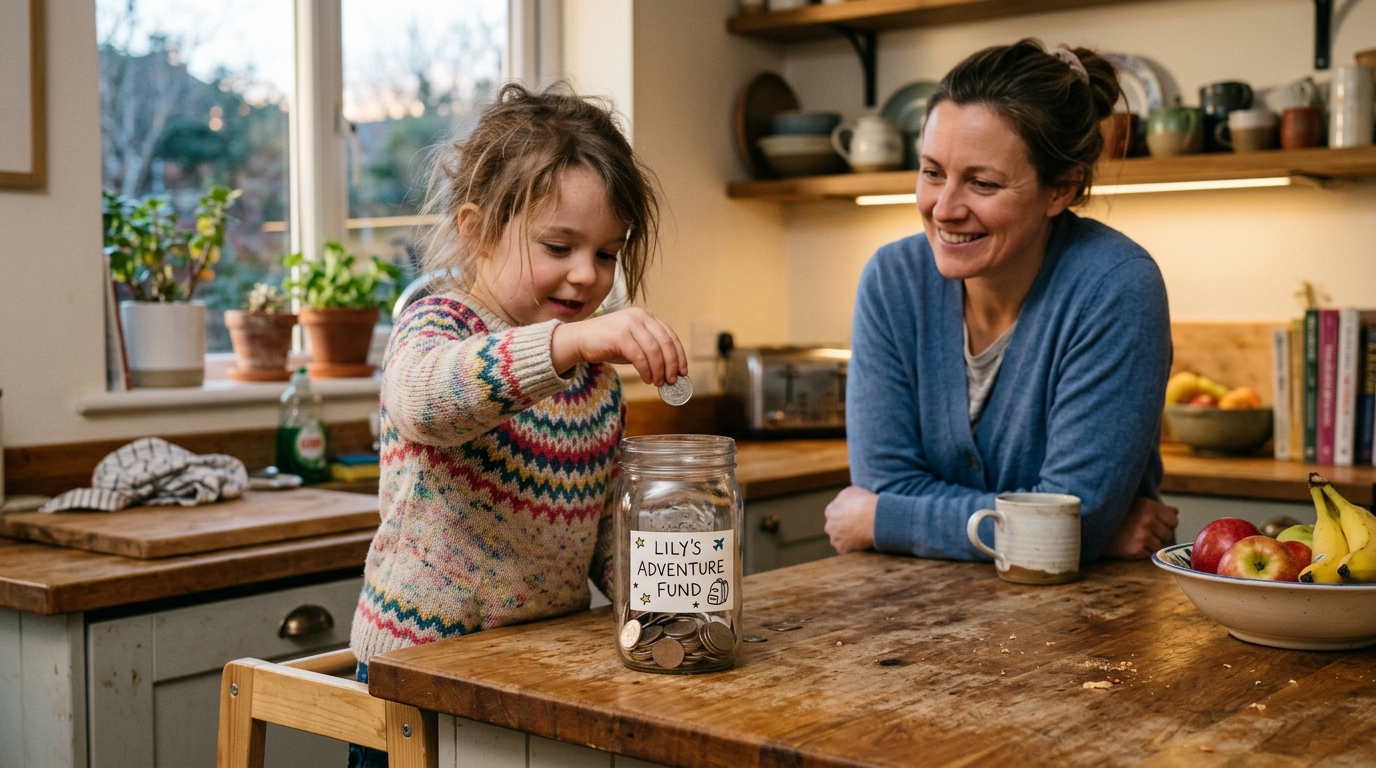
Allowance is its own thing. Small, weekly, and not tied to anything. This is the money-learning tool, exactly as Lieber describes it. Ours goes into a clear jar on the counter where our son can watch it grow, and the spending decisions are his to make and occasionally regret. The regret is the curriculum.
Ages and amounts, held loosely
The most common rule of thumb is 50 cents to a dollar per year of age, per week. So a six-year-old lands somewhere between three and six dollars, and plenty of families sit under that happily. Extra jobs in most households run from about 50 cents for small things to a few dollars for genuinely big ones. Under age five, I would not overthink amounts at all. A few coins in a jar teach the concept, and the concept is the point. What matters more at every stage is matching the work to what the child can actually manage, which is exactly what age-appropriate chores by age is for.
I went back to my son a few days after the table incident with our new family policy. He did not get his dollar. The table belongs to all of us, I told him, and so does wiping it. He was not impressed. Then I showed him the extra jobs list and the jar, and something shifted in his face when he understood there was now a real way to earn real money in this house. Three weeks on, the jar has coins in it, the car has been washed twice to a standard I would generously call enthusiastic, and he still wipes the table. Not every night. But when he does, neither of us mentions money, and that silence is the whole lesson I was hoping for.