
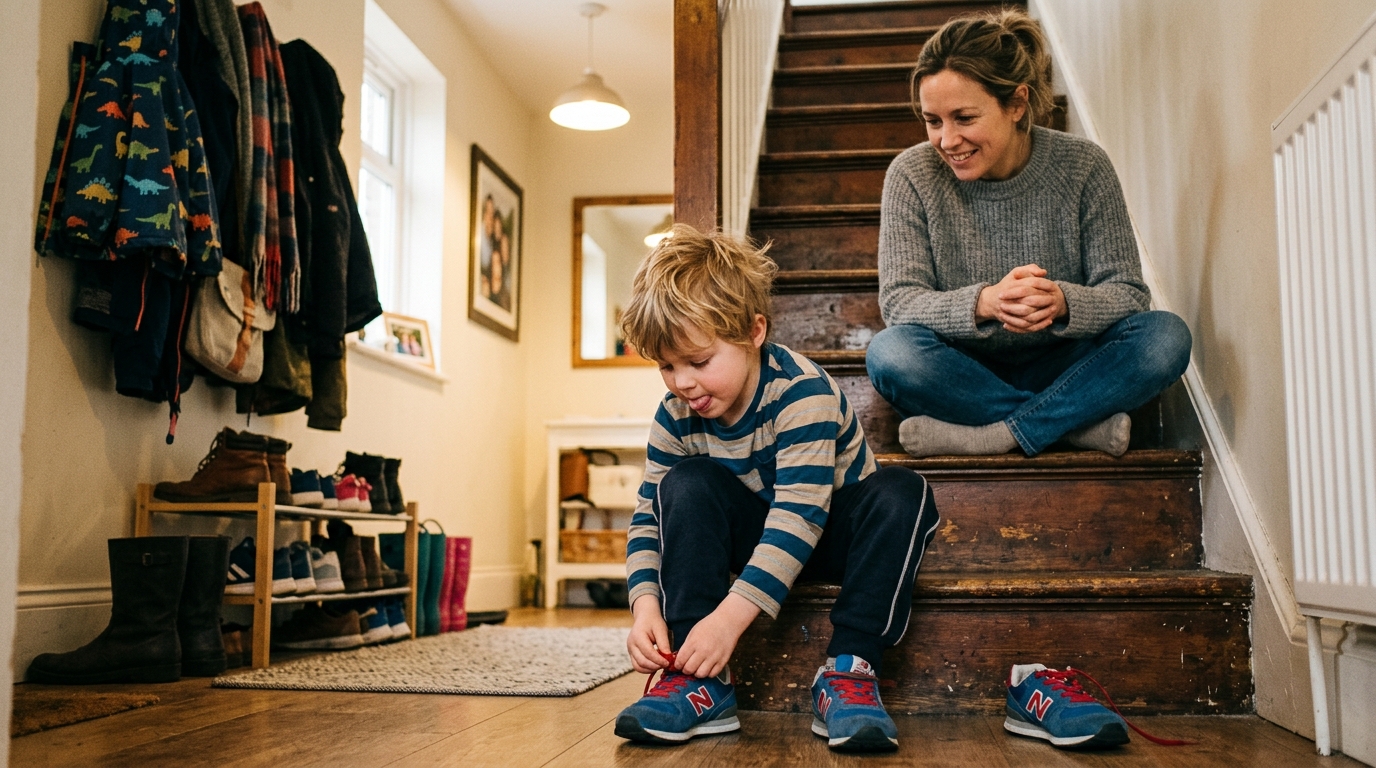
Last month at my sister's house, six of us were standing at the front door in our coats, ready for ice cream, while my niece Amara sat on the bottom stair with one sneaker in her lap. She is six. Her tongue was poking out the side of her mouth, both hands pinching two little loops of lace, and she was not going anywhere until this bow happened. My sister stood one stair up with her hands behind her back and said nothing. It took almost four minutes. Nobody helped. When the bow finally held, Amara looked up like she had just landed a plane.
My three are all still in velcro, so this is not a skill I have taught yet. It is the one I am preparing for, and that stairwell moment sent me home with questions. I asked my sister exactly what she did, then went digging through what pediatric occupational therapists say about how to teach a child to tie shoes, because her version matched the research almost step for step. That is rare enough that I wrote it all down.
When kids are actually ready
Most children learn to tie their shoes between ages 5 and 7. That range comes up again and again in occupational therapy resources, including The OT Toolbox, and the reason is not attention span or motivation. It is fine motor readiness. Tying a bow needs finger isolation, in-hand manipulation, hand strength, and the ability to make both hands do different jobs at the same time. OTs call that last one bilateral coordination, and it is the hard part. Most four year olds simply do not have it yet, and no amount of drilling installs it early.
So before you start, look for the quieter signs. Can your child button a shirt? Open a zip-top bag? Hold paper steady with one hand while cutting with the other? Those use the same machinery. If you are already working through teaching a toddler to dress themselves, shoe tying is the level after that, not the level beside it.
Here is my favorite piece of trivia on this, and it is real: many dentists use shoe tying as the benchmark for when a child can brush their own teeth without help. Same fine motor control, same two-handed coordination, same wrist work. If you have ever wondered when kids can brush their own teeth, the answer is roughly "when they can tie a bow." One skill, two payoffs. That tells you how much coordination is packed into this little knot.
How to teach a child to tie shoes with the bunny ears method
There are two classic methods. The one most parents grew up with is the around-the-tree version, where one loop stands up and the other lace circles it. Some kids do better with that one, especially kids with a strong dominant hand, and if your child already half-knows it, do not switch. But for most beginners, occupational therapists point to the bunny ears method because both hands do the same simple job: make a loop, then tie the loops together. Symmetrical tasks are easier for young hands.
Here is the whole thing, written so you can teach it tonight.
Step 1. The starting knot. Hold one lace in each hand and stretch them out to the sides. Cross them into an X. Tuck the top lace under the bottom one and pull both ends tight. Your child probably already knows this part.
Step 2. Make the first bunny ear. Fold one lace into a loop and pinch it near the base with a thumb and finger. Say "make a bunny ear" out loud. The script matters more than you would think.
Step 3. Make the second bunny ear. Same thing with the other hand. Now your child is holding two loops, one in each hand, pinched near the bases.
Step 4. Cross the ears. Cross the two loops into an X, exactly like the starting knot but with loops instead of laces.
Step 5. Tuck and pull. Tuck the top loop under the bottom one, push it through the gap, then grab a loop in each hand and pull sideways and slightly down. That is the bow.
Five steps, and steps 2 and 3 are identical. That repetition is why this method wins. My sister taught Amara the phrase "ear, ear, cross, tuck, pull" and had her chant it while she worked. By week two Amara was muttering it to herself on the stairs like a tiny pilot running a checklist.
Where kids get stuck
Almost every child hits the same three walls, so expect them instead of being surprised by them.
The loops collapse. This is a pinch strength problem, not an understanding problem. Use the rubber band trick above, or switch to thick, stiff laces for a while. Skinny round laces are the hardest laces in existence and most kids' shoes come with them.
They lose track of which lace is which. The fix that shows up in nearly every OT resource, including NTS Therapy, is two different colored laces. Cut a white lace and a colored lace in half, tie or sew them together, and lace the shoe so each side is a different color. Now "cross the blue over the white" is an instruction a five year old can actually follow.
The final pull undoes everything. Usually the tuck went over instead of under, or they pulled the loose ends instead of the loops. Slow that one step down. Do the first four steps for them and let them do only the pull. Which brings me to the single best teaching idea I found.
Teach it backwards. You do every step except the last one, and your child finishes the bow. Then hand over the last two steps. Then three.
OTs call this backward chaining, and clinics like Occupational Therapy Helping Children recommend it specifically for shoe tying. The logic is sneaky and kind. Your child gets the finished bow, the win, the "I did it" moment, on day one. Motivation stays high because every single practice ends in success, and the child works backward toward the start of the task instead of grinding forward and failing at step four every time.
Practice tricks that actually work
Take the shoe off the foot. Practice with the shoe on the table or in your child's lap, facing the same way it would on their foot. Bending over your own toes adds a balance challenge and flips the whole picture upside down. Master it on the table first, then move to the foot. Every OT source I read agrees on this one.
Sit behind or beside, never opposite. If you sit facing your child, your hands are a mirror image of theirs and your demo actively confuses them. Sit so your hands move the same direction theirs do.
Five minutes a day beats one long Saturday session. Short daily practice wins on skills like this. My sister's rule was five minutes after breakfast, then the shoe went away no matter where they got to. Frustration never had time to build. Marathon sessions end in tears and a child who hates the sight of laces.
Practice on other things. Lace two colored strings through holes punched in an egg carton. Tie bows on a chair leg, a stuffed animal, a bathrobe belt. The OT Toolbox suggests exactly this kind of variety because the hands learn the pattern faster when the setting changes.
For a developmentally ready child, expect two to four weeks of daily practice to get from nothing to tying with help, and another few weeks after that before it is truly automatic. Amara took about three weeks to her first solo bow. The stairwell victory came at week five.
Velcro is not failure
If you have tried for a couple of weeks and it is all tears, stop. Buy the velcro shoes, put the laces away, and try again in three months. This is not giving up. A child who is six months short on bilateral coordination cannot practice their way over that gap, and forcing it just teaches them that shoes are a fight. Nothing about school hinges on laces at five. It is not even on most school readiness checklists, and teachers would rather have a kid in velcro than a kid melting down in the coat hall.
I keep coming back to my sister on that stair, hands behind her back, saying nothing for four whole minutes. The teaching was mostly done by then. The hard part that day was not doing it for her. That is the piece I am trying to bank for my own three, because everything I have read about how to teach a child to tie shoes says the method matters less than the patience wrapped around it. Bunny ears, five minutes a day, shoe on the table, and a parent willing to be late for ice cream.