
My daughter was five days old the first time I tried to clean her properly, and I stood in the bathroom holding a warm cloth like it was a live wire. My husband hovered in the doorway. The water in the little basin had gone lukewarm because I had spent ten minutes second guessing the temperature. She was so small and so slippery in my head, even though I had not touched her yet, that I genuinely thought I might drop her or somehow do it wrong. I ended up crying a little before she did.
If your hands are shaking at the thought of that first wash, I have been exactly there, and I promise it gets easy fast. Learning how to bathe a newborn feels like defusing a bomb the first time and like nothing at all by week three. This post walks you through why you start with sponge baths, how to get the water temperature right, everything to lay out before you begin, how to hold a wet baby safely, how often babies actually need a bath, and the rash or cord signs that mean you should ring the doctor instead of carrying on.
Why you start with sponge baths, not the tub
Here is the thing nobody told me clearly. You do not put a newborn in a tub of water right away. Until the umbilical cord stump falls off and the belly button heals, which is usually somewhere between one and three weeks, you stick to sponge baths. That means washing her with a damp cloth while she lies on a towel, never lowering her into water.
The reason is simple. That little stump needs to stay dry and clean to heal and drop off without getting infected. Soaking it slows things down. If your baby was circumcised, the same go-slow rule applies until that heals too. So for the first couple of weeks, a warm cloth is your whole toolkit, and honestly it is easier than the tub anyway. If you want the full picture on caring for that stump between washes, I wrote out everything I learned in umbilical cord care for your newborn.
Once the cord is gone and the belly button looks healed and dry, you can move to a proper baby bath. Not before. There is no prize for rushing this part.
Getting the water temperature right
Cold water will make a newborn miserable and hot water can scald skin that is far thinner than yours. The number to remember when you learn how to bathe a newborn is around 37 to 38 degrees Celsius, which is 98 to 100 Fahrenheit, basically warm like a comfortable bath but on the cooler side of what an adult would pick.
You have two easy ways to check. A cheap bath thermometer takes all the guesswork out and I used mine every time for months. If you do not have one, dip your elbow or the inside of your wrist, not your hand, because those spots feel heat more like a baby does. The water should feel pleasantly warm and never hot.
- Fill the basin or run the cloth water before you undress the baby, so she is not lying cold and waiting.
- Always add cold water first, then warm, and swirl it so there are no hot pockets.
- Keep the room warm and free of drafts. Newborns lose heat fast, and a warm room matters as much as warm water.
Warm room, warm water on the cool side, and everything within arm's reach before baby is undressed.
Have everything ready before you start
The single biggest thing that turned bath time from scary to smooth was laying every item out first. Once a baby is undressed and damp, you cannot walk away to grab a towel, not even for a second. Here is what I kept within reach every time:
- Two soft towels, one to lay her on and a hooded one to wrap her in after.
- A bowl or basin of warm water and a couple of soft cloths or cotton wool.
- A fresh nappy and the clean clothes she was going into.
- Plain water for the first weeks, or a tiny amount of gentle, fragrance-free baby wash once you use any at all.
- A dry cloth for the belly button and any barrier cream you use.
How to actually do the sponge bath
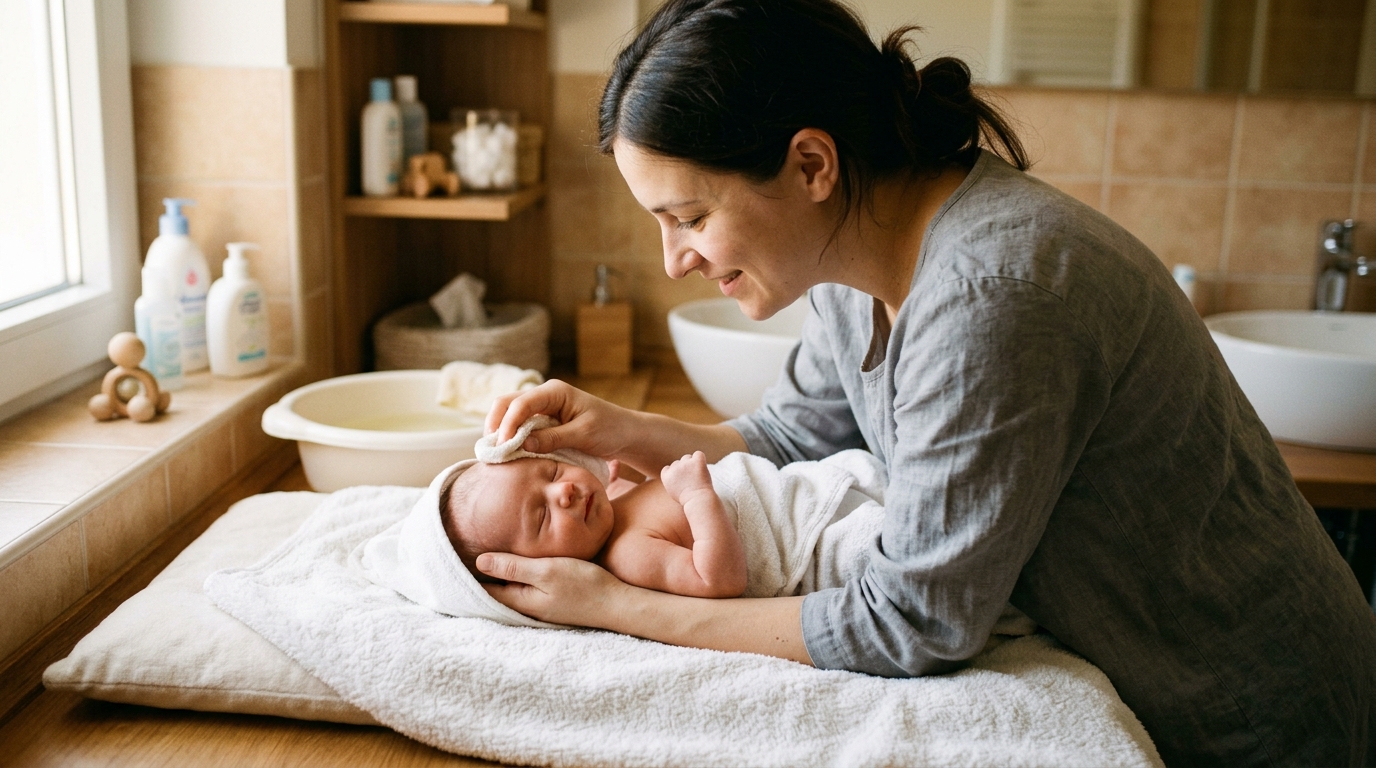
Now the part you came for. Lay your baby on a flat, padded surface, on top of a towel, and keep her partly wrapped so only the bit you are washing is uncovered. This keeps her warm and calm. Wet the cloth, wring it so it is damp not dripping, and go gently.
Work from cleanest to dirtiest and top to bottom. Start with the face using just plain water, no soap. Wipe each eye from the inner corner outward with a fresh piece of cloth or cotton wool for each eye. Do the rest of the face, then behind and around the ears, but not inside them. Never poke anything into the ears or nose.
Move down to the neck, and get right into those chubby creases where milk and fuzz collect. Then the arms, hands, chest, and tummy, keeping the cord stump dry. Wash the legs and feet, checking the folds. Save the nappy area for last, wiping front to back, especially for girls. Then pat her dry straight away, paying attention to every crease so no dampness lingers.
The whole thing should take just a few minutes. A shorter bath means less time getting cold and less time for both of you to get stressed. If she cries, that is normal at first. Talk to her, keep your movements slow, and know that the crying almost always fades once bath time becomes familiar.
Holding a wet baby without the fear
The slipperiness worried me more than anything. Once you graduate to the baby tub, the safe hold makes all the difference. Slide your non-dominant arm behind her back so her head and neck rest on your forearm and your hand grips her far armpit or shoulder. That grip is your anchor. Your other hand is then free to wash. Lower her feet in first, keep the water shallow, only a couple of inches, and never take your supporting hand off her, not to reach for anything.
How often newborns actually need a bath
Here is the reassurance I wish I had gotten sooner. Newborns do not need a bath every day. Their skin is delicate, and daily washing can dry it out and strip the natural oils it needs. Two or three baths a week is plenty for a newborn.
What you do need to do daily is keep the parts that get grubby clean. That means wiping the face, the neck creases, the hands, and the nappy area every day, which is really just topping and tailing. The full-body wash can happen a few times a week and no one will judge you. For the day-to-day rhythm of nappies, feeds, cord care, and everything in between, my newborn daily care checklist lays out what genuinely needs doing and what can wait.
Some families love a bath as part of the bedtime wind-down, and that is lovely if your baby enjoys it. But if bath time upsets her right now, a few washes a week with gentle daily wipes is completely fine.
When a rash or cord problem means call the doctor
I am a mom sharing what I lived and researched, not a medical professional, so please treat your own gut as the final say. Most bath-time worries are nothing. But a few signs mean you should stop wondering and call your pediatrician or health visitor.
Ring the doctor if you notice any of these:
- The cord stump area is red and spreading, swollen, oozing yellow pus, or smells bad. A little dried blood as it separates is normal, but redness creeping onto the belly is not.
- A fever in a newborn, meaning 38 Celsius or 100.4 Fahrenheit or higher, is always a reason to call the same day.
- A rash that blisters, weeps, spreads quickly, or comes with the baby seeming unwell, floppy, or feeding poorly.
- A nappy rash that is raw, bleeding, or has bright red spots dotted around the edges, which can point to a yeast infection that needs cream.
- Skin that stays very dry, cracked, or peeling in a way that does not settle with plain moisturizer.
For everyday dry patches, cradle cap flakes, or the mild peeling loads of newborns have in the first weeks, a gentle fragrance-free moisturizer and time usually sort it. But you never lose anything by calling. In those early weeks I phoned my health visitor about a spot on my daughter's tummy that turned out to be nothing, and she told me she would far rather field ten calls about nothing than miss one that mattered.
The takeaway
Learning how to bathe a newborn is one of those things that looks terrifying and becomes second nature within a couple of weeks. Stick to sponge baths until the cord falls off, keep the water warm and on the cooler side, lay everything out before you start, and hold her with one steady supporting arm you never take away. A few baths a week is all she needs, with gentle daily wipes in between.
Keep the warning signs tucked in your back pocket so you can tell a normal peeling patch from something worth a phone call. You will not do it perfectly the first time, and that is fine. She will be clean, warm, and held. That is the whole job.