
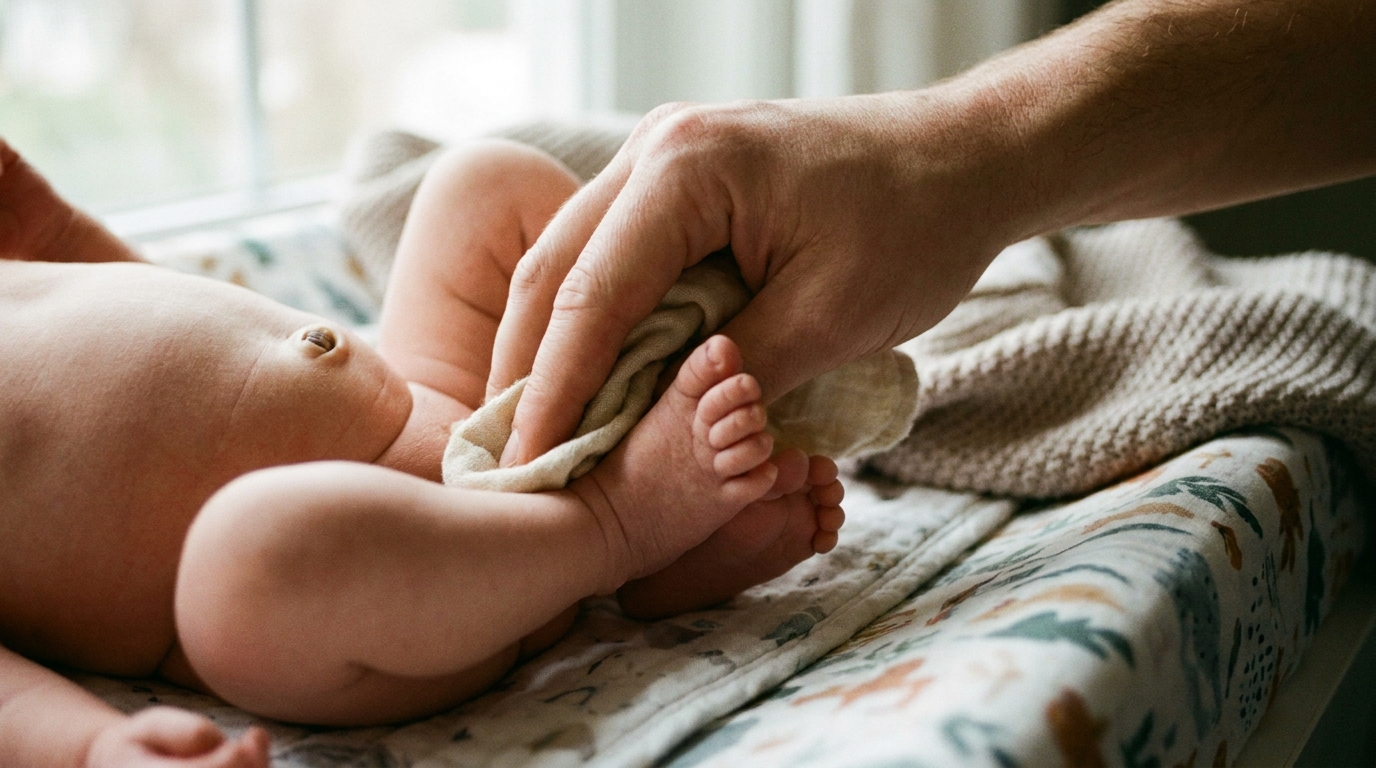
On day 3 with my first I looked at my baby's belly button and genuinely thought something was wrong. The dried-up stump was black, smelled slightly weird, and looked like it might be infected. I called the postpartum line at 9pm in a mild panic. The midwife sounded slightly bored. "That sounds completely normal. Leave it alone. Call back if it does X, Y, or Z."
What I needed in that moment was a clear, practical guide to umbilical cord care for a newborn that told me what is normal, what is not, and what to actually do. The leaflets in the hospital bag were vague. The internet was a mess of contradictory advice.
So here is the version I wished I had at 3am on day 3, plus the bonus answers to all the small questions nobody told me to ask.
What the umbilical cord stump actually is
When your baby is born, the umbilical cord is clamped about an inch from the belly button and cut. The bit of cord left attached to the baby is the stump.
In the first few days, the stump:
- Looks slightly wet or moist
- Is yellowish at first
- Slowly dries out and turns brown
- Then black
- Then falls off on its own
This usually happens between day 5 and day 15. Some stumps fall off as early as day 3. Some hold on for 3 weeks. All of that is within normal range.
The basic daily care: do less, not more
This is the part most parents over-complicate. Current advice from the WHO, NHS, CDC, and most pediatric guidelines is the same: dry cord care. Do nothing except keep it clean and dry.
The full care routine:
1. Fold the front of the diaper down below the stump so it stays exposed to air 2. Use a sponge bath (not a full bath) until the stump falls off 3. If it gets dirty (poop, urine), gently clean with a cotton ball and plain water, then pat dry 4. Let air get to it as much as possible 5. Do not put alcohol, antiseptic, breast milk, or any other substance on it unless your pediatrician specifically tells you to
That is the whole routine. Most of the old advice (alcohol swabs, special creams) has been removed because the evidence shows the cord heals fastest when left alone.
What is normal vs what is not
This is the question every parent asks. The answer is more reassuring than you might think.
What is normal
- The stump looks black or dark brown
- It is hard and stiff
- It smells slightly off (sort of like a healing scab)
- A small amount of yellow or pinkish discharge is visible at the base
- A few drops of blood when the stump first falls off
- A small wet spot on the diaper or onesie when the stump falls off
- The belly button looks slightly damp underneath when the stump falls off
- A small pink or red ring at the base of the stump
- The skin around it is normal color
What is not normal (call your pediatrician or doctor)
- The skin around the belly button is bright red, hot to touch, or spreading redness
- Yellow or green pus draining from the area
- A foul, strong smell (not just slightly off, but genuinely bad)
- Your baby has a fever (over 100.4 F or 38 C in a newborn is always a reason to call)
- Your baby is unusually sleepy or floppy
- Your baby is feeding poorly
- The cord seems to be reattaching or growing tissue (looks like a small bumpy lump, called a granuloma)
- Bleeding that does not stop (more than a few drops)
- Bleeding that starts more than a few days after the stump fell off
- The belly button is bulging or sticking out significantly
Most worrying signs above are signs of a possible infection (omphalitis, which is an infection of the umbilical stump area, considered a medical emergency in newborns). Newborn infections move fast. Do not wait to call.
What if the cord falls off and there is bleeding
A small amount of blood when the stump falls off is normal. Up to about a teaspoon's worth of dried blood and discharge can appear on the diaper or onesie that day.
What to do:
- Press gently with a clean piece of gauze for about 1 minute
- Let the area air dry
- Carry on with normal care
What is not normal:
- Heavy active bleeding that does not stop with gentle pressure
- Bright red blood seeping continuously
- Blood that soaks through the diaper or onesie
For active bleeding, call the doctor or take the baby to a clinic.
What if the cord smells
A slightly off smell is normal as the stump dries and tissue is reabsorbed. Sort of like a healing scab.
A foul smell is different. If the smell is genuinely bad (like rotting or pus), this is a sign of infection and you should call your pediatrician the same day.
What about bathing
Until the stump falls off, give sponge baths instead of full immersion baths.
A sponge bath is:
- Baby lying on a warm soft towel
- Warm water in a bowl or sink nearby
- A washcloth used to gently clean section by section
- Skip the umbilical area, just let it stay dry
- Dry the baby with a soft towel before letting them get cold
After the stump falls off and the belly button is fully healed (about 5 to 10 days after it falls off), you can switch to full baths in the baby tub.
What about clothes and diapers
A few practical things.
Diapers
Buy diapers with a cutout or fold the front down below the belly button. Many newborn diaper brands have a cutout designed for cord care. If yours do not, just fold the top of the diaper down so the stump is exposed to air.
The Pampers Pure, Honest Company, and many newborn-specific diaper brands have the cutout built in.
Onesies
Use side-snap kimono-style onesies or wrap-style ones for the first week or two. They are less rough on the stump area than over-the-head onesies. Most newborn clothing brands sell side-snap versions.
If you use regular onesies, just be careful when pulling them over the baby's head not to catch the stump.
Sleepwear
Sleep sacks and gowns work well in the first weeks because there is no waist band pressing on the stump.
What if the cord seems to be taking forever
Most umbilical stumps fall off between days 5 and 15. If yours is past day 15 and still attached, do not worry yet. Some stumps just take longer.
If the stump is still attached at day 21, it is worth a call to your pediatrician. They may want to take a look to make sure there is no underlying issue (rare).
Do not pull the stump off yourself. Even if it looks ready, even if it is hanging by a thread. Wait for it to fall off on its own. Pulling can cause bleeding and increase infection risk.
What about granulomas
After the stump falls off, some babies develop a small pink bumpy lump where the cord was. This is called an umbilical granuloma (a small mass of extra tissue that forms during healing).
It is harmless but can be slow to heal on its own. Most pediatricians treat it with a small dab of silver nitrate (a chemical that gently burns off the extra tissue) at a routine visit. This is painless for the baby. The granuloma is usually gone in a week.
Do not try to treat it yourself.
What if my baby has an outie belly button
Some babies have an "outie" belly button that protrudes outward instead of going in. Most outies are harmless and fix themselves in the first year.
A protruding belly button can also be a small umbilical hernia (a small opening in the abdominal muscles that allows a bit of intestine to push through, causing the belly button to bulge). These are common in newborns and almost all close on their own by age 4 or 5.
The signs of a hernia:
- The belly button bulges when the baby cries
- The bulge can be gently pushed back in
- The bulge is soft and not painful
- The skin over the bulge is normal color
When to call: if the bulge becomes hard, painful, red, or cannot be pushed back in, this is a possible incarcerated hernia (rare but a medical emergency).
What to tell yourself when staring at a weird-looking stump
The umbilical cord stump is one of the parts of newborn care that looks worse than it is. The black, dried-up appearance is supposed to look that way. The slight smell is supposed to be there. The little drops of blood at the end are part of the normal process.
The best umbilical cord care for a newborn is doing very little. Keep it clean. Keep it dry. Let air get to it. Do not put substances on it. Watch for the specific signs of infection.
Within 2 weeks the stump will have fallen off and the belly button will be healing. Within 4 weeks the belly button will look normal. In a year you will have to consciously remember which type of belly button your baby was born with.
The stump is one of the early small worries that turns out to be fine almost every time. You are doing this part right.