
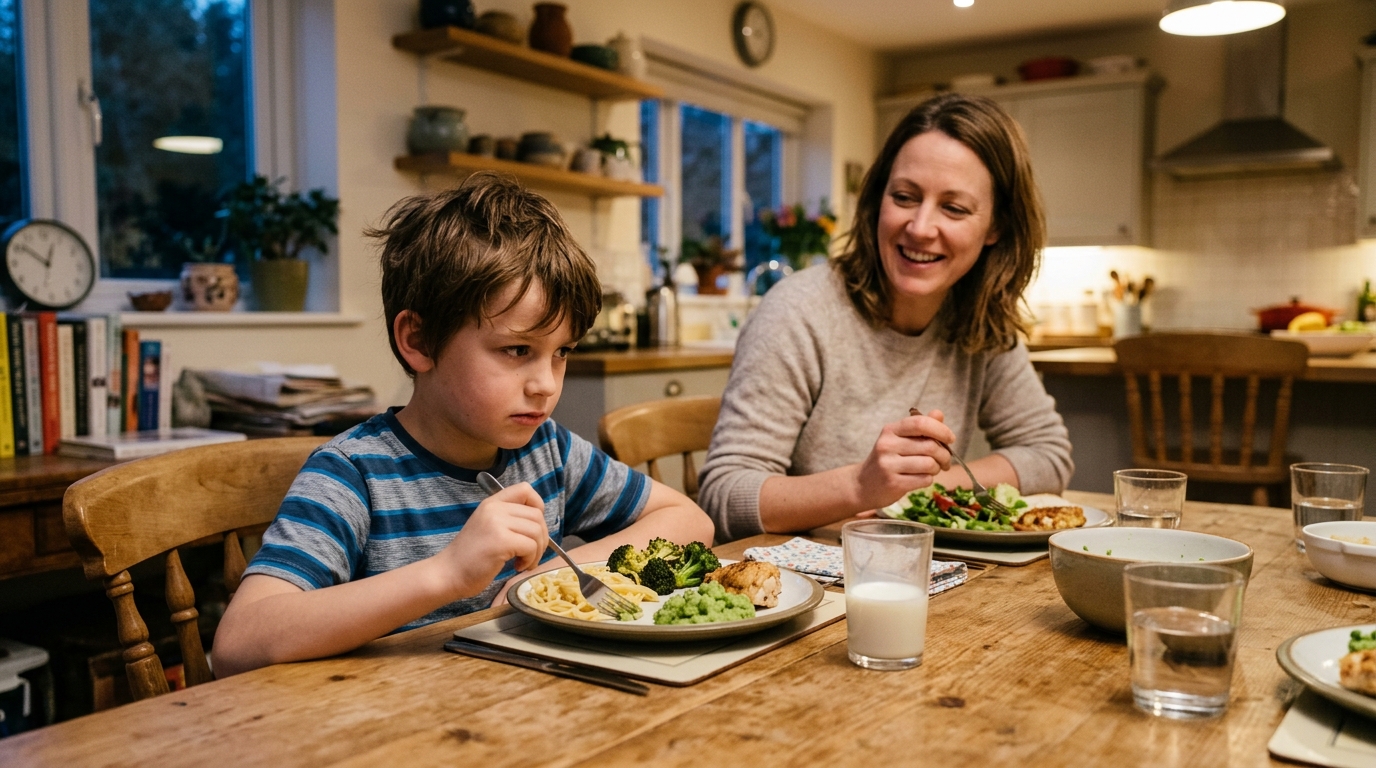
My son was seven when I finally admitted this was not a phase we were growing out of. It was a Tuesday, I had made a chicken traybake that half the internet swore their kids devoured, and he pushed a single roasted carrot to the edge of his plate like it might bite him. His little sister, three years younger, ate the lot. I sat there quietly panicking that I had raised a child who would live on beige food forever.
If your kid is five, seven, nine, and still eating a list of foods you could count on two hands, you are not doing this wrong and neither is your child. Fussy eating in an older child is far more common than the calm dinner photos on your feed suggest. This post covers why fussy eating persists past the toddler years, why pressure and bribes backfire, the low key family meal approach that shifted things in our house, how to serve new foods without a battle, and when extreme fussiness means a chat with your GP or a dietitian.
Why fussy eating in an older child sticks around
We are told picky eating is a toddler thing you outgrow, and for a lot of kids that is true. But for plenty of others it settles in and stays, and understanding why helped me stop taking it personally.
Sometimes it is simple habit. If a child has eaten the same safe ten foods for years and mealtimes have become tense, that pattern gets deep and comfortable. Sometimes it is about control. Food is one of the few things an older child gets the final say on, and a kid who feels pushed around elsewhere may plant a flag right there at the dinner table.
For some children it runs deeper than habit. Sensory sensitivity is real and common. The wet slip of a tomato, the smell of cooked broccoli, a sauce touching a potato, these can genuinely feel unbearable to a sensitive kid. And then there is anxiety. A child who worries about gagging, or who had one bad choking scare, can shrink their food list to only what feels safe.
Most older fussy eaters are not being difficult on purpose. They are managing something real, whether it is control, texture, or worry.
None of these mean something is broken. My son, it turned out, was a texture kid and an anxious one, which no amount of sneaking spinach into a smoothie could fix.
Why pressure and bribes backfire
Here is the hard truth I had to swallow. Almost everything my instinct told me to do at the table made things worse. "Just one bite." "No pudding until you finish." I said all of it. It worked in the moment sometimes, in that he would choke down a forkful with a face like thunder. But it taught him that the table was a place of pressure and that new food was the enemy he had to defend against every night.
Bribes have the same problem. When you make broccoli the toll a child pays to reach the ice cream, you quietly tell them broccoli must be awful, because why else would it need a reward attached. You also hand them more power, because now the negotiation is the meal. We spent months where dinner was basically a hostage exchange.
Pressure also raises the stress in a child who is often already anxious about food, and stress and appetite do not mix. The more I pushed, the smaller his list got. Backing off felt like giving up, but it finally let the pressure out of the room.
The low key family meal approach
What actually helped was boring and undramatic. The heart of it is an old idea from a feeding specialist called Ellyn Satter. You decide what food is offered and when. Your child decides whether they eat and how much. That is the whole deal, and holding that line changed our house.
In practice it looked like this for us.
- We ate together as often as we could, same food for everyone, no separate plate cooked to order.
- I served the meal, sat down, and then, the hard part, I let it go. No commentary on what he ate.
- I enjoyed my own food in front of him, no big show.
- Pudding, when we had it, came regardless of how dinner went, so it stopped being a prize.
The first few weeks felt like nothing was happening, and I had to physically stop myself from nudging. But once the tension drained out of dinner, something loosened in him. A child who is not braced for a fight has spare curiosity, and that is where trying new food starts.
If you have fought these battles since the toddler stage, you might recognise yourself in my earlier post on why your toddler refuses every meal you cook, because the same calm rules carry all the way up.
Serving safe foods alongside new ones
Dropping the pressure does not mean giving up on variety. It means changing how new food arrives, and the most useful move for us was always putting a safe food on the plate next to anything new. An older fussy eater needs to know there is a guaranteed win on that plate, so a new food is not a threat to whether they go to bed hungry. Next to the safe thing, I would add a tiny amount of something else. One roasted carrot. Three peas. No expectation that it gets eaten, just that it exists near them and they can see the rest of us eating it.
This is the drip approach, slow on purpose. A child might need to see, smell, and be near a new food a dozen or twenty times before they will touch it, and touching comes long before tasting. I stopped counting bites and started counting exposures. Him licking a piece of red pepper and putting it back was a genuine win, and I learned not to react, because a big "yes, well done" is just pressure wearing a party hat. Small portions help too, since a teaspoon feels doable where a mountain gets pushed away.
For more real world ideas, these foods picky eaters actually eat gave me a workable starting list when I felt out of ideas.
Getting them into the kitchen
Involving my son in the food before it reached his plate moved the needle too. A child who feels some ownership over a meal is more open to trying it, and the kitchen is a lower pressure place to meet new food than the table. We started tiny. He picked one new vegetable each week at the supermarket, his choice, no matter how random. He washed salad, sprinkled cheese, and tasted off the spoon while cooking, which felt totally different to him than the same food served on a plate. Growing cherry tomatoes on the windowsill did more for his willingness to eat a tomato than a year of me asking. Food you helped make is less scary than food that just appears.
When to talk to your GP or a dietitian
Most fussy eating in an older child is a slow patience game, not a medical problem. But some signs mean you should stop trying to solve it alone. I am a mom sharing what worked for us, not a medical expert, so please treat this next part as the important bit. Book a chat with your GP or ask for a referral to a paediatric dietitian if you notice any of these:
- The list of foods your child accepts is very short, roughly ten or fewer, and it is shrinking rather than growing.
- Your child is losing weight, falling off their growth curve, or is not gaining as they should.
- They cut out whole food groups, like refusing all fruit and veg, or all protein.
- Meals come with real distress, gagging, retching, or panic at certain foods, beyond ordinary reluctance.
- Mealtimes are causing serious stress in your family and nothing you try is shifting it.
There is a recognised pattern sometimes called avoidant restrictive food intake disorder, ARFID, where the fussiness is intense enough to affect a child's health or growth, and that needs proper support rather than a new dinner trick. Asking for help is not a failure. When I stopped white knuckling it alone and spoke to our GP, I felt lighter for weeks.
The takeaway
Fussy eating in an older child is common, it often has a real reason underneath it, and the pressure and bribes we reach for by instinct tend to make it worse. Take the tension out of the table, hold the line that you offer the food and they decide whether to eat it, and keep quietly serving new foods next to safe ones while you get them into the kitchen. Count exposures instead of bites, and keep the warning signs handy so you know when to bring in a GP or dietitian. It is slow, and some nights you will want to scream into a tea towel. But calmer meals were the thing that finally gave my son room to grow his list, one ignored carrot at a time.