
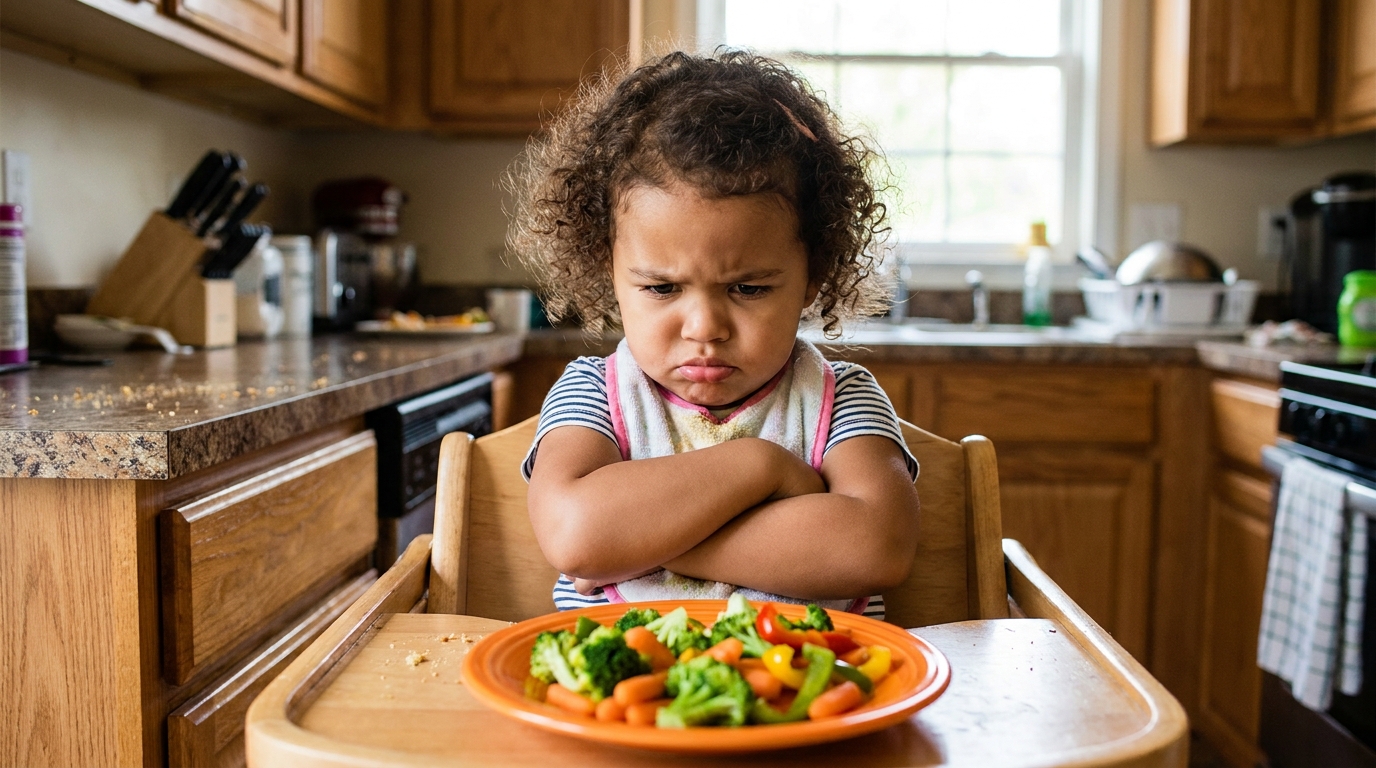
It's 6pm. The kitchen smells of the garlic and onion you cut at 5pm thinking you'd do something nice tonight. The plate is in front of your two-year-old. Three coloured things you cooked from scratch.
She looks at the plate. She looks at you. She picks up one piece of pasta. She holds it like a science specimen for nine seconds. She puts it back. She slides off the chair. She asks for a snack.
You stand there with a wooden spoon and the same thought every parent has had since cooking was invented. "What is wrong with my child."
Nothing's wrong with her. Almost every toddler on earth goes through this, and the reason has very little to do with you. It's biology. Once you understand what's happening, the whole mealtime war calms down.
Why she suddenly stopped eating
Between roughly twelve and eighteen months, every healthy toddler's appetite drops off a cliff. That's not a phase, and it's not your cooking. It's how humans are designed.
A baby in their first year roughly triples their birth weight. They have to eat. After that first birthday, growth slows hard. A toddler between one and three only gains around 2 kilograms a year, which is about 5 pounds. She literally doesn't need the same volume of food anymore, and her body knows it before you do.
So the same baby who hoovered down a whole jar of mash six months ago is now eating four peas and calling it dinner. The peas are enough. You just don't believe it because your brain still thinks of her as a hungry baby.
There are four real reasons toddlers refuse food, and your child almost certainly fits one or two of them.
1. The growth slowdown
Already covered above. She's genuinely not hungry. Forcing the issue doesn't change biology. It just turns mealtime into a fight.
2. Neophobia (fear of new foods)
Between roughly eighteen months and four years, almost every toddler develops what's called food neophobia. It's a built-in survival instinct. Back when our ancestors were wandering around with their toddlers, this fear of new foods stopped small humans from eating poisonous berries while everyone's back was turned.
Your toddler isn't being awkward when she refuses the green thing. Her brain is screaming "unknown substance, do not consume." The fix isn't to force it. The fix is repeated, low-pressure exposure. Most kids need to see a new food on their plate ten to fifteen times before they'll even try it.
3. Control
By eighteen months your toddler has worked out that her body is the one thing in this house she fully controls. She can't control bedtime. She can't control what she wears. She can't control the rain.
But what goes in her mouth? That's entirely her decision. And like any tiny dictator who's just discovered power, she's going to use it.
This is why pressure makes the situation worse. The harder you push, the more she clamps down. Mealtime becomes the battlefield where she proves to herself that she's still in charge.
4. Sensory overwhelm
Some toddlers are just wired more sensitive than others. They can't stand the texture of mash. They won't touch anything wet. They want their food separated, dry, plain, and the same every time. That's not naughtiness either. It's sensory sensitivity, and for many kids it eases off naturally by school age.
Seven things that work
None of these are magic. All of them take patience. But they work.
1. Stop being a short-order cook
If you cook three different meals because the toddler refused the first two, you teach her one thing. Refuse, and something better will appear. Serve the family meal. Always include one thing on the plate you know she'll eat, even if it's just a bread roll or some plain pasta. That way no child goes to bed truly hungry, and you stop running a restaurant.
2. Drop the "two more bites" rule
It feels productive in the moment. It's the single most damaging mealtime habit there is. Pressuring a toddler to eat teaches her body to ignore its own hunger signals and turns every meal into a fight. A 2006 review in the journal Appetite found that pressured kids ate less of the foods they were pushed to try, not more, even years later. Let her decide how much.
3. Let her see you eat the same food
Toddlers are the best mimics on earth. If she sees you, her dad, the grandparents, anyone she loves, tucking into the broccoli with genuine enjoyment, that does more for her future relationship with vegetables than any clever trick. Eat together. Out loud, with a little drama. "Mmm, this is so good."
4. Serve it fifteen times before you give up on a food
That neophobia we talked about. You beat it with repetition, not pressure. Put the courgette on her plate. She doesn't eat it. That's fine. Put it on her plate again next time. Just keep showing up. Around exposure number eight or ten, something often shifts.
5. Give her a job
A child who helped wash the strawberries is dramatically more likely to eat one. Letting your toddler crack an egg, stir a bowl, or arrange her own plate gives her control inside the meal instead of fighting against it. Even a two-year-old can rip basil leaves or sprinkle cheese.
6. Family meals, no screens, no negotiation
Eat together when you can. No tablet propped against the salt and pepper. No iPad on a stand. The research on this one is unusually clear. A 2014 review in Pediatrics found that kids who eat regular family meals with no screens have better diets, broader vocabulary, and lower rates of disordered eating later on. It doesn't have to be every night. Just often enough to feel like the default.
7. Trust her body
This is the hardest one. Most of us were raised by parents who policed our plates. Letting your child eat seven peas and stop, with no commentary, no bargaining, no "but you barely touched it" feels almost wrong. Do it anyway. Her body knows what it needs. Your job is to provide healthy options. Her job is to decide how much.
The habits that quietly make it worse
Some things feel helpful in the moment but make the picky phase last years longer. The big ones:
- Bargaining with dessert. "If you finish your dinner you can have pudding." Now dinner is something to suffer through to get to the good part. You've just told her the broccoli is bad.
- Distracting her with the TV so she eats more. Short-term win. Long-term disaster. Kids who eat distracted overeat and never learn to listen to their bodies.
- Praising her for eating. "Good girl, you ate it all!" This sounds nice. But it teaches her to eat for your approval instead of her own hunger.
- Snacking ninety minutes before dinner. A toddler doesn't have a big stomach. If she's had a banana, half a bagel, and a yoghurt at 4pm, she genuinely isn't hungry at 5:30pm.
- Sneaking vegetables into everything. Hiding spinach in a brownie is fine occasionally. But if it's your whole strategy, your child never actually learns to like spinach. The job is to build a relationship with the food itself.
When picky eating crosses into worrying
Picky eating is almost always normal toddler behaviour. But a few signs mean you should talk to your GP.
- Your child is dropping off their own growth curve, not just thin
- They eat fewer than twenty different foods total and the list is shrinking
- They gag, vomit, or melt down at the sight of certain textures
- They aren't gaining weight over a three to six month stretch
- They're losing skills like chewing or self-feeding
If any of these are happening, ask your GP for a referral to a paediatric feeding specialist. Some kids have genuine sensory processing issues or undiagnosed reflux, and they deserve real support, not Pinterest tips.
What you actually need to hear tonight
You're not failing. The plate on the floor isn't a verdict on your cooking or your love. Your toddler is doing the job her brain is wired to do, which is figure out who she is and what she has control over.
Your job is smaller than you think. Put good food on the table. Eat it with her. Don't turn mealtime into a war. Repeat for about eighteen months.
She's going to eat. Maybe not tonight. Maybe not the courgette. But she'll eat. And one day, years from now, you'll catch her asking for the green thing on her own plate, and you'll remember this evening in your kitchen and laugh.
That's the long game. You're doing it right.