
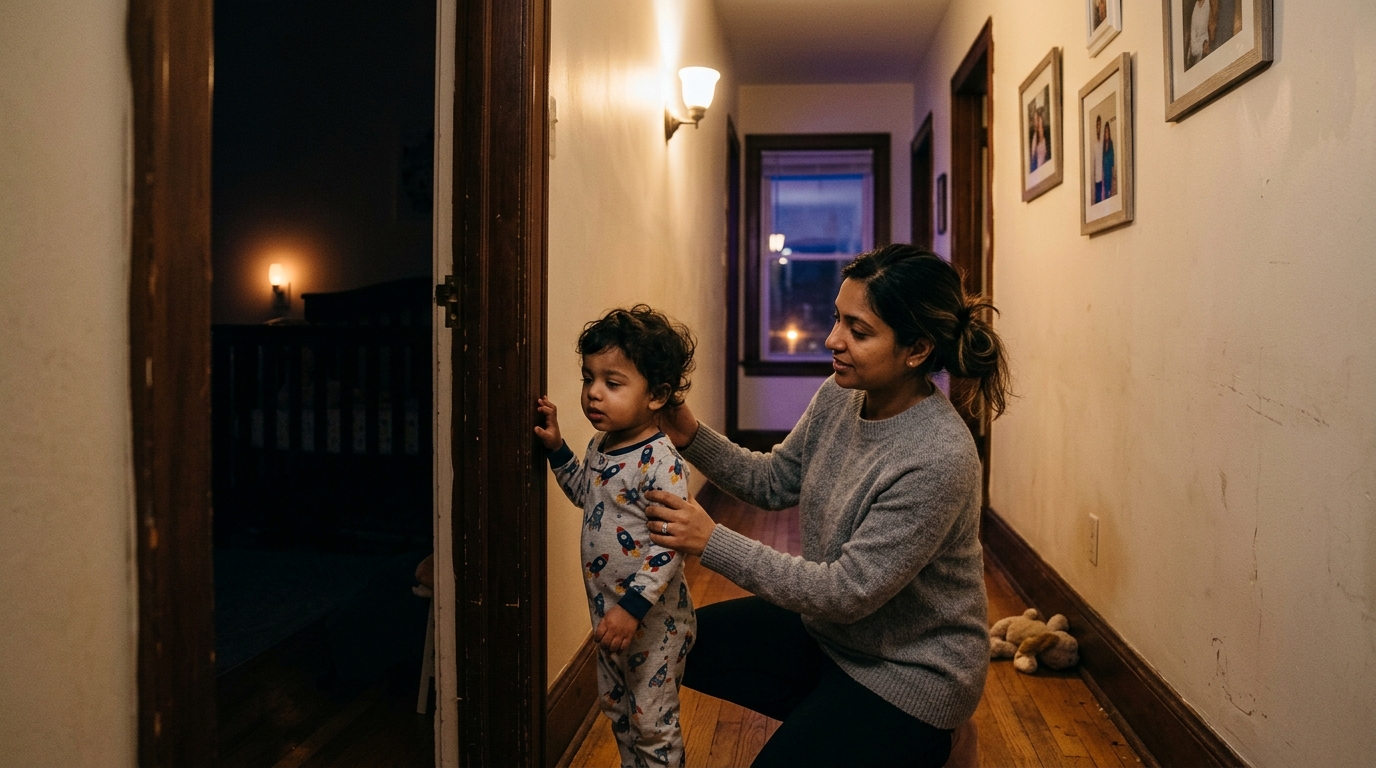
The first night we moved my daughter to the big-kid bed at 2 years and 7 months, I counted seventeen trips. Seventeen. I would tuck her in, kiss her head, walk to the living room, and before I had even sat down I would hear the soft pad of feet, and there she was in the hallway holding her rabbit, asking for water she did not want. By trip nine I was pleading. By trip fourteen I was using my scary whisper. By seventeen I was sitting on her floor in the dark, defeated, letting her stroke my arm until she passed out, which meant I could not move for forty minutes.
If your toddler won't stay in bed and keeps boomeranging back out the second you leave, I have been exactly where you are, and I want to save you the seventeen trips. The good news is this is one of the most fixable toddler problems there is, and it does not take crying it out or a wall of stickers. In this post I will explain why the popping-out starts right after the cot switch, walk you through the calm silent walk-back that ended it in our house, share the wristband reset that made it stick, show you how to tighten the bedtime routine, and name the moves that quietly make it worse.
Why your toddler won't stay in bed after the switch
When your child was in a cot, staying put was not a choice. The rails decided for her. The very first night in a bed, she discovers something huge: she can leave. That is a brand new power, and toddlers test new powers over and over to see if the rule is real.
There is a second thing going on too. For a lot of toddlers, the moment you walk out is the scariest part of the day. Not the dark exactly, but the separation. Coming to find you is not defiance. It is a little person checking that you still exist and still come back. The testing and the missing-you usually happen at once, which is why the same kid who giggles on trip three is teary on trip eight.
The behavior looks like defiance, but underneath it is a toddler asking the same question all night: are you still there?
Understanding that changed how I handled it. My job was not to win a battle. It was to be boring and predictable enough that her brain finally believed it: yes, I am here, and nothing exciting happens if you get up. That is the whole method.
The calm silent walk-back method
This is the part that works, and it works precisely because it is dull. Sleep researchers call it the silent return to bed. Every time she gets out, you walk her back with almost no words, no eye contact drama, and no emotion. You become a slightly boring piece of furniture that returns her to bed. Here is how we ran it.
The first exit gets your one and only speech
The first time she comes out, you get to say one warm, complete sentence: "It's sleepy time now, I love you, stay in your bed." Walk her back, tuck her in once, and leave. That is your whole allowance of words for the night.
Every exit after that is nearly silent
Every time after that, you walk her straight back with either total silence or the same four flat words. We used "sleepy time, back to bed," in the same dull tone every time. No new water, no new questions answered, no cuddle on the floor. You guide her back, tuck, and go.
The magic is in the sameness. She is running an experiment: does getting up produce anything interesting? A parent who negotiates on trip four and snaps on trip nine gives her unpredictable results, which is exactly what keeps a toddler pulling the lever. A parent who does the identical boring thing forty times gives her nothing to work with, and the experiment fizzles out.
Expect it to get worse before it gets better
Night one we walked her back twenty-two times, more than the pleading night. That is normal and actually a good sign. It is called an extinction burst, where the behavior spikes right before it drops because she is testing harder to see if the old rules still apply. Night two was about twelve, night three was five. By the end of the first week we were down to one or two. Keep your face flat and keep walking.
The wristband and reward reset
The walk-back handles the leaving. A small morning reward gives her something to move toward, which pulls many toddlers over the line faster.
We kept ours simple. I bought a pack of cheap silicone wristbands from a party shop and called them her nighttime bands. The rule: stay in your bed all night, and in the morning you pick a band to wear for the day. No screen, no candy. Just a little thing that was hers, earned, and visible on her wrist all day.
A few things that made the reward actually work:
- Reward staying in bed, not falling asleep fast. She cannot control sleep, but she can control her feet. Praise the thing she has power over.
- Give it in the morning, right away: "You stayed in your bed all night, so you get to choose a band." Toddlers need the reward close to the win.
- Keep it tiny and repeatable. Big prizes burn out and turn into a negotiation.
- Never take an earned reward away to punish a rough night. If she gets up, she simply does not earn it that morning, calmly, no shame.
If the getting-out is tangled up with a bigger bedtime fight, where she resists the whole routine and not just the leaving part, the reward alone will not be enough. The routine itself needs work.
Tighten the bedtime routine so there is less to fight
A toddler who pops out ten times is often one whose body is not ready for sleep yet, or who is overtired and wired past the point of settling. The walk-back is much easier when the runway into sleep is smooth. What we tightened:
- Same order, same steps, every night, so her body winds down on autopilot. Bath, pajamas, teeth, two books, one song, lights out. Predictable is calming.
- Watch the clock for the overtired window. An overtired toddler gets a second wind and physically cannot lie still. If she is melting down at bedtime, move the whole routine 20 to 30 minutes earlier for a week, not later.
- Handle the stalls before you leave, not after. The last sip of water, the potty trip, the rabbit located, the closet checked, all inside the routine. Then the well is dry and there is no reason left to come out.
- Kill the screens for at least an hour before bed. The light and the buzz make settling harder for a little brain.
If bedtime itself has become a nightly standoff and not just the staying-in-bed part, we broke down a calmer approach in our 3-step toddler bedtime routine, which pairs well with the walk-back.
What not to do
These are the moves that feel right in the moment and quietly keep the boomerang alive.
- Do not lie down with her until she sleeps. It works tonight and traps you tomorrow, because now your presence is what she needs to fall asleep, and she will come find it every time she stirs.
- Do not turn walk-backs into a conversation. Every question you answer is a reason to get up again. Boring wins.
- Do not yell or make it a big emotional scene. Anger is still attention, and to a toddler testing the rules, a dramatic reaction is the jackpot.
- Do not switch methods every night. Half the reason walk-back works is repetition. Give any approach a week or two before you decide it failed.
When to check with your doctor
Most stay-in-bed struggles are ordinary toddler testing that responds to consistency within a couple of weeks. But talk to your pediatrician if you notice any of these:
- She wakes screaming, sweaty, eyes open but not really awake, and cannot be comforted or does not recognize you. That pattern points to night terrors, handled very differently from ordinary waking, and we cover them in understanding toddler night terrors.
- She snores heavily, gasps, or seems to stop breathing in her sleep, which is worth flagging for possible sleep apnea.
- The bedtime distress looks like real, intense anxiety, or a new separation fear shows up alongside daytime changes in eating or mood.
- Nothing shifts at all after two to three weeks of calm, consistent walk-backs, and everyone in the house is running on empty. A fresh set of eyes sometimes catches what you cannot see from inside the exhaustion.
The night I stopped negotiating and started silently walking her back was the night this turned around, even though it got louder before it got quieter. You are not being mean by being boring. You are teaching a little person that bedtime is safe and not up for debate. Pick your flat little script, keep your face calm, and walk her back as many times as it takes. Soon it will be zero.