
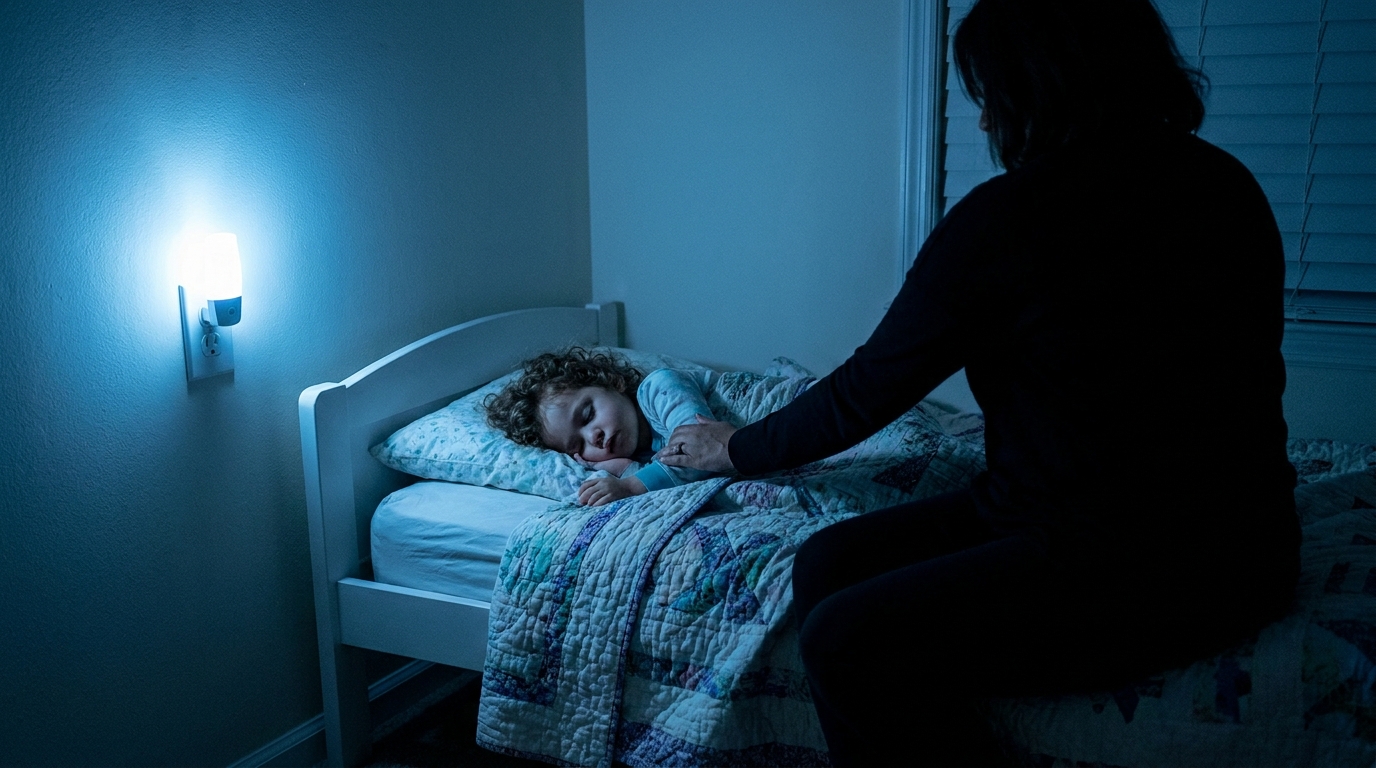
It is 4:47am. Your toddler is standing in their cot or at their door calling your name. This has been happening for three weeks. You have tried going in immediately, leaving them for a few minutes, earlier bedtime, later bedtime, night light, no night light, blackout curtains. Nothing has held for more than two days.
Early waking is one of the most common toddler sleep complaints, and one of the most frustrating to fix, because you genuinely cannot tell which of the five possible causes is driving it without watching for patterns first. Pick the wrong solution for the wrong cause and you make it worse, not better.
This article walks through the five most common reasons toddlers wake between 4am and 5:30am, how to figure out which one you are dealing with, and what to actually do about it.
Why does it always happen at 4am?
Sleep happens in cycles, and in the early hours of the morning, human sleep gets progressively lighter. By 4am, most toddlers are in the lightest stage of sleep they will reach all night. Any small disruption, a slight temperature change, a sound from outside, a full bladder, a drop in blood sugar, is enough to fully wake them during these shallow cycles in a way it would not at 10pm or midnight.
This is why 4am feels like the predictable time. It is not a coincidence. It is the end of the night, the point where the gap between sleeping and waking is smallest. If your toddler has any underlying reason to stir, this is when it will happen.
The 5 most common causes of 4am toddler waking
1. Overtiredness from a too-late bedtime
This is the cause that surprises parents the most. You would expect an overtired toddler to sleep longer, not shorter. But an overtired toddler produces elevated cortisol to compensate for the sleep debt, and cortisol is a stimulating hormone that shortens the final stretch of sleep. The result is a child who stays up until 8:30 or 9pm and then wakes at 4:30am instead of 6am, having had less actual sleep than a child who went to bed at 7pm. If your toddler is going to bed after 8pm and waking early, an earlier bedtime is usually the fix, not a later one.
2. Undertiredness from too much daytime sleep
The opposite problem. A toddler who naps too long, or too late in the day, enters bedtime without enough sleep pressure to hold them through to 6am or later. Sleep pressure is the biological need to sleep that builds throughout the day from the moment you wake up. If too much of that pressure is discharged by a two-hour afternoon nap that ends at 4:30pm, there is simply not enough left to carry through 14 hours of night. If your toddler is still on long naps and waking early, the nap may need capping or shifting earlier.
3. Hunger
Toddlers have small stomachs and fast metabolisms. A toddler who ate dinner at 5pm and went to bed at 7pm has gone 12 hours without food by 5am. If they ate a light dinner or refused dinner, the blood sugar drop in the early hours is often enough to pull them out of sleep. The sign of hunger as the cause is a toddler who wakes genuinely distressed rather than just chatty or playful, and who settles quickly when offered a small snack. A bedtime snack containing protein and fat, cheese on crackers, peanut butter on toast, full-fat yoghurt, can extend sleep by 30 to 60 minutes in hunger-driven early waking.
4. Environmental triggers: light, noise, and temperature
In early summer or in rooms with east-facing windows, sunrise at 4:30 to 5am produces enough light to push a toddler in light sleep straight into waking. The solution is genuine blackout curtains, not the thin ones. Hold them up to the window on a bright morning and check if light comes through. If it does, they are not working. Similarly, external noise from bins, birds, early traffic, or a partner leaving for work can be enough at that light sleep stage. White noise playing throughout the night helps mask these triggers consistently.
5. Habitual waking: the pattern has become the cause
Once a toddler has been waking at 4am for three or more weeks, the brain begins to anticipate the waking independently of whatever started it. This is called conditioned waking. The original cause, hunger, light, a temporary illness, may have resolved, but the body clock has locked onto 4am as a wake time and now holds the pattern on its own. This is the hardest cause to fix because there is no longer an original trigger to address. The fix involves gradually shifting the body clock using light exposure, activity timing, and consistent sleep windows over 10 to 14 days.
The fix, matched to each cause
Once you have seven days of data, you can match the cause to the right response.
- Too-late bedtime: Move bedtime earlier by 15 minutes every 2 to 3 days until you reach 6:30 to 7:30pm depending on your toddler's age and nap situation. Expect a few worse nights as the schedule shifts before it improves.
- Too-long nap: Cap the afternoon nap at 45 to 90 minutes depending on age, and wake them if needed. The nap should end by 3pm for toddlers going to bed at 7:30pm.
- Hunger: Add a bedtime snack containing protein and fat within 30 minutes of sleep time. Cheese and whole-grain crackers, a small bowl of warm oats with peanut butter, or half a banana with yoghurt all work. Avoid sugary snacks that spike blood sugar briefly and then drop it.
- Light and noise: True blackout curtains plus white noise running all night. The white noise should be at a consistent volume, not fading, and should still be playing when your toddler wakes so the sleep environment is identical at 4am to what it was at 7pm.
- Habitual waking: The gradual schedule-shift approach takes 10 to 14 days. The full protocol is in the sleep guide below, but the principle is exposing your toddler to bright light immediately on waking and using the nap and bedtime schedule to compress and shift sleep pressure forward.
What not to do at 4am
Most parents, in the fog of 4:47am, do things that feel logical in the moment but extend the problem for weeks.
- Do not bring them into your bed unless you are happy for this to become the permanent response. If it happens once or twice during an illness, fine. If it happens three nights running, the toddler's brain has learned that waking at 4am leads to your bed, and you have added a new cause on top of the original one.
- Do not make 4am interesting. No toys, no full lights, no extended conversation, no phone screen. The goal is for 4am to be as unremarkable as 2am. If waking is rewarded with stimulation and interaction, it becomes harder to stop.
- Do not give up after three days. Almost every sleep intervention produces worse nights in the first two to four days before improving. If you switch approaches every three days, you never get past the initial resistance phase.
- Do not assume it will resolve on its own. For some toddlers it does, within a week or two. For most, particularly those who have been doing it for more than three weeks, something in the environment or schedule needs to actively change.
Toddler early waking FAQ
Is 5am a normal toddler wake time?
Some toddlers are genuinely early risers, and 5:30 to 6am can be within the normal range for a small number of children. But 4am to 5am is not biologically typical for a well-rested toddler. Most toddlers between 12 months and four years need 10 to 14 hours of total sleep in a 24-hour period. If the early waking is cutting total sleep below that range, it is almost always fixable.
Could this be a sleep regression?
Sleep regressions typically involve multiple night wakings, not just early waking, and are linked to specific developmental milestones. They tend to last two to four weeks before settling. If your toddler is only waking early and it has lasted more than four weeks, it is more likely a schedule issue or habitual waking than a regression.
My toddler wakes at 4am and then wants to nap at 7am. Should I let them?
No, not if you can avoid it. A 7am nap confirms to the body clock that the day has started, resets sleep pressure from nearly zero, and makes the next night's wake time just as early or earlier. Keep them awake until the usual nap time, even if the morning is rough. It gets easier within a few days.
Does a toddler sleep clock work?
Toddler sleep clocks work well for children who are developmentally ready to understand the concept, usually around 2.5 to 3 years. They are less effective under two. They are also not a fix for the underlying cause. They are a boundary tool. The schedule or environmental issue still needs addressing separately.
What comes next
Start with the 7-day log. Once you know which cause you are dealing with, you will know which fix to run. Most families see meaningful improvement within 10 to 14 days of running the right strategy for the right cause. The guide below has the full night-by-night plan for habitual waking, the complete nap-to-bedtime timing windows by age, and the specific approach for handling a toddler who is awake and calling for you at 4am without reinforcing the pattern.