
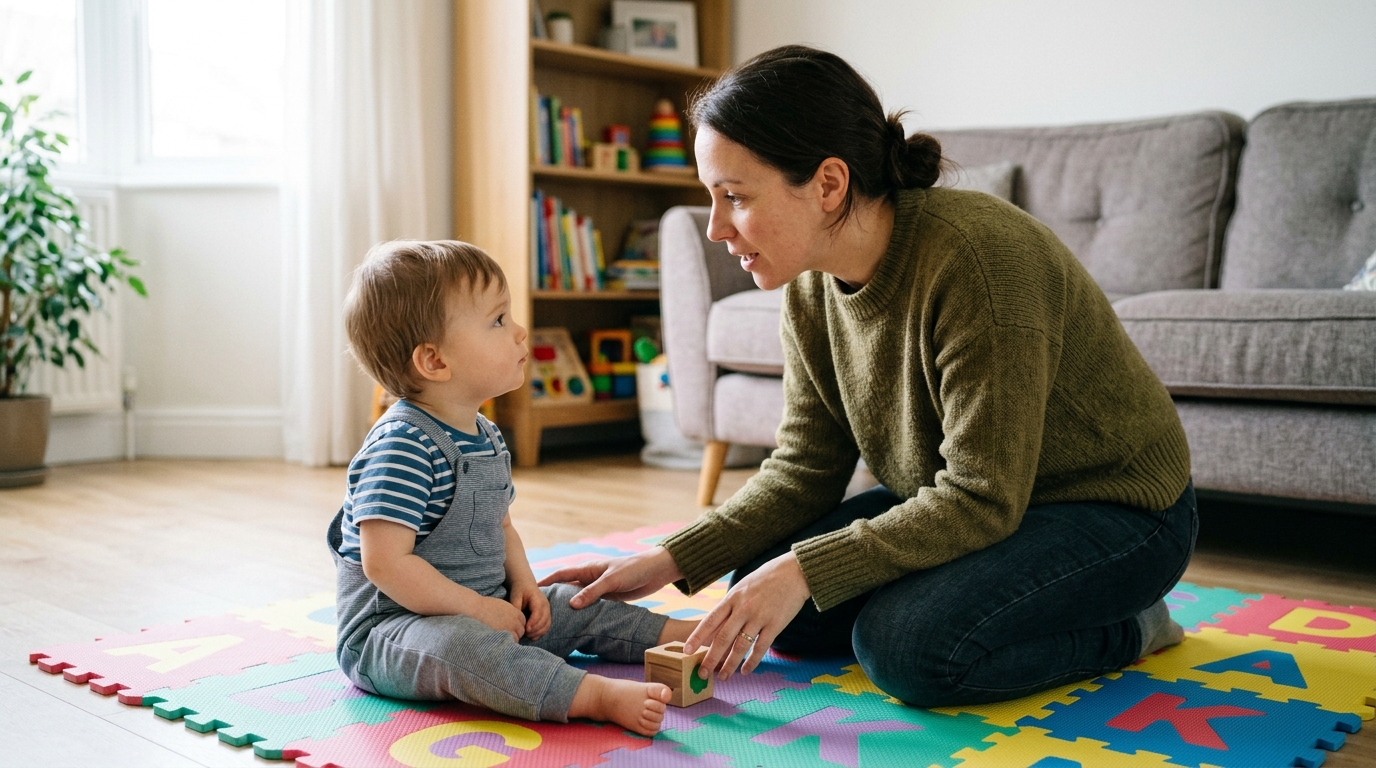
At 22 months my son had about 8 words. "Mama," "Dada," "ball," "more," "no," "dog," "milk," "bye." That was it. The neighbor's daughter at the same age had a hundred words and was singing songs. Every conversation at the playground felt like a slow public exposure of how behind he was.
I started asking the pediatrician at every appointment. She would gently say "I am not worried yet, but let's keep watching." That was a frustrating answer when I was worried. I started reading about speech delay at 3am. I started recording his words in a notes app, panic-counting. I considered private speech therapy. I considered everything.
By 2 and a half he had exploded into full sentences. By 3 he was talking nonstop. He had been a late talker, which is a known and usually harmless variant of normal language development.
If you are wondering whether your toddler should be talking more by now and whether you should worry, here are the actual speech milestones, the difference between a late talker and a real delay, and exactly when to ask for an assessment.
The actual speech and language milestones
The official milestones are wider than parenting books usually suggest. The range of normal is huge.
12 months
- 1 to 3 words
- Responds to her own name
- Babbles in long strings with intonation that sounds like sentences
- Points at things she wants
- Waves bye-bye
- Looks at you when you call her name
15 months
- 3 to 5 words
- Understands simple commands ("give me the ball")
- Points to objects when named
- Imitates sounds
18 months
- 10 to 25 words (the range is wide)
- Points to body parts
- Follows one-step directions
- Uses gestures (waving, clapping, blowing kisses)
- Names familiar objects
24 months (2 years)
- 50 to 200 words (yes, the range is that wide)
- Starts combining 2 words ("more milk," "Daddy go," "no want")
- Follows 2-step directions
- Asks simple questions
- Names common objects in pictures
- Speech is understood by parents about 50 percent of the time
30 months (2.5 years)
- 200 to 500+ words
- 3-word phrases regularly
- Uses pronouns (I, you, me)
- Speech is understood by parents about 75 percent of the time
36 months (3 years)
- 500 to 1,000+ words
- Sentences of 3 to 4 words
- Asks "why" constantly
- Tells simple stories
- Speech is understood by strangers about 75 percent of the time
The wide ranges at every age are not a mistake. Speech development genuinely varies hugely within the normal range.
What "normal late" looks like
Many toddlers are late talkers but completely typical otherwise. These are kids who have:
- A vocabulary at the lower end of normal for their age
- Good comprehension (they understand what is said to them)
- Good non-verbal communication (pointing, gestures, eye contact)
- Normal social interaction
- Normal play skills
- No other developmental concerns
About 1 in 7 toddlers fits the "late talker" profile at 18 to 24 months. Of these:
- Around 70 to 80 percent catch up on their own by age 3 or 4
- The rest may have a real language delay that benefits from therapy
The hard part is that you cannot always tell at 22 months which group your child is in.
The signs of a normal late talker
If your child is on the slower side of vocabulary but shows these signs, you are probably looking at a normal late talker, not a delay.
- She understands what you say (you can tell because she responds correctly)
- She points at things she wants and uses gestures
- She makes eye contact and engages socially
- She plays with toys appropriately (pretend tea party, putting cars in a row)
- She has some words and they are gradually increasing
- She tries to communicate with you in other ways (sounds, leading you by the hand)
- She enjoys being read to
- Her cognitive development seems on track
These children often catch up dramatically between 24 and 36 months. The "explosion" is real.
The signs of a possible speech or language delay
These signs warrant earlier assessment.
Signs to act on
- She is not responding to her name by 12 months
- She has no words by 16 months
- She is not pointing or gesturing by 18 months
- She has fewer than 10 words at 18 months
- She has fewer than 50 words or no 2-word phrases at 24 months
- She does not seem to understand simple questions
- She loses words she had before (regression)
- She is not interested in other people or social interaction
- She is not making eye contact during interaction
- Her play is repetitive or unusual (lining things up, intense focus on parts of toys)
- She does not respond to her name even though her hearing seems fine
- She is consistently behind on multiple milestones, not just language
The combination of language delay and any of the social or play concerns is more significant than language delay alone. (We covered some related territory in Is My Toddler's Separation Anxiety Normal.)
What to do if you are worried
The general principle: do not wait. Early intervention works. The earlier any real delay is addressed, the better the outcomes.
Step 1: See your pediatrician
Make a specific appointment to discuss speech, not just mention it at a routine visit. Be specific:
- "She has X words at Y months."
- "She is not yet doing Z."
- "I would like a referral for a speech evaluation."
A good pediatrician will not dismiss your concerns. If yours does and you are worried, get a second opinion or go directly to a speech therapist.
Step 2: Get a hearing test
Hearing loss is the single most common cause of speech delay and it is easy to miss. Many children with chronic ear infections have ongoing mild hearing loss that affects speech development.
A formal hearing test is usually free or low-cost and worth doing for any toddler with speech concerns.
Step 3: Speech therapy assessment
A speech-language pathologist (SLP) can do a formal assessment to determine whether there is a delay and what kind.
In the US:
- Early Intervention programs (under age 3) often provide free or low-cost assessments and therapy
- Private speech therapy is available but expensive without insurance
- Some public schools provide assessments
In the UK:
- The NHS provides speech and language therapy assessments via your GP referral
- Private speech therapy is available and faster
- Some children's centers offer free drop-in groups
Step 4: What therapy actually involves
Speech therapy for toddlers is mostly play-based. A typical session:
- The therapist plays with the child
- Models specific sounds or words during play
- Coaches the parent on techniques to use at home
- Tracks progress over weeks
Therapy is rarely intensive at this age. Often 30 to 60 minutes a week with parent coaching to do similar work at home daily.
The results often come faster than parents expect. A child seeing a therapist weekly may have a noticeable language jump within 2 to 3 months.
What helps at home regardless of professional assessment
Whether or not you pursue an assessment, these things support speech development in any toddler.
1. Talk constantly
Narrate your day. "Mommy is making toast. I am putting butter on the toast. Now I am cutting it into triangles."
This sounds odd at first. After a week it becomes automatic. Toddlers learn language from hearing it.
2. Slow down your speech
Speak slightly slower than normal. Use shorter sentences. Pause before key words. Make it easier for her to catch the sounds.
3. Read every day
Aim for 5 to 10 books a day at this age. Same books over and over is fine. Repetition builds vocabulary faster than variety.
Touch and feel books, lift the flap books, simple picture books all work.
4. Reduce background noise
Background TV, music constantly, and noisy environments make language harder to learn. Quiet times where she can focus on your voice support speech development.
(We covered the screen time question in detail in Does Screen Time Really Cause Speech Delays in Toddlers.)
5. Sing songs with actions
Songs with actions and hand movements engage multiple brain systems at once and support language. Old MacDonald, Wheels on the Bus, Twinkle Twinkle all work.
6. Wait before giving
When she points at something, wait a few seconds. Say the word ("milk?") and pause. Sometimes she will try to say the word. Even if she does not, she heard you label it.
7. Expand on what she says
When she says "ball," you say "yes, the red ball. The big red ball is bouncing."
This is called expansion and it is one of the most evidence-based parent techniques for language development.
8. Limit pacifier use during awake time
A pacifier in the mouth makes it harder to babble and form sounds. Save pacifiers for sleep when possible.
9. Reduce solo screen time
Especially under 2. Replace with conversation, books, and play. (Full picture in How Much Screen Time Is Actually Okay for Toddlers.)
10. Get her around other kids
Children learn language from peers as well as adults. Playgroup, daycare, family gatherings all provide language input she does not get at home alone.
What about bilingual homes
Children in bilingual homes sometimes appear to talk later because they are processing two languages. Research shows:
- Total vocabulary across both languages is usually normal
- The vocabulary in each language alone may appear smaller
- Mixed-language sentences are normal and not concerning
- Bilingual children are not at higher risk of true language delay
If your child is in a bilingual home and seems behind, talk to a speech therapist who specializes in bilingual development. They can assess across both languages.
When the "wait and see" approach is wrong
Some toddlers genuinely do catch up. Some do not. The hard part is that "wait and see" has a real cost when the delay is real.
If you are torn, lean toward earlier assessment. The downside of getting a speech evaluation when nothing was wrong is minimal. The downside of waiting and missing a window for early intervention can be significant.
A few situations where you should not "wait and see":
- Your gut is telling you something is off
- She is consistently behind on multiple milestones, not just speech
- She is regressing (losing skills she had)
- She is not socializing with you or other children
- There is a family history of language disorders or autism
- You can get a free or affordable assessment without much hassle
What to tell yourself at the playground
The other moms whose toddlers are talking more are not better moms than you. The child whose vocabulary is bigger is not smarter. Language development at this age is wildly variable and largely outside your control.
If your child is developing normally in other ways and her vocabulary is just on the slower side, the catch-up is probably coming. You can support it with the techniques above and wait without pretending it is not stressful.
If something feels off, trust your instinct and get the assessment. Early intervention works, and most kids who need it do significantly better than the same kids who do not get it until later.
Either way, you are paying attention. The fact that you are reading this article at 11pm is evidence of love, not failure. Most parents whose kids end up needing support are the same parents who noticed first. The noticing is the start of the help.
She will talk. The version of her that exists in six months is going to surprise you. Most late talkers find their words. So will yours.