
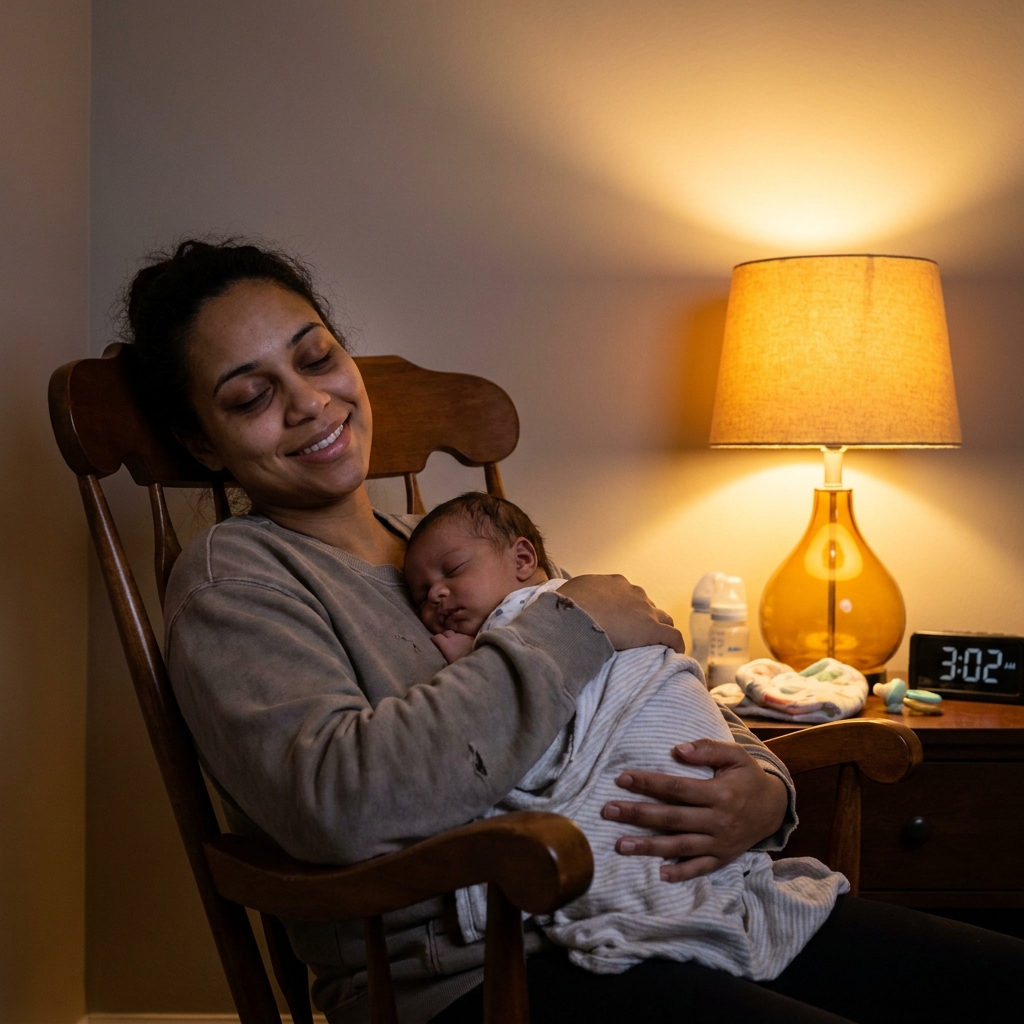
It's 1am. She's been screaming for 22 minutes. You can hear her on the monitor and you can also hear her through three walls. Your partner is on the bed next to you, eyes closed, but you both know neither of you is asleep.
You promised each other you'd give it ten minutes. Then ten more. The book you read said it would peak around minute 30 and then fade. You don't believe the book any more. You're not sure you believed it then.
Should you go in?
This is the cry-it-out question, and almost every parent who's tried it has had this exact 1am moment. There is no clean answer that fits every family. But there is good research, and there are honest things to say about what the method does and doesn't do.
What "cry it out" actually means
Cry it out is the most heavily-flamed version of a category of methods called extinction sleep training. The strict version, sometimes called Weissbluth extinction, asks parents to put a baby down awake at bedtime and not return until morning, regardless of crying. Almost nobody actually does this version.
What most parents mean when they say "cry it out" is the Ferber method, which is graduated extinction. You leave the room, then check in at gradually increasing intervals (3 minutes, then 5, then 10, then 12, etc) without picking the baby up. You comfort briefly, then leave again.
There's also gradual retreat (chair method), where you sit in the room and slowly move further away over a week or two. This is sometimes counted as cry-it-out by critics. It's much gentler.
The point is, "cry it out" is a wide range of approaches, not one thing.
What the actual research shows
There have been several decent studies on Ferber-style sleep training. The most cited:
A 2012 paper in Pediatrics (Price et al) followed 326 families who used graduated extinction or "camping out" from 7 months. At 12 and 24 months, there were no differences in behavioural outcomes, attachment, mental health, or cortisol levels compared to families who didn't sleep train. The kids slept better. The mothers reported less depression.
A 2016 trial in Pediatrics (Gradisar et al) found the same. Cortisol (the stress hormone) actually dropped over the course of the training week, not rose. No measurable harm.
A 2022 systematic review in Sleep Medicine Reviews covered roughly 30 sleep training studies and found consistent benefits for infant sleep, parent mood, and parent-infant relationship, with no evidence of long-term harm.
So the headline: under 6 months, the research is thin and most experts say wait. From around 6 months, with a healthy baby and a consistent method, there is no good evidence that graduated extinction harms babies.
What the research can't tell you is whether it's right for your baby and your family. Numbers can describe a population. They can't describe the kid in the next room.
What cry-it-out works for
In honest terms, cry-it-out helps when:
- The baby is at least 6 months old, healthy, and gaining weight well
- The night wakings are mainly about how she falls asleep, not about hunger or illness
- The parents are at the absolute end of what they can sustain
- Both parents agree on the plan (this matters more than people think)
- The household can stay consistent for at least 7 to 14 nights
It often does not work, or causes more pain than it solves, when:
- The baby is under 6 months
- There's a recent illness, teething flare, or major life event
- One parent is reluctant or hasn't really agreed
- The "method" gets abandoned at minute 32, then started again the next week, then abandoned again
- The crying lasts more than 60-90 minutes a night with no improvement after 5-7 nights
What the research doesn't capture
There are some honest things the studies can't measure.
- How it feels to listen to her cry. The research will tell you no measurable cortisol increase in the baby. It will not tell you what it does to your cortisol. For some parents, that's a non-issue. For others, the emotional cost is real and worth weighing.
- How your relationship handles it. Two exhausted parents who agree on the plan will get through cry-it-out fine. Two exhausted parents who disagree often come out of the week with a relationship problem on top of the sleep problem.
- Cultural and family pressure. If your mum, your aunties, and your grandmother all think cry-it-out is cruel, you will not feel supported through it. That's part of the calculation.
The gentle alternatives
If cry-it-out feels wrong for your family, there are gentler approaches that also work, just slower.
- Chair method. Sit by the cot until she sleeps, then move the chair a foot further away every few nights. Takes about three weeks. Lots of parents find this is the right trade-off between night-time peace and waiting it out.
- Pick-up, put-down. When she cries, pick her up only long enough to calm, then put her back down. Repeat. Takes a few nights of physical labour but no extended crying.
- Just waiting. Many babies start sleeping longer stretches between 9 and 14 months without any training, if you can outlast the regression.
None of these are "better" than cry-it-out. They're different trade-offs of time, emotional cost, and consistency.
How to actually make the decision
If you're stuck, three questions tend to settle it.
1. Can both of us commit to this method for seven nights without changing tack? If no, pick a different method. 2. Is our baby older than 6 months and basically healthy? If no, wait. 3. Will we regret this in five years? Most parents don't. The parents who do are almost always the ones who were pressured into a method that didn't feel right to them by partners, family, or sleep consultants.
There is no version of this that doesn't involve some hard. The question is which kind of hard suits your family.
What you actually need to hear at 1am
If she's crying right now and you're reading this on your phone in bed: it is fine to go in. It is fine to stay out. There is no version of this where doing the next 90 seconds the "right" way will define her as a person. She will be fine either way.
You are not weak if you can't do it. You are not cruel if you can. The parents who get through this and look back happy are not the ones who picked the perfect method. They are the ones who picked one and stayed steady.
Whatever you choose tonight, choose it together. Stay kind to each other. And try, if you can, to sleep when she sleeps.
She is going to learn to sleep. So are you.