
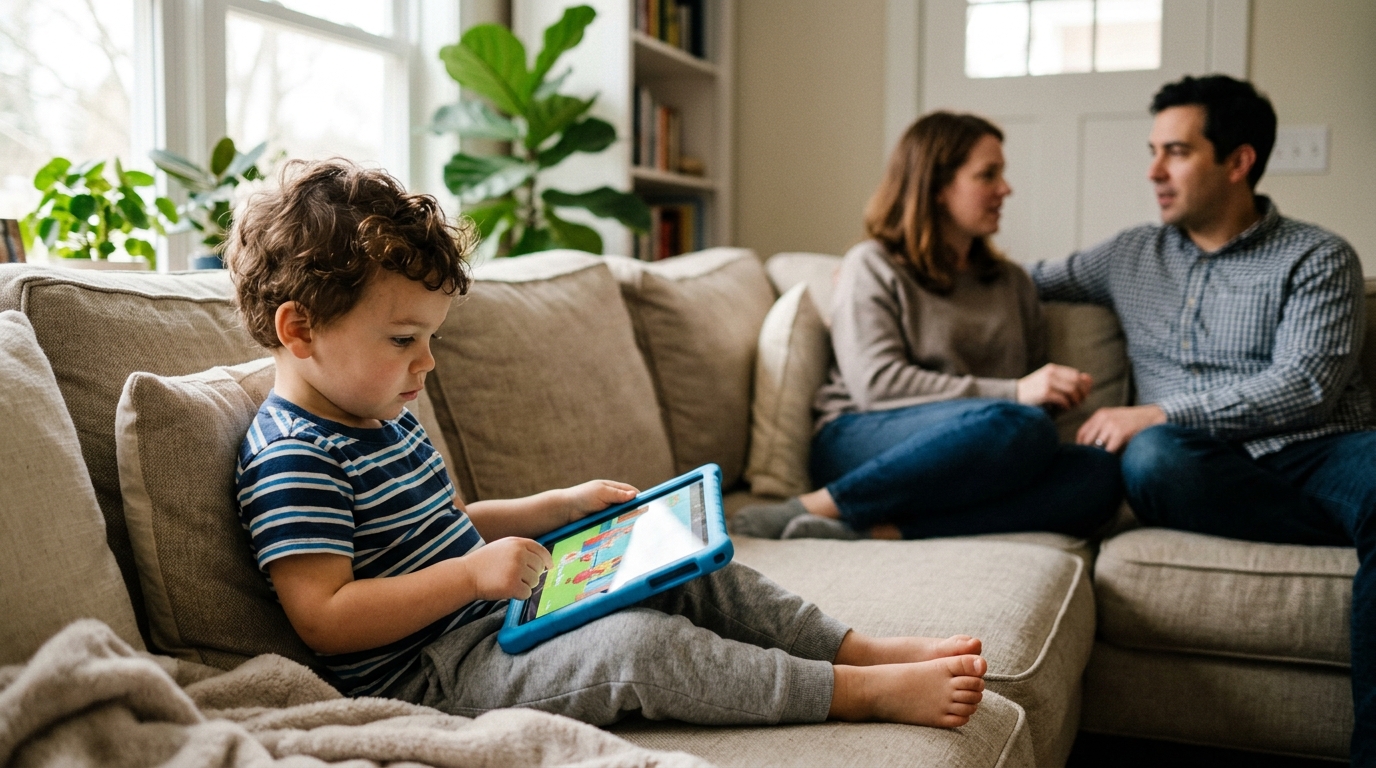
At my daughter's 2-year check, the pediatrician asked how many words she had. I said somewhere around 50. The pediatrician said that was on the lower end of the normal range. Then she asked, in a slightly meaningful tone, how much screen time we did.
I went home and started anxiously googling "screen time speech delay toddlers" at 11pm. The first 10 results said different things. The headlines were dramatic. Some said any screen time at all caused language delays. Others said specific kinds of content were fine. The American Academy of Pediatrics had one set of guidelines. The World Health Organization had another. The actual research was buried under a hundred opinion pieces.
If you are worried about your toddler's screen time and what it might mean for her speech, here is the honest version of what the research actually shows, what kinds of screen time matter more than others, and what to do.
What the research actually shows
The relationship between screen time and toddler speech development is real but more specific than the headlines suggest. The clearest evidence.
The volume effect
Multiple studies have found a dose-response relationship: more daily screen time is associated with smaller vocabulary and lower language scores at age 2 to 3.
The specific numbers:
- A 2019 meta-analysis found that for every additional 30 minutes of daily screen time, expressive vocabulary scores dropped slightly
- A landmark Canadian study (2020) found that toddlers watching more than 2 hours of screens daily were 6 times more likely to have language delays than toddlers watching less than 30 minutes
- A 2023 Japanese study of over 7,000 toddlers found 2+ hours of daily screen time at age 1 was associated with delayed communication skills at ages 2 and 4
The effect is real. The size of the effect depends on the amount.
The type of content effect
Not all screen time has the same effect.
- Background TV (the TV on while no one is actively watching) has the strongest negative effect, even more than direct viewing. It reduces the amount of conversation in the home and the language input the toddler receives.
- Educational content has mixed effects. Programs designed for toddlers (Bluey, Sesame Street, Daniel Tiger) have small positive language effects when watched with a parent. Watched alone, the effects are smaller or neutral.
- Fast-paced cartoons (Cocomelon, the high-stimulation content designed to keep attention) are associated with worse outcomes than slower content.
- YouTube auto-play (where the algorithm keeps serving content) is associated with worse outcomes than chosen content with breaks.
- Video calls (FaceTime, Zoom with grandparents) are associated with neutral or positive effects, because they involve real-time interaction.
The displacement effect
Screen time is bad for language development partly because of what it replaces. Time on a screen is time not spent:
- Talking to parents
- Playing with objects
- Imitating sounds and actions
- Reading books with an adult
- Playing with other children
If a child is on screens 3 hours a day, that is 3 hours of language-building activities they did not do.
Co-viewing matters
The single biggest moderator of screen time effects is whether a parent is present and interacting. A toddler watching Bluey alone has different language outcomes than a toddler watching Bluey with a parent who points out colors, asks questions, and connects what is happening to her own life.
The 30 minutes of co-viewed content is roughly equivalent (linguistically) to 30 minutes of book reading. The 30 minutes of solo viewing is not.
The official guidelines
American Academy of Pediatrics (AAP)
- Under 18 months: No screens except video calls
- 18 to 24 months: Limited high-quality programming, only with a parent present
- 2 to 5 years: Maximum 1 hour per day of high-quality content, ideally with a parent
World Health Organization (WHO)
- Under 1 year: No sedentary screen time
- 1 to 2 years: No sedentary screen time recommended (some now suggest no more than 1 hour as a maximum)
- 2 to 4 years: No more than 1 hour per day
What this means in practice
The official recommendations are stricter than most real-world households can sustain. The aim of the guidelines is to push families toward lower amounts and higher-quality content, not to make parents feel they have failed if they exceed the limit some days.
How much is too much?
A practical framework that fits the research.
- Up to 30 minutes a day of co-viewed quality content: very little measurable risk to language
- 30 to 60 minutes a day, mix of co-viewed and solo: small risk that grows with more solo content
- 1 to 2 hours a day: moderate risk, especially if solo and fast-paced
- More than 2 hours a day: significant risk, especially under age 3
- Background TV constantly: significant risk regardless of foreground screen time
The exact "right" amount depends on your child, your family circumstances, and what kind of content. (For more on toddler development boundaries, see How to Set Boundaries With a Clingy Toddler.)
How to tell if screen time is affecting your toddler
The honest signs that screen time is having a negative effect.
- Vocabulary is below the average for her age (around 50 words by 2, 200+ by 2.5, simple sentences by 3)
- She struggles to focus on a book or quiet activity for more than a few minutes
- She melts down when screens are turned off (some pushback is normal, full meltdowns are a sign)
- She is not babbling or trying to communicate without screens
- She prefers screens over interactive play
- She is not pointing, gesturing, or making eye contact in social moments
- She seems irritable or withdrawn after long screen sessions
If any of these are happening and screen time is more than 30 minutes a day, reducing screen time is often the first intervention to try before doing anything else.
(If you are worried about speech development specifically, see My Toddler Is Not Talking Yet: Should I Be Worried.)
How to reduce screen time without a war
Once screen time has become a habit, reducing it can be hard. A few things that work.
Replace, do not just remove
The biggest mistake is taking away screens with nothing in their place. The toddler is bored, frustrated, and you are right back where you started.
Replace with:
- A new toy rotation (rotate toys weekly so they feel fresh)
- A sensory bin (dried rice, beans, water beads)
- Play dough sessions
- Outdoor time
- Audio stories or music (much less harmful than screens)
- Backyard or park time
Set screen time to specific moments
Random screen time as needed often becomes more than you intended. Try fixed slots:
- 30 minutes after lunch (while you have your coffee)
- 20 minutes during dinner prep
- 20 minutes after a meltdown to reset
Predictable timing reduces the constant negotiation about screens.
Use a visual timer
Toddlers do not understand "10 more minutes" but they understand a sand timer or a visual countdown. Set the timer at the start of screen time. When it ends, screens off.
Build in transitions
The transition from screen to no-screen is the hardest part. Have a specific bridge activity:
- A snack at the table after screens off
- A specific song that signals it is over
- A clear next activity ("now we are going to the park")
The transition is more important than the time limit itself.
Lead by example
If you are on your phone constantly, your toddler is going to want screens too. The single biggest predictor of toddler screen time is parent screen time.
Put your phone in a drawer when you can. Make screen time a parallel family activity, not a way to keep the child quiet while you scroll.
What about Cocomelon specifically
Cocomelon comes up in every conversation about toddler screens. The honest take.
Cocomelon is engineered to maximize attention. The pacing, color changes, sound effects, and rapid scene cuts are all designed to keep toddlers watching. This is not accidental. The result is content that holds attention far better than other shows but may also overstimulate developing brains.
The research on Cocomelon specifically is limited, but research on similar fast-paced content shows:
- Reduced attention span in the hour after watching
- Higher meltdowns when turned off
- Lower engagement with slower activities afterward
Most child psychologists recommend avoiding Cocomelon and similar high-stimulation content for under 4s, especially in unlimited amounts. Slower paced shows (Bluey, Daniel Tiger, Mister Rogers, Sesame Street) are better choices when you do use screens.
What about iPads vs TV
Some research suggests interactive screens (iPads, phones, video games) have stronger effects on attention and behavior than passive TV viewing, especially because of the dopamine response to swiping and tapping.
For toddlers, TV on a wall (slower-paced, no swiping) is generally a better choice than a tablet in their hands.
What I would tell my younger self at the 2-year check
The pediatrician was right to ask. Screen time matters. But she was also right to ask gently. We were not failing. We were doing 45 minutes a day of mostly Bluey, sometimes with one of us watching alongside.
I reduced it to 30 minutes a day. I replaced one of the screen sessions with a sensory bin. I started narrating more during the day. I read more books. I put my phone down more often.
By her 2.5-year check, she had 250 words and was making 3-word sentences. The pediatrician said all was well. The screen time was probably not the only factor (developmental timing matters a lot at this age) but reducing it did not hurt.
You are not a bad mom for using screens. You are not a bad mom for sometimes using more than the guidelines suggest. Modern parenting includes screens. The goal is to use them thoughtfully, not to eliminate them.
If your toddler's language is on track and she is engaged with the world, a moderate amount of screen time is fine. If her language is behind or her behavior is changing, reducing screens is often the highest-leverage thing you can do.
Either way, you are figuring it out. That is what mothering is.