
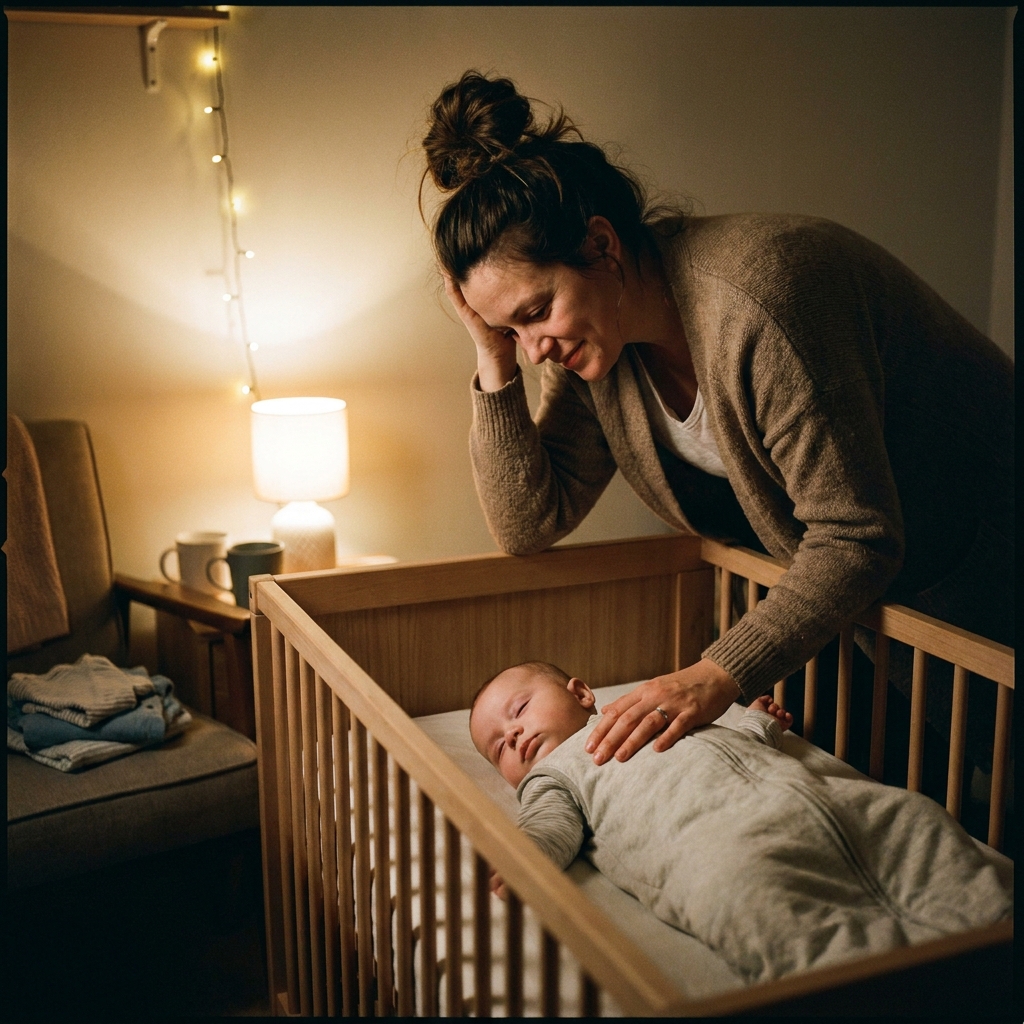
The official advice is do not co-sleep. The actual reality is that around 60 percent of new mums fall asleep with their baby in bed at some point in the first three months, and most of them do it while breastfeeding at 3am.
The dangerous version of co-sleeping is the unplanned version. Mum is exhausted, falls asleep on the sofa with the baby on her chest, baby slides into the gap between mum and the cushion. The deaths most often associated with co-sleeping happen in this specific scenario, not in a properly set-up bed.
If you are going to do it (and statistically you are), then knowing the actual rules makes it dramatically safer. Here is what the current evidence says, sourced from UNICEF Baby Friendly UK and the Academy of Breastfeeding Medicine.
What the safe sleep guidance actually says
There are two different versions of co-sleeping in the public conversation, and confusing them is what makes the advice feel contradictory.
Room sharing (baby in a separate cot or crib next to your bed): recommended for at least the first 6 months by every major paediatric body. Reduces SIDS risk by around 50 percent compared to baby in their own room.
Bedsharing (baby actually in your bed with you): officially not recommended in the UK or US, but the recommendation comes with major caveats that often get lost. The Lullaby Trust and UNICEF both publish "safer bedsharing" guidance specifically because they know parents will do it anyway.
When people say "the world co-sleeps," they mean bedsharing. When governments say "do not co-sleep," they often mean a mix of both. The conversation is messier than it needs to be.
When bedsharing is never safe
Some situations dramatically increase the risk of sudden infant death and should rule out bedsharing entirely. These are not negotiable.
- Either parent has drunk alcohol, taken sleep medication, or taken any recreational drug
- Either parent smokes (even if not in the bedroom, the effect on baby sleep arousal is persistent)
- The baby was born premature (before 37 weeks) or weighed under 2.5 kg at birth
- The baby is younger than 3 months and you are not breastfeeding (formula-fed babies under 3 months have higher SIDS risk in bedsharing situations)
- You are sleeping on a sofa, recliner, armchair, or any surface that is not a flat firm bed
- The bed has heavy duvets, fluffy mattresses, memory foam, or lots of pillows
- You are unusually exhausted (after surgery, with a fever, or sleep-deprived to the point you cannot wake quickly)
If any of these apply, the baby goes in a separate cot, no exceptions. The most dangerous scenarios in co-sleeping deaths almost always involve one of these factors.
The 7 rules that make bedsharing safe
If none of the above apply and you have made an informed decision to bedshare, these are the conditions that the evidence shows make it as safe as possible.
1. The C position (cuddle curl)
Lie on your side facing the baby. Knees bent up, lower arm tucked under your head or pillow, top arm curled around the baby's body. Your body should form a C-shape around the baby. This is the position breastfeeding mothers naturally adopt in deep sleep and it physically prevents you from rolling onto the baby.
The baby is at the level of your breast, not your face. Babies should never be higher up the bed where they can end up under pillows.
2. Firm mattress, flat surface
The mattress should be firm enough that pressing into it leaves only a slight indent. Soft mattresses, especially memory foam, increase suffocation risk because the baby's face can sink into the surface.
3. No duvets or pillows near the baby
Use the duvet only up to your waist. Push pillows away from the baby. The baby should sleep in a baby sleeping bag or in a light sleeveless suit, not under your duvet.
The single most common factor in bedsharing deaths is bedding around the baby's face.
4. The baby sleeps on their back
Always. Even in bedsharing. Side sleeping and tummy sleeping increase SIDS risk regardless of where the baby is sleeping.
5. The baby is between mum and the edge of the bed (or in the middle of two adults if both are co-sleep aware)
Babies must not sleep next to walls, headboards, between mattress and wall gaps, or where they can fall off the bed. The Lullaby Trust recommends a bed rail or a flat surface against the bed (not the wall, leave at least a 2-inch gap or close it completely).
If two adults are in the bed, both must agree to and understand co-sleeping. A partner who is not actively aware will not have the same protective reflexes around the baby.
6. No long hair loose, no jewellery, no cords
Long hair tied back. Necklaces and bracelets off. Dressing gown ties, hood drawstrings, anything cord-like nowhere near the bed.
7. The room temperature is between 16 and 20 degrees Celsius
Slightly cooler than your normal preference. Babies overheat fast when sleeping close to a parent's body heat. Overheating is one of the modifiable risk factors for SIDS.
Why breastfeeding mothers bedshare safely more often
The data is striking. Breastfeeding mothers who bedshare in the safe configuration have very low SIDS rates, comparable to babies sleeping in cots next to the parents' bed. Formula-feeding mothers who bedshare have measurably higher rates.
The proposed reason: breastfeeding triggers different sleep patterns in the mother. Breastfeeding mothers naturally adopt the C position, wake more frequently during the night (matching the baby's wake cycles), and have a heightened awareness of the baby's position even in deep sleep. Formula-feeding mothers do not get the same hormonal trigger for this kind of light, baby-aware sleep.
This is not a moral judgement. It is a practical reason why the safer-bedsharing guidance specifically references breastfeeding throughout.
The sidecar setup (a real alternative)
If bedsharing feels too uncertain but you also do not want the baby in a separate room, a sidecar crib is the compromise that gives you most of the benefits of both.
A sidecar crib (sometimes called a co-sleeper or bedside crib) attaches to the side of your bed at the same mattress height with one side dropped down. The baby is in their own protected space but is at arm's length for feeds without you having to fully wake up.
The most popular brands in the UK are SnuzPod, Chicco Next2Me, and BabyBjorn Cradle. Most last 6 to 9 months before the baby outgrows them. They are the single most useful piece of newborn kit we owned.
What to do if you fall asleep accidentally
This is the most important practical scenario. You are feeding at 3am, you are exhausted, and you are about to nod off whether you mean to or not.
If you are in your bed in a safe sleep setup (firm mattress, no duvet near baby, C position): you have made the bed already safer for accidental fall-asleep. Falling asleep there is not a disaster.
If you are on the sofa, armchair, recliner, or anywhere except a properly set-up bed: this is the dangerous version. Before you start the feed, decide where the baby will end up if you fall asleep. Either feed in bed in safe conditions, or have your partner present to take the baby the moment you start to drop.
Sofa sleeping with a newborn has 50 times the SIDS risk of safe bedsharing. This is the single most important distinction to know.
What to tell yourself at 3am
Co-sleeping is not the moral failing it sometimes gets framed as. Half the world does it. The version that is dangerous is the unplanned, exhausted, on-the-sofa, after-a-glass-of-wine version. The version that is in line with how humans have slept with babies for thousands of years is the planned, sober, breastfed, safe-bed version.
If you have read this and decided to bedshare in safe conditions, you are not doing anything irresponsible. You are making an informed choice with the same evidence the public health bodies use, applied to your actual situation.
And if you have read this and decided you do not want to bedshare, that is also right. Get the sidecar crib. Feed in the chair. Move the baby back to the crib after every feed. There is no single correct way.
Whatever you choose, the goal is the same: a baby who sleeps safely, a mother who sleeps enough to function, and a setup that you can actually maintain for the months that this stage lasts.
You are doing fine.