
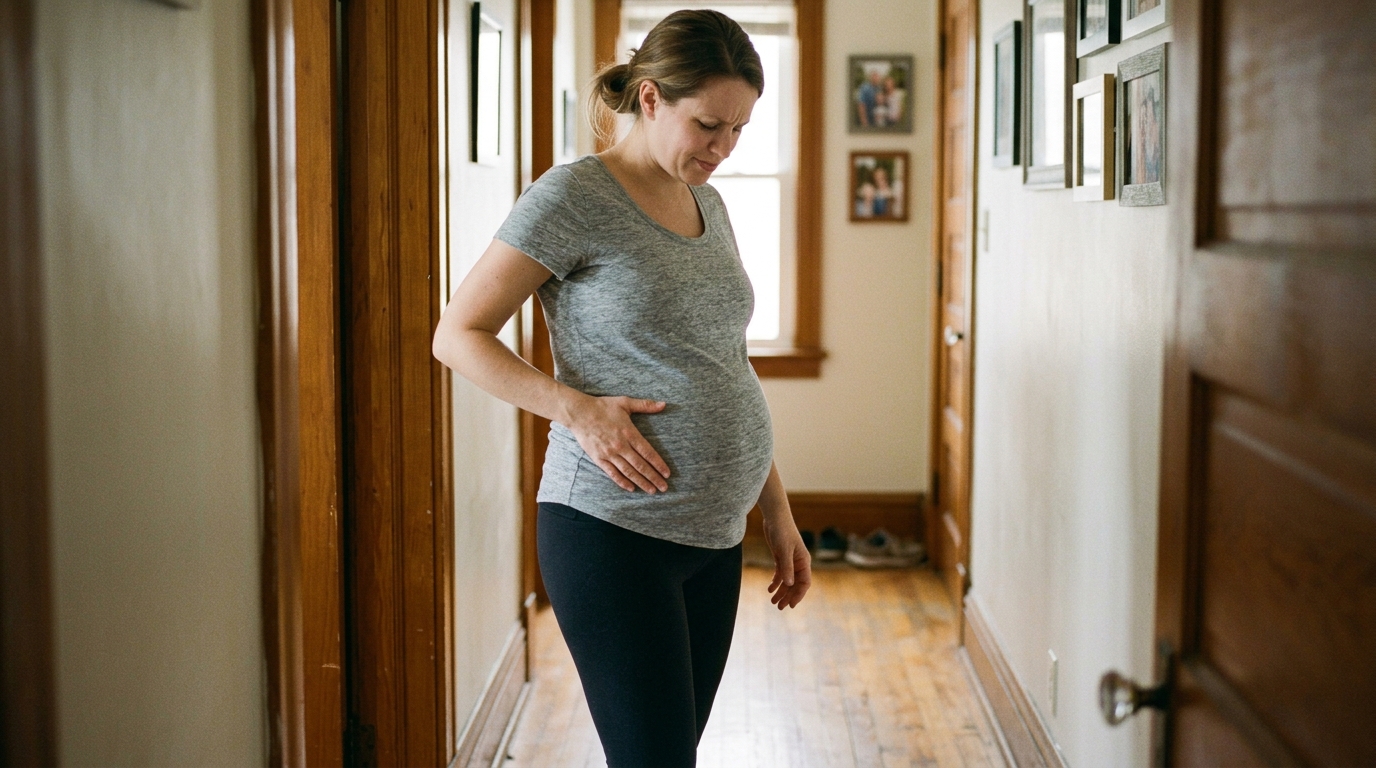
I was about 18 weeks along, standing at the kitchen sink, when I turned too fast to grab the ringing phone and a sharp pull shot down the right side of my bump. It felt like someone had plucked a tight rubber band deep inside my belly. I grabbed the counter and froze, half convinced something was wrong. Then, maybe ten seconds later, it just faded like nothing happened.
If you have felt that quick, stabbing tug low on your bump and had your heart drop, I want to put your mind at ease. Round ligament pain in pregnancy is one of the most common aches of the second trimester, and it caught me completely off guard because nobody had mentioned it. This post walks you through what round ligament pain actually feels like, why it happens, the positions and moves that ease it, what makes it worse, and the warning signs that mean you should call your midwife instead of waiting it out.
What round ligament pain in pregnancy feels like
Round ligament pain in pregnancy has a very specific personality once you know it. It is sharp and quick, more of a stab or a strong pull than a steady ache. It usually shows up low on the bump, on one side or both, often the right, and it can shoot down toward your groin.
The biggest clue is the timing. It tends to hit when you move suddenly. Rolling over in bed, standing up fast, sneezing, coughing, laughing hard, or getting out of the car. Mine almost always came from twisting quickly. And here is the reassuring part. It is brief. A few seconds, maybe up to a minute, and then it eases off. It does not build, it does not come in a rhythm, and it does not stick around for hours.
Most mamas start noticing it in the second trimester, somewhere between 14 and 27 weeks, as the bump grows heavier. It can carry on into the third trimester too. If your pain is dull and constant, or low and rhythmic, that is a different thing, and I will get to when that matters further down.
A quick, sharp pull that fades in seconds is the classic signature of round ligament pain.
Why round ligament pain happens
You have two round ligaments, one on each side, and their job is to hold your uterus in place inside your pelvis. Before pregnancy they are short and fairly relaxed. As your baby and uterus grow, these ligaments have to stretch, sometimes to several times their original length. That is a lot of change for a band of tissue.
When you move quickly, the ligament stretches or contracts faster than it comfortably can, kind of like a rubber band snapping taut. That fast pull is the stab you feel. It is not the baby, it is not your cervix, it is just a support structure being asked to do a big job in a short time.
Knowing the mechanics genuinely helped me panic less. Round ligament pain in pregnancy is your body stretching to make room, not a sign that anything is going wrong inside. It is uncomfortable, but it is a normal part of the second trimester for a lot of us.
Positions and moves that ease it
Once I understood what was happening, I found a handful of things that took the edge off. None of them are complicated, and most are about slowing down and giving those ligaments a break.
- When a pull hits, bend toward the pain. Flexing your hip and leaning into the sore side takes tension off the ligament and shortens the sharp moment.
- Move slowly and give your body a heads up. Before you stand, sit up, or roll over, pause for a beat. Sudden is the enemy.
- Roll over in bed like a log. Keep your knees together and turn your whole body as one unit instead of twisting your belly.
- Support the bump when you sneeze, cough, or laugh. A hand under the bump or a gentle bend at the hips before a big sneeze can head off that jolt.
- Try a warm bath or a warm compress low on your belly. Warmth helps the muscles and ligaments relax. Keep it warm, not hot.
- Change positions when the ache lingers. If sitting aggravates it, stand and walk gently. If standing does, sit and put your feet up.
A pregnancy support belt helped me later on too, since it takes some of the weight off those ligaments during the day. And gentle movement, like prenatal stretching or a slow walk, kept everything from getting stiff. If you are dealing with more than one kind of ache right now, my post on pregnancy back pain in the third trimester has more on supporting your changing body as the weeks go on.
What makes round ligament pain worse
Just as some things ease it, a few things reliably set it off. Once I knew my triggers, I could get ahead of them.
- Sudden movements. Jumping up from the sofa, spinning to catch a toddler, hopping out of bed. Speed is the main culprit.
- Overdoing it. A long day on your feet, too much walking, or heavy lifting leaves those ligaments tired and touchier.
- Being still too long and then moving fast. Stiff ligaments protest more, so ease into that first move after sitting a while.
- Dehydration and general muscle fatigue can make everything feel more sensitive, so keep your water bottle close.
None of this means you have to move through pregnancy like glass. It just means a little warning to your body before big movements goes a long way. Swollen, achy legs can pile on top of all this too, and if that is you, swollen feet in pregnancy covers what helped me on the days my whole lower half felt heavy.
When to call your midwife instead
This is the part I want you to actually remember, because knowing the difference is what lets you relax about the normal twinges. Round ligament pain is quick, sharp, movement-related, and gone in under a minute. It does not come with other symptoms.
Call your midwife or doctor, or go in to be checked, if your pain is anything other than that. Specifically:
- Pain that is regular or rhythmic, coming and going in a pattern. That can be a sign of contractions, especially before 37 weeks, and needs checking.
- Pain that is severe, constant, or does not ease when you rest and change position.
- Any bleeding or fluid leaking from your vagina, even a small amount.
- A fever, chills, or feeling generally unwell alongside the pain.
- Pain with burning or stinging when you pee, which can point to a urinary or kidney infection.
- Strong cramping low in your belly, lower back pressure that builds, or more than four or five tightenings in an hour.
- Reduced movement from your baby, or a gut feeling that something is not right.
I am a mom sharing what I have lived and researched, not a medical professional, so please treat your own instincts as the final word here. In my second pregnancy I had a pain that felt off, more constant and lower than my usual twinges, and I called the midwife. It turned out to be a mild urinary infection caught early, and I was so glad I did not just assume it was ligaments. You never lose anything by making the call. A good midwife would far rather reassure you than have you sit at home worrying.
The takeaway
Round ligament pain in pregnancy is that sharp, fast pull low on your bump when you move too quickly, and for most of us it is a completely normal part of the body stretching to make room. Slow your movements, bend into the pain, support your bump, and use warmth and pillows to take the edge off.
Keep the warning signs in your back pocket so you can tell a harmless twinge from something that deserves a phone call. That knowledge is what let me get on with my day instead of holding my breath every time I stood up. You have got this, and your body knows what it is doing.