
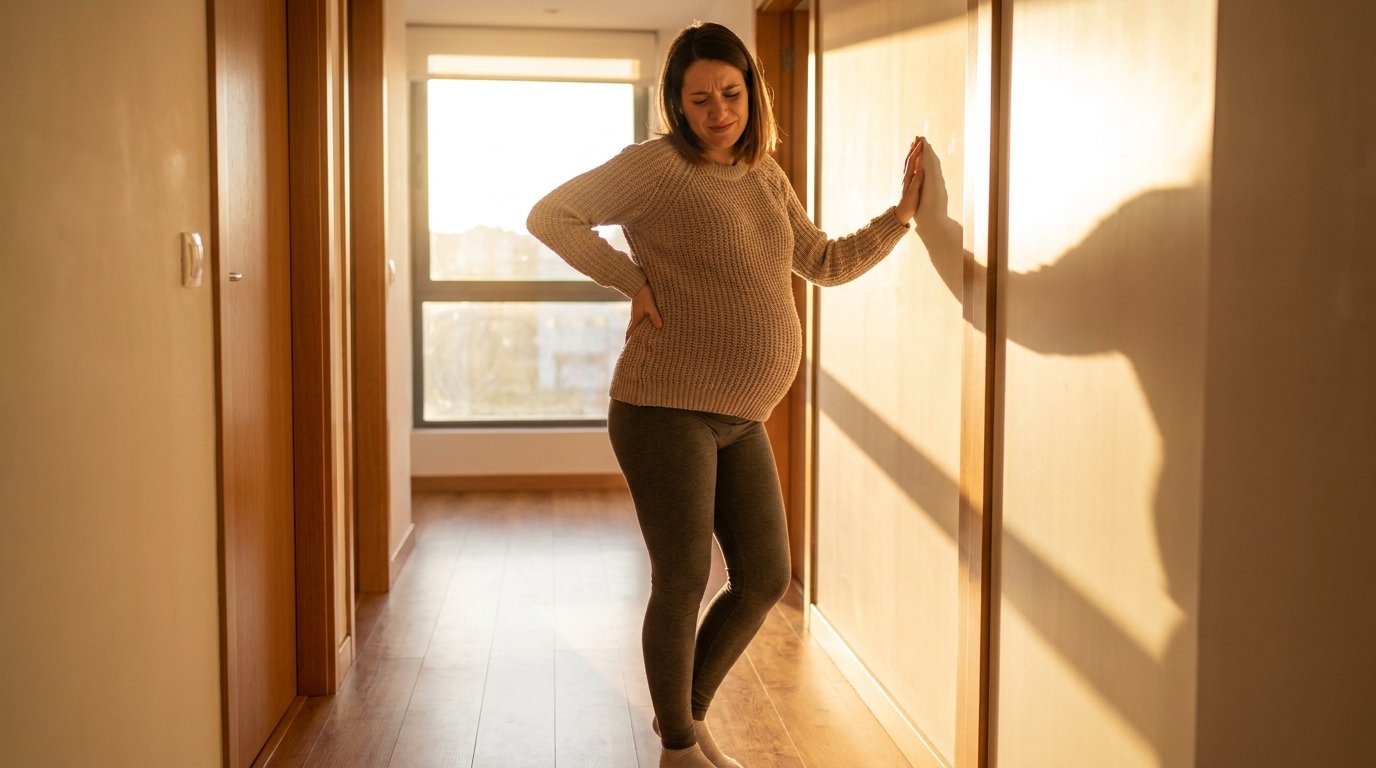
At 32 weeks I sneezed and could not stand up straight for twenty minutes. The pain went from my lower back through my hip and down the back of my leg, and for a moment I genuinely thought something had given way. By the next morning it had dulled to a constant ache that made every chair the wrong chair and every position the wrong position.
That was sciatica. About 1 in 3 third-trimester pregnant women get it. Add in regular lower back pain, pelvic girdle pain, and the general structural complaints of carrying a small person in the front of your body, and you get the statistic that around 70 percent of pregnant women have meaningful back pain by week 35.
Here is what is actually causing it and what genuinely helps. I tried most things on the standard list. Some were useless. A few worked.
What is happening in your back
Three things stack on each other in the third trimester to produce back pain.
Relaxin. A pregnancy hormone called relaxin softens the ligaments throughout your body to allow the pelvis to expand for birth. The ligaments in your lower spine and pelvis become looser too, which makes them less supportive. Joints move in ways they were not designed to.
Centre of gravity shift. As the baby grows in front of you, your centre of gravity moves forward. Most pregnant women unconsciously compensate by leaning slightly backward, which puts strain on the lower back muscles and compresses the lumbar spine.
Weight gain plus uterus pressure. By 35 weeks the uterus weighs around 5kg. It presses on the lower back from inside, on the pelvic muscles, and sometimes directly on the sciatic nerve (the largest nerve in the body, which runs from the lower back through the buttock and down each leg). When the uterus or baby pushes on the sciatic nerve, that is sciatica, and it produces the classic shooting pain or numbness down one leg.
None of this is fixable. The baby has to stay where the baby is. What you can change is how you manage it.
What actually helps pregnancy back pain in the third trimester
After trying everything, these are the ones that genuinely made a difference. In rough order of impact.
A proper pregnancy support belt
The single highest-impact buy of the third trimester for me. A pregnancy support belt or bump band (Serola, Belly Bandit, GabriallaSupport are commonly recommended) wraps around your lower back and under the bump, lifting the weight of the bump slightly and supporting the lower back. The relief is often immediate.
Wear it for the times you are on your feet: walking, cooking, anything where you are standing or walking for more than 15 minutes. Take it off when sitting or lying down. Not for night use.
Around £20 to £40. Worth every penny.
Sleep on your left side with a pregnancy pillow
Your sleeping position matters more than almost any other intervention.
- Side sleeping, ideally left, which is best for blood flow to the placenta
- A pillow between your knees to align the hips
- A pillow under the bump to support its weight
- A wedge pillow against your back to stop you rolling onto it
A full body pregnancy pillow (Sleepybelly, Theraline, Bbhugme are popular) does all of this in one piece of equipment. Around £40 to £100, and it dramatically reduces morning back pain.
Daily prenatal yoga or pelvic floor exercises (15 minutes)
This is the one most people skip because it sounds like more work. It is the one with the most consistent evidence.
YouTube has free prenatal yoga classes that work specifically on the muscles that support the lower back and pelvis. 15 minutes a day for two weeks visibly reduces pain. Search for "third trimester prenatal yoga back pain." Yoga with Adriene, Sarah Beth Yoga, and Pregnancy and Postpartum TV have good free options.
If yoga is not your thing, basic pelvic tilts and cat-cow stretches done on the floor for 5 minutes morning and evening hit the same muscles.
Warm bath or shower
Heat genuinely works for muscle tension. A 15 minute warm bath (not hot, hot is not safe in pregnancy) or warm shower with the water aimed at the lower back relaxes the muscles enough to interrupt the pain cycle.
Avoid heat directly on the bump or for very long sessions. Body temperature above 39 degrees C is not advised in pregnancy. Warm bath, not hot tub.
Pelvic floor physiotherapy
If pain is significant enough to limit daily activities, a pelvic floor physio (in the UK you can self-refer to NHS women's health physio in many areas, or pay privately) can give you targeted exercises and hands-on treatment.
This is dramatically more effective than generic advice. Most women who see a pelvic floor physio in pregnancy say they wished they had gone sooner.
Paracetamol when you need it
Paracetamol is the only standard pain relief considered safe throughout pregnancy. Up to 1g (two tablets) every 4 to 6 hours, maximum 4g in 24 hours.
Avoid ibuprofen and all NSAIDs after week 20 (they reduce blood flow to the baby's kidneys). Avoid co-codamol and stronger painkillers without specific advice from your GP or midwife.
A dose of paracetamol an hour before bed often makes the difference between sleeping and not.
What helps with sciatica specifically
If the pain is shooting down one leg rather than just sitting in your lower back, that is sciatica and a slightly different toolkit applies.
- The piriformis stretch: lie on your back, cross the painful-side ankle over the opposite knee, gently pull the opposite thigh toward your chest. Hold 30 seconds. Repeat 3 times. Do twice a day.
- The pigeon pose modified: in prenatal yoga, this opens the hip and reduces sciatic nerve pressure.
- Avoid sitting still for long periods. Sciatica is worse when you sit. Get up every 30 minutes.
- Use a wedge cushion for the car to reduce direct pressure on the sciatic nerve.
- Sleep on the non-painful side to keep weight off the affected nerve.
- Swimming or aqua-natal classes are extremely effective. The water unloads the joints and the gentle movement is anti-inflammatory.
If sciatica is severe, see a pregnancy-trained chiropractor or osteopath. Both are widely available privately and produce consistent results. NHS pelvic floor physio is the slower but free equivalent.
What does not help (mostly)
A few things often recommended that have limited evidence:
- Bed rest. Long periods lying down actually worsen pregnancy back pain. Movement is better than stillness.
- Heat patches stuck to the skin for hours. Risk of overheating, not much benefit.
- Inversions, deep backbends, or anything from non-prenatal yoga that twists or arches the spine. Often makes pain worse.
- Generic massage chairs and devices. Risk of pressing on the bump, limited effect.
Postural changes that prevent worsening
Things to consciously do during the day that reduce the daily accumulation of pain:
- Stand with feet hip-width apart, weight evenly distributed, knees soft. Not locked.
- Sit with both feet on the floor, lower back supported by a cushion, hips slightly above knees.
- Get out of bed by rolling to your side first, then pushing up with your arm. Never sit straight up.
- Lift nothing heavier than your handbag in the third trimester. Ask for help with shopping bags, suitcases, anything substantial.
- Wear supportive shoes. No high heels, no flat flip-flops. Trainers or supportive sandals work best.
When pregnancy back pain is something else
For most women, the back pain is mechanical and resolves after birth. A few signs that mean call your midwife or maternity assessment unit the same day:
- Sudden severe back pain combined with vaginal bleeding (could indicate placental abruption)
- Pain across the lower back with regular tightenings (could be early labour)
- Back pain plus fever, chills, or pain when urinating (could be a kidney infection)
- Sudden numbness or weakness in both legs, loss of bladder or bowel control (very rare but a medical emergency, possibly cauda equina syndrome)
- Sciatica that suddenly worsens dramatically or includes loss of feeling in the buttocks or genital area
- Pain that you cannot manage with paracetamol and physical adjustments
- Pain that is significantly worse on one side, especially with fever (could be kidney issue)
The maternity assessment unit at your hospital is staffed 24/7 and they would rather see you and reassure you than miss something. Do not wait for your next routine appointment.
Related reading
- Pregnancy Insomnia at 3am: Why You Cannot Sleep and What Helps
- Third Trimester: What is Normal vs What Means Call Your Midwife
- Diastasis Recti: The Postpartum Belly Gap
What to tell yourself at 35 weeks
The back pain ends. Most women report dramatic improvement within hours of birth as the weight comes off the spine, the hormones shift, and the pelvis returns toward its pre-pregnancy alignment. By the six-week postpartum check, the majority of women have no significant pain.
Until then. Belt during the day. Pillow at night. Yoga for 15 minutes. Paracetamol when you need it. Movement over stillness. A physio referral if it is getting in the way of life.
You are not weak. You are not exaggerating. Your body is doing structural work that no other condition asks of it, and the pain you feel is not in your head. Take it seriously. Manage it actively. And know that the version of you who can bend down to pick up the laundry without flinching will be back, probably within hours of the birth.