
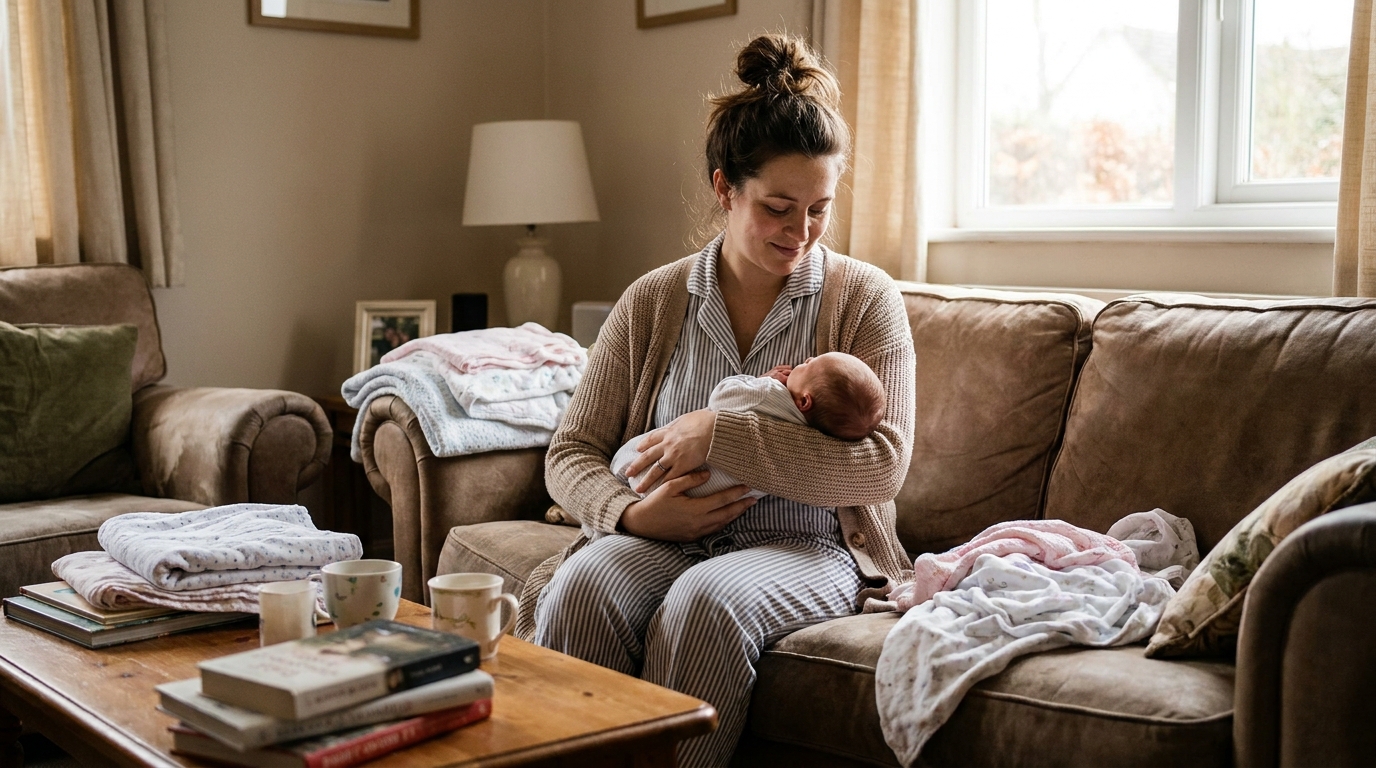
The first time I came home from hospital with a baby I was holding a bag of pads the size of mattresses, a paper leaflet about "warning signs," and absolutely no idea that for the next six weeks I was going to feel like my body had been borrowed by someone else and returned in worse condition.
The discharge midwife told me to "rest when the baby rests" and "take it easy for six weeks." Both of those sentences were useless. Both of my own midwives skipped the part about night sweats that soak through three sets of pyjamas, the day three cry that comes out of nowhere, the cramping that gets worse when you breastfeed, and the fact that you cannot actually sit down comfortably for nearly a fortnight.
This is the postpartum recovery first 6 weeks that I wish I had read before my first baby, written by someone who has been through it twice and is telling you the truth.
What is actually happening in your body
In six weeks your body has to undo nine months of changes. The uterus, which has stretched from the size of a pear to the size of a watermelon, contracts back down. The placental wound (the dinner-plate sized raw patch where the placenta detached from the uterus) has to heal from the inside. Hormones drop off a cliff in the first 72 hours. Blood volume, which doubled during pregnancy, returns to normal over weeks. The pelvic floor, ligaments, and abdominal muscles all have to find their way back.
None of this is fast. Most of it is uncomfortable. All of it is invisible from the outside, which is why people will say "you look great" when you feel like a slow-motion car crash.
Week 1: the survival week
This is the week nobody can prepare you for, partly because it is also the week your baby is at the most unpredictable.
Bleeding (lochia). Heavier than the worst period you have ever had. Bright red, with clots up to the size of a 50p coin or quarter. You will need the giant maternity pads, not normal pads or tampons (do not use tampons until your six-week check at the earliest, you risk introducing infection into the still-healing uterus).
Cramping (afterpains). Sharp cramps that feel like early labour, especially when you breastfeed. Breastfeeding releases oxytocin, which contracts the uterus, which is good for healing but feels brutal. Worse with each subsequent baby. By the third day you are mentally apologising to the women you know who had four kids.
Night sweats. Around night two or three, you will wake up at 3am completely drenched, like you have been swimming in your sleep. This is your body shedding the extra fluid from pregnancy. It lasts roughly a week. Sleep in old t-shirts. Keep towels on the mattress.
Perineal pain. Even if you did not tear, the area is bruised, swollen, and not used to having had a baby pushed through it. Sitting hurts. Standing hurts. Walking up the stairs hurts. The toilet is its own special event. The Frida Mom peri bottle (a soft squirty bottle of warm water to rinse with while you wee) is the single most useful postpartum purchase you can make. Ice pads tucked into your pants help too.
The day three cry. Around day three or four, your milk comes in. At the same time, the surge of pregnancy hormones crashes down to nothing. The combination produces a 24-hour window where you will cry uncontrollably about a slightly cold cup of tea. This is normal and expected. It is not postnatal depression yet.
What helps in week 1:
- Stay in bed or on the sofa as much as possible
- Have someone bring you food, water, and the baby (you handle the baby, that is enough)
- Pillows on the bed in unlikely places (under your knees, behind your back, under one elbow)
- Stool softeners from day one (the first poo is something nobody talks about and everybody fears)
- Big knickers, soft trousers, a button-up t-shirt for feeding
- Phone on silent, visitors capped at one hour
Week 2: the false dawn
You will start to feel slightly human at the end of week one or beginning of week two. You might get dressed in real clothes. You might walk to the kitchen and back without wincing. You might think you are out of the woods.
You are not out of the woods.
Week two is when most women try to do too much and then crash hard at the end of the week. The bleeding lightens but is still there. The night sweats are still happening. The baby's cluster feeding is starting (see the cluster feeding survival guide for that whole story). You are deeply, fundamentally tired in a way that sleeping cannot fix because the sleep keeps getting interrupted.
What works in week two is doing one less thing than you think you can. If you feel like you could go for a walk, do half the walk. If you think you could shower and wash your hair, just shower. If you have visitors planned, cancel one set. The mums I know who recovered fastest were the ones who under-did everything in weeks 2 and 3.
Week 3 to 4: the emotional week
The baby blues should be gone by now. If they are not, this is the window where you start paying attention to whether something else is going on.
Postnatal depression often shows up between weeks 3 and 8. The signs are not what you might expect. It is rarely sobbing in bed. It is more often a flat, foggy, slightly absent feeling. A sense that you cannot quite feel the love for the baby that you think you are supposed to. Intrusive worries that loop around your head at 4am. Anger at small things. A tightness in the chest.
If any of that is happening to you, talk to your midwife or GP this week. Do not wait for your six-week check. Postnatal depression is genuinely common (around 1 in 7 mums), genuinely treatable, and the earlier you flag it the faster you feel like yourself again.
The other thing that often hits in week 3 or 4 is the partner returning to work. This is the moment most mums describe as the loneliest of the whole postpartum period. Try to have at least one person on the calendar each day during this stretch, even if it is just a friend who pops in for half an hour. The isolation feeds the low mood, and the low mood deepens the isolation.
Week 5 to 6: the slow comeback
By week five, most women start to feel recognisably like themselves again. Not back to normal. But recognisable.
The bleeding has usually stopped or is down to a light spotting that comes and goes. The night sweats have ended. The cramping is mostly gone. You can sit on a normal chair without thinking about it. You might have started doing short walks with the pram.
This is also the window where the six-week check happens. Worth knowing what it actually covers, because the leaflet does not tell you.
Your six-week check (GP, not midwife):
- They check the perineum (or C-section scar) is healing
- They check your blood pressure
- They ask about bleeding, mood, and how you are coping
- They check the uterus has returned to size
- They will not usually examine internally unless you have specific symptoms
- They will tell you when you can resume exercise and sex
- They will offer you a contraception conversation (which feels surreal at six weeks postpartum, but is necessary because you can ovulate as early as week three, even while exclusively breastfeeding)
If you have anything bothering you (pain, weird bleeding patterns, low mood, sex worries, peeing or pooing problems), this is the appointment to bring it up. The GP has typically scheduled 10 minutes. Make a list before you go or you will forget half of it.
What about C-section recovery
If you had a caesarean, add roughly two extra weeks to the timeline above. The first week is genuinely harder because you are also recovering from major abdominal surgery. The painkillers help, the wound looks alarming when the dressing comes off, and getting in and out of bed feels like a project.
Specific C-section advice that I wish someone had told me:
- A pillow held over your stomach when you cough, sneeze, or laugh genuinely reduces the pain (it counter-pressures the wound)
- Walk as soon as the staff let you, even just to the bathroom. Movement prevents blood clots and helps wind move through your system (which it has to, and which is painful until it does)
- The scar itches as it heals. Resist scratching. Loose cotton underwear above the scar, not below it.
- High-waisted period pants designed for C-sections (Frida Mom and Bodily make decent ones) are worth the money in weeks 1 to 3.
- The numb feeling around the scar can last 6 to 12 months. This is normal nerve healing.
The recovery problems that are not normal
The "rest and recover" framing makes it sound like everything that happens postpartum is just part of healing. Most of it is. A few things are not, and you should not wait for the six-week check if any of these happen:
- Soaking a maternity pad in an hour or less after week 1
- Passing clots larger than a 50p coin or golf ball after week 2
- Bleeding that gets heavier again after lightening
- Fever above 38 degrees C / 100.4 F
- Sudden severe headache, vision changes, or swelling in hands and face
- Pain in one calf, especially with swelling or redness (could be a blood clot)
- Severe abdominal pain, or pain that gets worse rather than better
- C-section wound that is hot, red, oozing, or smells off
- Severe perineal pain or perineal wound that opens up
- Thoughts of harming yourself or the baby, or feeling completely disconnected from the baby
The first four can indicate a postpartum haemorrhage or infection. The next two can indicate preeclampsia or a blood clot. The last one needs an urgent mental health response. If any of these are happening, call 111 (UK), 911 (US), or whatever your equivalent is, and go in. You will not be overreacting. They would rather see you and send you home than miss it.
Related reading
- Diastasis Recti: The Postpartum Belly Gap and How to Check Yourself
- Mastitis: How to Spot It Early and the 24-Hour Treatment Plan
- Pregnancy Back Pain That Will Not Quit: What Actually Works
What I would tell my younger self at week 1
The version of you reading this from a sofa with a 4-day-old asleep on your chest is doing the actual hardest part. Not the labour. The labour was a few hours of intense work with people around you. This part is six weeks of slow, lonely, invisible work, mostly at 3am, mostly while bleeding.
You are not behind because you have not done the bath yet. You are not failing because you cried at the cat. You are not a bad mother because the breastfeeding hurts more than the leaflet said. Your body is doing the largest physiological undoing it will ever do, and your brain is rebuilding itself on a hormone level that does not match anything you have felt before.
Week one ends. Week two ends. By week six, you will be someone who has done this. By month three, the version of you sitting on this sofa today will already feel like a different person.
For now: stay in bed, eat the food, drink the water, accept the help, take the painkillers, and stop trying to be impressive. The only impressive thing this month is that you grew an entire human inside your body and pushed them out of it. You have done enough.
You are doing it. Slowly, painfully, and exactly right.