
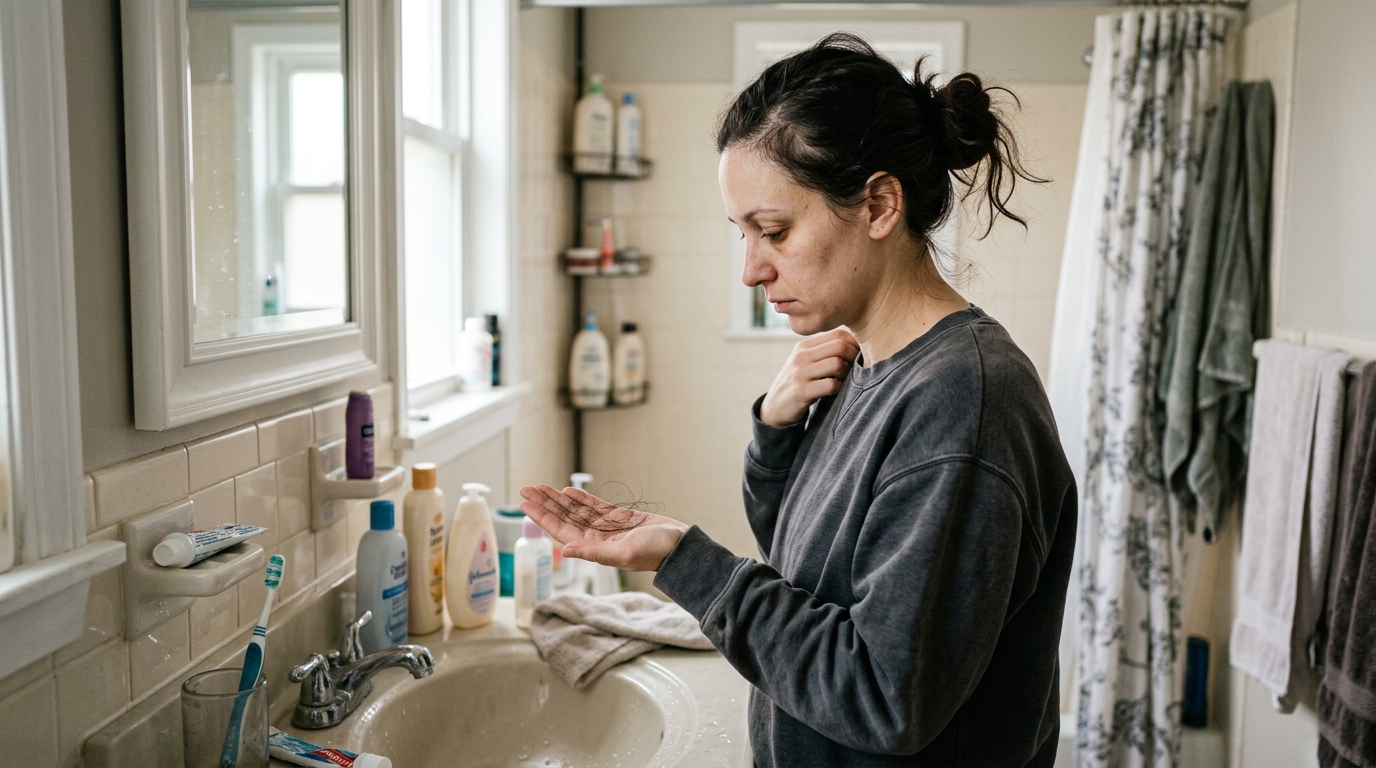
I was 16 weeks postpartum when I pulled my hand out of my hair in the shower and watched what felt like half my scalp drift down the drain. I called the doctor. The doctor's office said it was probably normal but to come in if it kept happening. It kept happening for the next 4 months.
Postpartum hair loss is one of the most alarming and least talked about parts of the early postpartum period. You feel like you are going bald. The bathroom drain looks like a small mammal lives in it. Strangers do not say anything because they cannot see what was there 6 months ago.
If you are in the middle of the shedding phase and wondering whether this is normal and when it will stop, here is the real timeline, the real reason your hair is falling out, and what genuinely helps it grow back.
The real reason postpartum hair loss happens
This is the part most websites get wrong by oversimplifying. The clear version.
In normal life, about 90 percent of the hair on your head is in the growing phase (called anagen). The other 10 percent is in a resting phase (telogen) before falling out and being replaced.
During pregnancy, high levels of estrogen and progesterone keep more hair in the growing phase. Almost no hair sheds. By the third trimester, many women have noticeably thicker, fuller hair than they have ever had. This feels like a small upside to pregnancy.
Within 24 to 48 hours of birth, those hormone levels crash. The hairs that had been kept in the growing phase by pregnancy hormones all shift into the resting phase at the same time. Around 3 to 4 months later, those resting hairs all start falling out in a synchronized wave.
The medical term for this is telogen effluvium (a condition where a large amount of hair enters the resting phase at the same time, leading to noticeable shedding 2 to 4 months later). It is not actually losing hair faster than normal. It is losing months of shedding all at once.
When the shedding starts and stops
The realistic timeline.
- Birth to month 3: Hair stays thick. Very little shedding. You are still being told you have great hair.
- Month 3 to month 4: The shedding starts. Often suddenly. You notice handfuls in the shower and clumps in the brush.
- Month 4 to month 6: Peak shedding. This is when the bathroom looks alarming and your hairline visibly recedes. New baby hairs may start sprouting around the hairline at the same time.
- Month 6 to month 9: Shedding slows. The hairline regrowth becomes more visible. You can pull your hand out of your hair without a wad of hair coming with it.
- Month 9 to month 15: Hair fully returns to normal volume. The new baby hairs grow in fully and integrate with the rest of your hair.
By your baby's first birthday, most women's hair is roughly back to its pre-pregnancy state. Some women say their hair texture changed permanently (became curlier, straighter, finer, or coarser). Most just have the same hair they had before.
What postpartum hair loss looks like
A few specific patterns to expect.
- The most common pattern: significant overall thinning, with the worst loss around the temples and front hairline
- Hair coming out in clumps in the shower is normal. So is hair in your brush. So is hair on your pillow.
- A small fringe of new baby hairs sprouting along the hairline, often in odd angles
- The hairline appears to recede by a few millimeters as the old hairs fall out before the new ones grow in
- A noticeable bald patch along the hairline in some women, especially around month 5
You do not lose all your hair. Even at peak shedding, you keep the majority. But the contrast with the pregnancy-thick hair you had makes the loss feel dramatic.
What actually helps postpartum hair loss
The hard truth: there is no treatment that stops postpartum hair loss. The shedding is hormonal and it has to run its course. But a few things genuinely help the situation.
1. A multivitamin with iron
Many postpartum women are mildly anemic from blood loss during birth, breastfeeding demands, and tiredness preventing them from eating well. Low iron worsens hair shedding.
Take a postnatal multivitamin with iron, or keep taking your prenatal multivitamin. Spatone, Floradix, or basic ferrous sulfate from a pharmacy all work.
If you suspect significant anemia (fatigue beyond normal newborn tiredness, pale skin, dizziness, shortness of breath climbing stairs), see your doctor for a blood test.
2. Protein in every meal
Hair is essentially protein. Most new moms are under-eating protein because of how rushed and disrupted meals are with a newborn. Aim for at least 70 to 100 grams of protein a day.
Easy postpartum protein sources:
- Greek yogurt (great breakfast)
- Eggs (cook in batches)
- Cheese
- Hummus and seeds
- Protein bars (Quest, Built, Trader Joe's brand)
- Tinned tuna or salmon
- Bone broth
- Cottage cheese
(For the full first 6 weeks postpartum picture, see Postpartum Recovery: The First 6 Weeks Nobody Warns You About.)
3. Topical minoxidil (carefully, and only after speaking to your doctor)
Minoxidil (the active ingredient in Rogaine) is sometimes used for severe postpartum hair loss. It is technically safe in breastfeeding because very little is absorbed through the skin.
However, most dermatologists recommend waiting until the natural regrowth has happened before using it. Many women who start minoxidil discover their hair was already starting to grow back on its own.
If your shedding is severe enough that you are considering minoxidil, see a dermatologist. They can rule out other causes and discuss whether treatment is worth it.
4. A good haircut
Counterintuitive, but it works. A haircut that:
- Removes some of the length (less weight, hair looks fuller)
- Adds layers to create movement and volume
- Includes face-framing pieces to disguise the receding hairline
- Uses a curtain bang or wispy fringe to cover the patchy regrowth
This will not regrow your hair faster but it will dramatically improve how it looks while it grows back.
5. Stop traction styles
The hair you have left needs to be treated gently. Avoid:
- Tight ponytails
- Tight buns
- Braids that pull
- Hair extensions
- Aggressive brushing
- Hot tools daily
Loose styles, soft scrunchies, and gentle brushing all reduce the breakage that compounds the shedding.
6. Sleep, hydration, and lower stress
This is the part that sounds glib but is real. Postpartum stress, sleep deprivation, and dehydration all worsen hair shedding.
You cannot fix newborn sleep deprivation in the early months. But you can:
- Drink 3 liters of water a day
- Sleep when the baby sleeps when possible
- Outsource what you can
- Ask for help (more on this in Why Newborn Care Is So Hard)
What does not help (skip these)
A few products and routines that get hyped but do not move the needle.
- "Hair growth" shampoos and conditioners (no shampoo can affect the follicle)
- Biotin gummies (most women have plenty of biotin; supplementation does not help)
- Castor oil (no evidence it speeds regrowth)
- Scalp massage (feels nice, does very little)
- Expensive scalp serums (almost all are marketing)
- Special pillowcases
- "Cooling helmets" or similar trending devices
Save the money for the multivitamin and a good haircut.
When postpartum hair loss is something else
Most postpartum hair loss follows the standard pattern and resolves on its own. A few situations warrant a doctor visit.
Worth a doctor visit if:
- Shedding lasts more than 12 months postpartum
- You develop bald patches rather than overall thinning (could indicate alopecia areata, an autoimmune hair loss condition)
- You have other symptoms of thyroid issues (weight changes, fatigue, feeling cold all the time, dry skin) — postpartum thyroiditis is common and can cause hair loss
- You have other signs of iron deficiency or anemia
- The loss seems to be worsening rather than improving past month 6
- You have severe scalp itching, redness, or pain
- Your nails are also brittle or breaking
- You are losing hair from other parts of your body
A routine blood test for full blood count, ferritin (iron stores), and thyroid function can rule out the common medical causes of hair loss that mimic postpartum shedding.
The breastfeeding question
Many moms wonder if breastfeeding worsens hair loss. The evidence is mixed.
Some studies suggest breastfeeding moms shed slightly more because of the additional hormonal and nutritional demands. Other studies show no difference.
If you are breastfeeding and worried, the answer is not to stop. The extra hair loss (if any) is small, and breastfeeding has many other benefits. Focus on the protein, iron, and water intake. The hair will come back regardless of whether you are still breastfeeding when it does.
What about hair texture changes
Some women find their hair grows back with a different texture than before. Curlier, straighter, finer, coarser, with a different part, or with the cowlicks in new places.
This is real. The follicle structure can change during pregnancy and postpartum recovery, and the new hair growing in does not always match the old hair. Most of these changes are permanent.
This is not bad news. It is just new. Many women say they grew to like their new hair more than the old version.
What to tell yourself with another handful of hair in the drain
You are not going bald. You are shedding the buildup of nine months of hairs that did not shed during pregnancy. The fact that this is happening all at once is biology, not pathology.
By month 9, the worst will be behind you. By month 12 to 15, you will have a recognizable head of hair again, possibly slightly different from before but fully there.
In the meantime, do not panic. Eat the protein. Take the iron. Get the haircut. Be gentle with what is left. And know that almost every mom in the playgroup is going through some version of the same thing right now, and none of you can see it on each other.
Six months from now you will be the one quietly comforting a friend who has just realized her hair is falling out. You will tell her exactly what you needed someone to tell you: it ends, it grows back, and you are still you.