
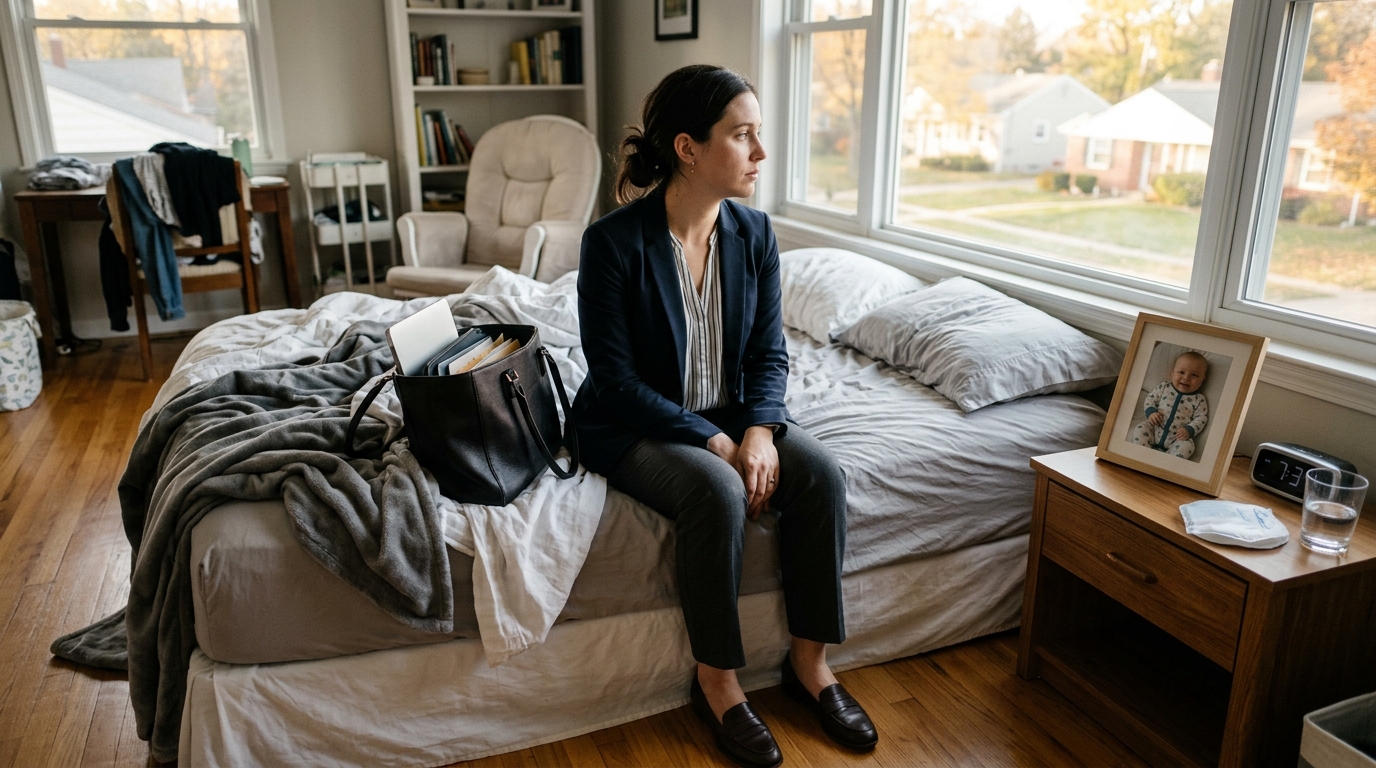
I went back to work at 14 weeks postpartum. The maternity leave had been hard but I had assumed the structure of work would help. Instead, the first week back I cried in the bathroom every day at lunchtime. The second week I started having intrusive thoughts about getting in the car and just driving until I ran out of road. By week three I was barely sleeping and not eating, and I told nobody.
If you are going back to work after a baby and the dark feelings are getting worse rather than better, you are not imagining it and you are not weak. Postpartum depression at return-to-work is a real and well-documented pattern. Here is what is happening, how to tell whether it is depression or just hard, and what actually helps.
Why returning to work can trigger or worsen PPD
The maternity leave to work transition stacks multiple risk factors at the same time. Each one alone would be enough to challenge mental health. Together they often tip a woman who has been coping into a crisis.
Acute sleep loss collides with full-time demands. You were already sleep-deprived. Now you are also commuting, performing at work, and doing pickup and bedtime on the same day.
The grief of separation is real. Many moms describe the first day back as a quieter version of grief. Acknowledged or not, that grief uses energy that could otherwise be used for coping.
Hormonal shifts continue. Estrogen and progesterone do not return to pre-pregnancy levels for months. If you stop breastfeeding around this time, additional hormonal changes happen.
Identity disruption. The version of you that worked is not exactly the version of you now. The version that mothered is not the version that is now at the office. Holding both is harder than it sounds.
Sleep deprivation has caught up. By month 4, many moms have hit a wall of accumulated sleep loss that the body cannot keep absorbing.
The support network shrinks. During maternity leave you had friends checking in. Once you are "back to normal life," the texts taper off.
All of this is happening at the same time. Symptoms that were just under the surface can become more visible.
The signs of postpartum depression at return-to-work
Postpartum depression can develop or worsen at any point in the first year. The return-to-work window is one of the higher-risk periods.
The symptoms to watch for in yourself
- Persistent low mood that lasts more than 2 weeks
- Loss of interest in things that usually bring pleasure
- Crying at unexpected moments
- Anger or irritability that surprises you
- Feeling disconnected from the baby
- Feeling disconnected from your partner
- Intrusive worries about the baby's safety
- Intrusive thoughts about harming yourself
- Feeling like a "bad mom" or a "bad worker" or both
- Inability to sleep even when you have the chance
- Lack of appetite or comfort eating to excess
- Difficulty concentrating at work
- A flat numb feeling rather than sadness
- Panic attacks or chest tightness
- A sense that the people you love would be better off without you
If you are recognizing yourself in 4 or more of these for more than 2 weeks, this is worth a doctor's appointment.
If you are recognizing any thoughts about harming yourself or the baby, this is worth a call to your doctor today.
The difference between PPD and "just hard"
Going back to work with a young baby is hard. It is hard for almost every mom. Hard alone does not mean depression.
"Just hard" usually looks like:
- Tiredness that improves with a weekend or two of catching up
- Sadness about leaving the baby that gets better as you settle into the routine
- Some days are bad and some are okay
- You can still feel joy and connection at home
- You can still concentrate at work most of the time
- You sleep when you have the chance to sleep
- You are eating and exercising when possible
Postpartum depression looks like:
- Tiredness that does not improve with rest
- Sadness that worsens over weeks
- Most days are bad
- You feel flat or absent even at home
- You cannot concentrate even on simple tasks
- You cannot sleep even when you have the chance
- You are not eating, or you cannot stop eating
- You are losing interest in things you used to enjoy
- You feel like you are watching your life from outside
The single best diagnostic question to ask yourself: "Is this getting better or worse over the past 2 weeks?" Hard but improving suggests adjustment. Hard and worsening suggests depression.
What actually helps
If you are recognizing yourself in this, here is what genuinely makes a difference.
1. Tell someone today
The single most important step. Tell your partner, your mom, your closest friend, your doctor, anyone. The shame of postpartum depression makes you hide it. Hiding it makes it worse.
The sentence that works: "I think I might be more than just tired. I am struggling and I need help."
2. See your doctor within the week
A doctor visit gets you on the pathway to support. The visit usually includes:
- A standardized depression screening
- A blood test to rule out thyroid problems (postpartum thyroiditis is common and mimics depression)
- A conversation about your sleep, mood, and daily functioning
- Referrals to perinatal mental health services
- A discussion of whether medication might help
Many SSRIs (selective serotonin reuptake inhibitors, a class of antidepressants) are considered safe in breastfeeding. Sertraline (Zoloft) is the most common first choice. Do not let breastfeeding stop you from getting medication if you need it.
3. Get one specific work accommodation if possible
Even small changes help significantly:
- A later start time once or twice a week
- A dedicated pumping space if you are still breastfeeding
- One half-day a week working from home
- A short-term reduction in workload
- Skipping non-essential meetings for the first month back
Talk to your manager honestly if you can. Many will accommodate more than you expect. If your relationship with your manager does not allow honesty, talk to HR.
4. Rebuild the bedtime routine
Sleep is the single biggest lever for mood. Easier said than done with a baby, but specific things help:
- Have your partner do the night feeds for one stretch (if you can)
- Go to bed at 9pm with the baby for a few weeks
- Use the baby monitor on a low setting so you can sleep more deeply
- Keep caffeine before 10am
- Use a wind-down hour before bed (no work email, no scrolling)
5. Move daily
Even 20 minutes of walking has a measurable antidepressant effect. With a baby this can be:
- Walking the baby in the stroller before work
- A lunchtime walk around the block
- Yoga during the baby's bedtime nap
- A short evening walk with your partner pushing the stroller
You do not need to commit to 5am gym sessions. 20 minutes a day, however you fit it, is the threshold that helps.
6. Connect with other moms
Isolation is the fuel of PPD. Specific things that help:
- A weekly catch-up with one mom friend (text, video, or coffee)
- A baby-friendly exercise class
- An online mom support group (some are run by mental health professionals)
- A partnership with one other mom on parallel return-to-work schedules
7. Therapy alongside medication
The combination of antidepressant medication and CBT (cognitive behavioral therapy) is the most evidence-based treatment for PPD. Therapy alone helps many women. Many find both together help fastest.
Perinatal-specialist therapists exist in most areas. Worth asking for one specifically. They understand the patterns better than general therapists.
What about extending maternity leave
If your return-to-work has triggered a mental health crisis, extending leave may be an option. The pathways vary by country and employer.
In the US
- FMLA (Family and Medical Leave Act) provides up to 12 weeks unpaid leave, but most parents have used this for the initial maternity leave
- Some states (California, New York, New Jersey, Massachusetts) have paid family leave programs that can sometimes be extended
- Short-term disability sometimes covers PPD
- Your employer may have additional discretionary leave
In the UK
- Statutory maternity leave is up to 52 weeks
- If you have not used it all, you can still use the remainder
- After SMP ends, you can take unpaid leave or sick leave
- Sick leave with a doctor's note for PPD is legitimate and protected
We covered the specifics in more detail in Can You Extend Maternity Leave for Postpartum Depression.
When to go to the emergency room
PPD can become a psychiatric emergency. Go to the ER or call emergency services if:
- You are having clear thoughts about harming yourself
- You are having thoughts about harming the baby
- You are hearing voices or seeing things that are not there (this can be postpartum psychosis, a rare but serious condition that needs urgent care)
- You feel completely unable to keep yourself or the baby safe
- You have a plan for self-harm
None of these mean you are a bad mom. They mean your brain needs urgent medical support. The same way you would go to the ER for chest pain, you go for these symptoms.
What partners should know
If you are reading this for someone you love, the things that help most.
- Believe her when she says she is struggling
- Do not try to talk her out of her feelings
- Do specific concrete tasks without being asked (dinner, laundry, baby duty)
- Drive her to the doctor's appointment
- Sit with her during the appointment
- Let her sleep
- Tell her she is a good mom (frequently)
- Do not minimize ("it is just baby blues")
- Do not pressure ("when do you think you will feel better")
- Watch for the warning signs of escalation
- Take the night feeds for a stretch
- Make space for her own self-care without judgment
What to tell yourself in the bathroom at lunchtime
You are not broken. You are not a bad mom. You are not failing at being a working parent. You are dealing with a real medical condition that has effective treatment and a recovery curve that most women complete.
Postpartum depression, especially the return-to-work version, is one of the most treatable mental health conditions there is. Most women who get appropriate support feel meaningfully better within 6 to 12 weeks of starting treatment.
The version of you that exists right now, struggling in the office bathroom, is not the version that will exist in 4 months. By then, with the right support, you will be looking back at this period as a hard chapter, not a permanent state.
Tell someone today. See the doctor this week. Start the support that will get you back to yourself. You deserve that. So does the baby.
You are not alone in this. Roughly 1 in 7 moms goes through some form of postpartum depression, and the majority recover fully. You will too.