
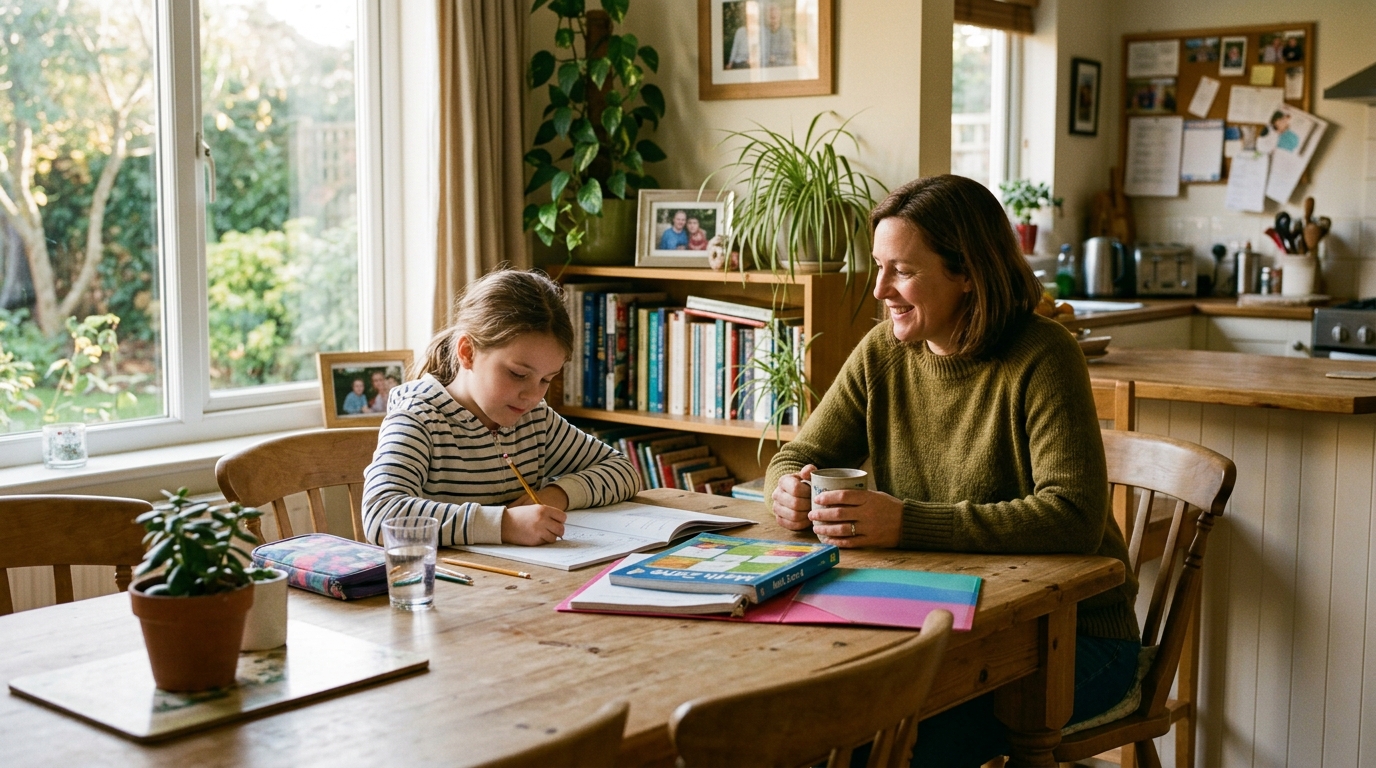
It was a Tuesday in October, about 5:30 in the evening, and my 8 year old was lying face down on the kitchen floor next to his spelling book. Not crying exactly. Just done. I had asked him three times to sit up and write six words, and each time he slid a little further down the chair until he poured himself onto the tiles like a sad little puddle. I stood there with dinner half made and my own patience gone, and I heard myself say something I am not proud of. Something about how easy this was and why was he making it so hard. He looked up at me and his lip wobbled, and I felt like the worst mother alive.
If your evenings look anything like that, I want you to know you are not doing it wrong and neither is your kid. Homework battles are one of the most common things parents write to me about, and I fought them for years before things got calmer. In this post I want to walk you through how to get kids to do homework without turning your kitchen into a war zone every single night. We will cover why the fighting happens, the routine that finally worked for us, and the one situation where the resistance is actually telling you something important.
Why the power struggle backfires every time
Here is the thing I wish someone had told me sooner. When you stand over a child and demand they do their homework right now, you have handed them the one thing they still control, which is whether or not they pick up the pencil. A 7 or 8 year old cannot control much in their day. Homework is the hill they can actually die on, so they die on it.
The more I pushed, the more my son dug in. It was not laziness. It was a kid grabbing the only bit of power in reach. Once I understood that, I stopped trying to win the fight and started trying to make the fight unnecessary. That shift changed everything, and it is the same idea I wrote about in why your toddler says no to everything. The ages are different but the need is the same. Kids want a say.
So the goal is not to make your child obey. The goal is to build a routine so predictable and so low pressure that there is nothing left to push against.
Set a homework time and keep it boring
Children thrive on knowing what comes next. When homework floats around the evening as a vague threat that could land at any moment, it hangs over everyone. Pin it down instead.
Pick a time that fits your child, not a parenting book. Some kids need a full hour to decompress after school with a snack and some running around. Mine was one of those. Others do better getting it done straight away before they melt into the couch. Watch your own child for a week and you will see their pattern.
Then make that time the same every day. Ours became 4:30, after a snack and 20 minutes in the garden. It stopped being a negotiation because it was just what happened at 4:30, the way brushing teeth happens at night.
- Keep the spot consistent too, like the same end of the kitchen table
- Clear away toys and screens before you start, not during
- Have the pencils and water already there so nobody leaves to hunt for supplies
- Keep your own phone in another room so you are genuinely available
Break it into short chunks with real breaks
A 7 year old brain is not built to grind through 40 minutes of worksheets. Neither is a 9 year old one honestly. When my son saw a full page of maths, he saw a mountain, and his body just refused to start climbing.
What worked was shrinking the mountain. We used a timer and did 10 minutes on, then a 5 minute break where he could get up, wiggle, grab a drink, whatever. Then another 10 minutes. Suddenly the work was not one endless slog. It was a couple of short sprints with a rest in between, and he could see the finish line the whole time.
For younger kids you might do even smaller. Five words, then a break. Three maths problems, then a stretch. You are not being soft. You are matching the work to the attention span they actually have, which is the whole point.
You are not lowering the bar. You are meeting your child where their focus actually lives.
Some evenings the homework genuinely is too much for the time your child can give. If that keeps happening, it is worth a quiet word with the teacher, and I will come back to that near the end.
Be nearby, not on top of them
There is a huge difference between sitting near your child and hovering over their shoulder correcting every letter. I learned this the embarrassing way. The tighter I watched, the tenser he got, and the more mistakes he made, which made me watch harder. A miserable little loop.
So I backed off physically. I would sit at the same table peeling potatoes, close enough to help if he asked, far enough that he did not feel my breath on his neck. When he got stuck, I helped with that one thing and then went back to my own task. Some wrong answers went to school wrong, and the world kept turning.
Being present without taking over tells your child two things at once. You are here if I need you, and I trust you to do this yourself. That combination builds the independence you actually want, instead of a kid who cannot start until an adult is locked onto them.
Let natural consequences do the teaching
This one was hard for me because it meant letting my son fail a little. But the most powerful teacher in the homework fight is not you. It is the mild, real consequence of not doing the work.
If homework does not get done in the calm window you set, that is it. You do not chase them around the house at 8pm begging. The work goes to school undone, and the teacher handles it there, with a missed sticker or a lunchtime finish or whatever their classroom does. A child who feels that small sting a couple of times learns far more than a child who is nagged for two hours and rescued at the last minute every night.
Your job is to hold the routine and stay calm. Their job is the homework. When you stop carrying their half of it, a lot of the fighting simply has nowhere to go. This is the same principle I leaned on when my 4 year old would not listen. Less rescuing, more letting the real world do the talking.
Say it plainly and kindly. Homework happens at 4:30, and if it is not done, that is between you and your teacher. Then let go.
When homework resistance is really a learning struggle
Everything above assumes the fight is about power and routine, which most of the time it is. But sometimes a child resists homework so hard, and so consistently, because the work genuinely feels impossible to them. That is a different problem and it needs a different response.
Watch for these signs over a few weeks, not a bad day here and there:
- Real distress or tears at the sight of a specific subject, especially reading or maths
- Taking far longer than their classmates on the same task, night after night
- Saying they are stupid or that they hate their brain
- Homework that seems way above what they can actually do, even when calm and rested
- Complaints of tummy aches or headaches only around schoolwork
If you are seeing a cluster of those, do not push harder. Book a chat with the teacher and describe exactly what you see at home. Ask whether they see the same struggle in class. A pattern like this can point to a learning difference such as dyslexia or dyscalculia, or an attention issue, and the earlier it is looked at the more you can help. Teachers see hundreds of kids and can often tell you quickly whether your child is worth a closer look from a specialist or educational psychologist.
Trust your gut here. You know your child. If the resistance feels less like defiance and more like drowning, that is worth raising, and no good teacher will mind you asking.
Give it a couple of weeks
None of this fixes the fight overnight. The first few days of a new routine can actually feel worse, because your child will test whether you really mean it. Hold steady and boring and kind, and give it two solid weeks before you decide anything.
For us, the floor-puddle evenings faded out over about a month. Not because my son suddenly loved spelling, but because homework stopped being a battle he could win by refusing. It became just a thing we did at 4:30, in short chunks, with me nearby but not looming. Some nights are still a slog. Most are fine now. And I am no longer the mother standing over a puddle on the kitchen floor, which was worth every boring evening it took to get here.