
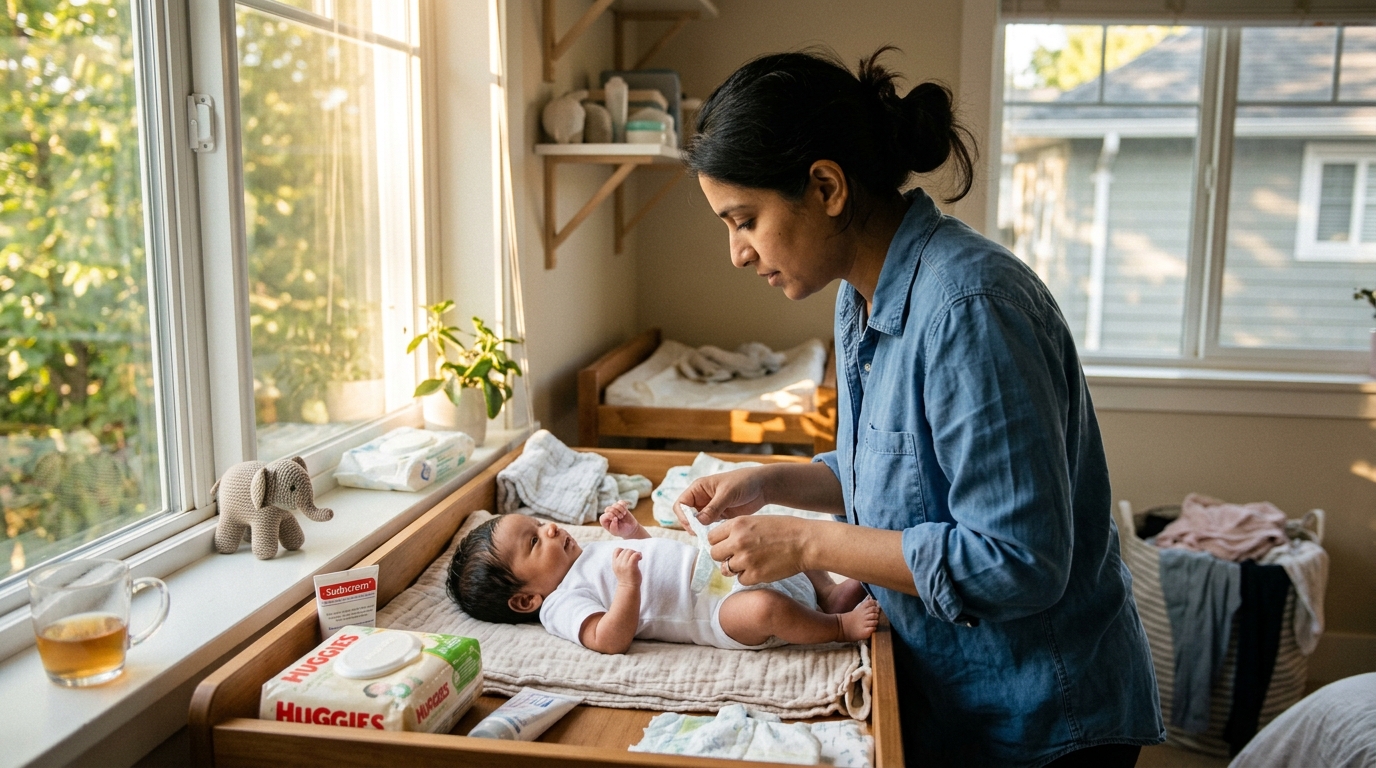
At my six-day checkup with my first baby, the nurse asked how many dirty diapers he'd had that morning and I froze. I honestly had no idea. I'd been counting wet ones because a printout told me to, but the poop ones had blurred into one long sleepless smear. I remember driving home from that appointment convinced I was already failing at the one job that came with actual instructions.
If you're staring into a diaper right now wondering if this is normal, I've been there more times than I can count. The truth is that newborn poop changes a lot in the first weeks, and what's fine on day three would worry me on day thirty. So let's talk about how often should a newborn poop, what the colors and textures actually mean, and the specific signs that made me pick up the phone and call the doctor.
How Often Should a Newborn Poop by Age
In the very first days, your baby is clearing out meconium, that sticky dark green-black tar that does not want to let go of anyone's skin. Most babies pass it within the first 24 to 48 hours. After that, things speed up fast.
Here's the rough pattern I watched play out with both of mine, and it lines up with what our pediatrician told me:
- Days 1 to 2: one or two meconium poops as the gut wakes up
- Days 3 to 5: poops get more frequent, three or more a day, as milk comes in
- Week 1 to 6: often after every feed for breastfed babies, so five to twelve times a day is common
- After 6 weeks: this is where it gets confusing, and I'll explain why below
So when people ask how often should a newborn poop, the honest answer is that a lot in those early weeks is a good sign. Frequent poops usually mean your baby is getting enough milk. In the first month, more than three or four dirty diapers a day tells you feeding is going well.
Breastfed vs Formula: The Poop Is Genuinely Different
This tripped me up because my two babies fed differently and their diapers looked nothing alike.
Breastfed baby poop is usually mustard yellow, loose, sometimes seedy or a little watery. It can smell almost sweet, or at least not that bad. It comes often in the newborn stage, frequently mid-feed with a sound that will startle you in a quiet room.
Formula-fed baby poop tends to be thicker, more like peanut butter or paste, and the color leans tan, khaki, or light brown. The smell is stronger, closer to what you'd expect. Formula-fed babies often poop a bit less often than breastfed newborns, more like one to four times a day.
Neither is better. They're just different fuel making different output. Once I stopped comparing my formula-fed second baby to my breastfed first, I relaxed a lot. If you want a full rundown of the daily rhythm in those early weeks, I put it all in our newborn daily care checklist.
Normal Newborn Poop Colors and Textures
Color threw me more than frequency did. Here's what falls inside normal:
- Dark green-black and sticky: meconium, first couple of days only
- Greenish-brown: the transition poop around days 3 to 4
- Mustard yellow, seedy, loose: classic breastfed baby
- Tan or light brown, thicker: classic formula-fed baby
- Occasional green: often totally fine, can happen with a cold, a foremilk-heavy feed, or just because
Green poop sent me into a spiral once at 2am. It was nothing. Babies produce green poop for all sorts of harmless reasons, and a single green diaper in an otherwise happy, feeding baby is rarely a problem.
The Breastfed Baby Who Suddenly Stops Pooping
This is the part I wish someone had warned me about before it happened. Somewhere around six weeks, my breastfed baby went from pooping after every feed to not pooping for four whole days. I was certain something was wrong.
It wasn't. Around this age, many exclusively breastfed babies slow down dramatically because breast milk is so well absorbed that there's genuinely little waste left over. A breastfed baby can go anywhere from several days to over a week between poops and still be completely healthy.
The thing that matters is what the poop looks like when it finally arrives, and how your baby seems in the meantime. If they're feeding well, having wet diapers, and the poop when it comes is soft, you're fine. Soft is the key word. A soft poop after five days is not constipation, no matter how much it built up in there.
A breastfed baby who goes days without pooping but stays comfortable and still passes soft stool is usually just being efficient, not constipated.
This mostly applies to breastfed babies. If a formula-fed newborn suddenly stops pooping for a few days, I'd watch more closely and call sooner, because formula constipation is more common.
What Real Constipation Actually Looks Like
Constipation is not about frequency. I had to unlearn that. It's about the texture and the effort. Here's what actually points to constipation in a newborn:
- Hard, dry poops that look like little pellets or firm balls
- Poop that clearly causes pain, with a red straining face and crying that doesn't settle
- Dry, firm stool combined with fewer wet diapers, which can hint at dehydration
- A hard, swollen belly along with fussiness
A grunting, red-faced, straining baby who then produces a soft poop is not constipated. Newborns are just bad at pooping at first. Their abdominal muscles and their brain haven't fully coordinated the whole push-and-relax thing, so they look like they're running a marathon to do something that ends up soft. That's normal newborn straining, and it usually sorts itself out.
Real constipation in an exclusively breastfed baby is actually uncommon. It shows up more once you introduce formula or, later, solids.
When to Call the Doctor
I'm cautious by nature, and with newborns I'd always rather make the call than sit up all night worrying. Here are the signs that mean stop reading and phone your doctor or health visitor:
- No poop at all in the first 48 hours of life
- White, chalky, or pale grey poop, which can signal a liver problem and always needs same-day review
- Red blood in the poop, or black poop after the meconium stage has passed
- Poop that looks like red currant jelly, especially with a baby who is screaming in waves, which is an emergency
- Signs of dehydration: far fewer wet diapers, a sunken soft spot, no tears, a very sleepy or floppy baby
- Hard pellet poops with obvious pain, or a fever in a baby under 3 months
That last one matters on its own. Any fever in a baby under three months old is a call-right-now situation, poop or no poop.
If your baby has jaundice on top of pale poops, that combination needs prompt attention too. I wrote more about that in when to call your GP about newborn jaundice, because the two can be linked and it's worth knowing the signs.
The Bottom Line
So, how often should a newborn poop? A lot in the first weeks, often after every feed, and then possibly much less once a breastfed baby hits around six weeks. Frequency swings wildly and most of that swing is normal. What you're really watching is the texture, the color, and how content your baby seems.
Soft poop and a settled baby means you can breathe, even after a four-day gap. Hard pellets, pain, blood, or pale chalky stool means you make the call. If you ever feel unsure and your gut says something's off, that instinct is worth trusting. Reflux and feeding troubles can muddy the picture too, and I broke those down in our post on baby reflux signs if the fussiness feels bigger than the diaper.
You are not failing. You're learning a brand new person one diaper at a time, and honestly, you're already paying closer attention than you give yourself credit for.