
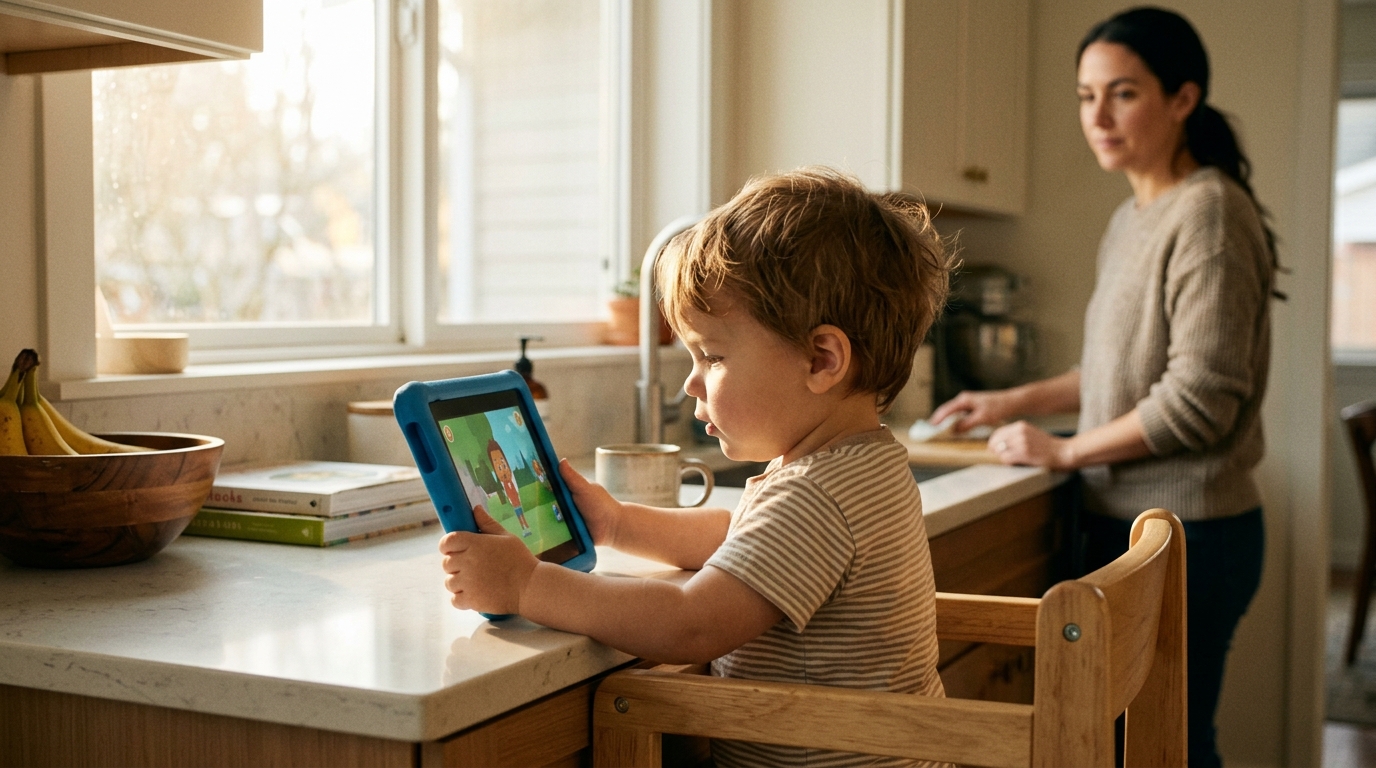
The American Academy of Pediatrics says 1 hour a day for toddlers. The World Health Organization recommends even less. Most parenting articles say "as little as possible." None of them seem to account for the fact that sometimes you need to take a shower and the toddler is screaming at the bathroom door.
If you have been silently worrying about how much screen time your toddler is actually getting and how that compares to what is okay, here is the realistic version. The actual limits by age, the difference between content types, and what to do when real life pushes you past the official guidelines.
This is not the version that pretends the guidelines are easy to follow. It is the version that takes the research seriously while acknowledging that you have to live in a real house with a real child.
The official guidelines (and what they really mean)
The big organizations have similar recommendations.
American Academy of Pediatrics (AAP)
- Under 18 months: No screen time except video calls
- 18 to 24 months: Limited high-quality programming watched together with a parent
- 2 to 5 years: Maximum 1 hour per day of high-quality content, ideally co-viewed
- 6+: Personalized media plan
World Health Organization (WHO)
- Under 1 year: No sedentary screen time
- 2 to 4 years: No more than 1 hour per day, less is better
What the guidelines really mean
The guidelines are based on the research showing higher screen time correlates with worse outcomes in language, attention, and sleep. They are set conservatively to push families toward less.
The guidelines do not mean:
- Your child is harmed by every additional minute
- 1 hour is fine but 1 hour 5 minutes is dangerous
- All screen time is equally harmful
- Following the limits perfectly is the only way to raise a healthy child
The guidelines are a direction, not a hard line.
How much screen time most toddlers actually get
The honest data on real households.
A 2024 Common Sense Media study found:
- The average daily screen time for US children 0 to 2: 1 hour 40 minutes
- The average for ages 2 to 4: 2 hours 30 minutes
- The percentage of toddlers exceeding the AAP guidelines: about 75 percent
In other words: most toddlers get more screen time than the guidelines recommend. You are not unusual if your child does too. The question is how to move toward less, not how to feel guilty about the current amount.
A realistic framework by age
The framework I use, which accepts real-life constraints.
Under 18 months
Recommended: Avoid screens entirely except video calls with family.
Realistic: The strict AAP recommendation is genuinely the right answer here. Babies under 18 months get almost nothing from screens and miss the active engagement they need from caregivers.
Video calls with grandparents are fine. Background TV (even if you are not watching) is the most harmful pattern at this age and worth eliminating.
18 to 24 months
Recommended: 0 to 30 minutes of co-viewed high-quality content. No solo screen time.
Realistic: 30 minutes of co-viewed content a day is achievable in most families. If you sometimes go to 45 minutes, you are not harming your child.
Good content at this age: Sesame Street, Mister Rogers' Neighborhood, slow-paced nature documentaries, books on Tumblebooks, video calls.
Avoid: Cocomelon and similar high-stimulation content, anything with rapid scene cuts, YouTube auto-play.
2 to 3 years
Recommended: 1 hour per day of high-quality content, mostly co-viewed.
Realistic: 1 hour total, split into two 30-minute sessions, is achievable for most families on most days. Some days will be more (sick day, long sick parent, long travel). That is normal.
Good content at this age: Bluey, Sesame Street, Daniel Tiger's Neighborhood, slow nature programs, simple educational shows.
Limit fast-paced, rapidly cut content. (For more on the speech development implications, see Does Screen Time Really Cause Speech Delays in Toddlers.)
3 to 5 years
Recommended: 1 hour per day of high-quality content.
Realistic: 1 to 1.5 hours on weekdays is what most families land on. Weekend days can be more. Sick days, traveling days, and special circumstances are exceptions.
The 5-year-old who watched 2 hours on Saturday because the family was at the airport is not damaged. The 5-year-old who watches 3 hours every day is at higher risk of attention and language issues.
What "high-quality content" actually means
The phrase "high-quality content" is overused and undefined. What it really means.
Signs of good toddler content
- Slow pacing: scene cuts happen every 5 to 10 seconds, not every 1 to 2 seconds
- Real-life themes: family, friendship, school, simple problem-solving
- Quiet moments: pauses between dialogue, time for kids to process
- Cause and effect: actions have logical consequences shown
- Emotional vocabulary: characters name and discuss feelings
- Repetition: songs, phrases, routines that children can learn
- Realistic interactions: how people actually talk to each other
- Limited or no advertising: especially for under 5s
Examples of good toddler content
- Bluey
- Daniel Tiger's Neighborhood
- Mister Rogers' Neighborhood
- Sesame Street
- Old episodes of Reading Rainbow
- Octonauts
- Curious George
- Most nature documentaries (BBC, National Geographic)
Signs of low-quality content
- Rapid scene cuts (every 1 to 2 seconds)
- Bright flashing colors
- High-energy music constantly
- Characters speaking in unnatural voices
- No quiet moments
- Frequent character changes
- Plots that do not make sense
- YouTube algorithm-driven autoplay
Examples to limit or avoid
- Cocomelon
- Most YouTube Kids algorithm content
- Mukbang or "kids react" videos
- Most superhero cartoons designed for older kids
- Anything from the parent's adult shows playing in the background
When more screen time is actually okay
The real life situations where exceeding the guidelines is reasonable.
Sickness
A sick toddler needs rest. Screens are often the only thing she can tolerate when she feels awful. Use them. You can reset the screen time pattern when she is well.
Long travel
Flights, road trips, train journeys. Screens are the difference between a peaceful journey and a meltdown that affects everyone. Use them. The guidelines are about daily averages, not single events.
A genuinely needed parent break
A long parenting day with no help, a difficult moment for you, a 20 minute decompression in the bathroom. Putting on a show for 30 minutes so you can reset is not a failure. It is a tool for keeping yourself functional, which keeps you a better parent.
A young sibling
If you have a newborn and a toddler, the toddler is going to get more screen time than the older sibling did. This is normal and unavoidable. The toddler will be fine.
A move, illness, family crisis
During genuinely difficult periods, screen rules can flex. Resume the normal pattern when the crisis passes.
When screen time is the problem
The honest signs that screen time has become an issue in your family.
- Your toddler is melting down when screens are turned off
- Her language is lagging or her behavior is escalating
- She is uninterested in non-screen activities
- She demands screens constantly
- She is sleeping badly
- She seems more irritable overall
- You are scrolling on your own phone while she watches her tablet
- The 1-hour rule has crept to 3 hours over months
If you recognize multiple of these, a reset is worth doing. The reset is usually not painless but it works.
How to reset screen time after it has crept up
A specific plan that works in most households.
Days 1 to 3: Acknowledge it together
Tell your toddler ahead of time that the rules are changing. Use simple language: "We are going to watch a little less from now on. There will still be time for shows, just less of it. We are going to play more together instead."
Days 4 to 7: New structure starts
Set specific times for screens (e.g., after lunch and after dinner) for 20 to 30 minutes each. Outside those windows, screens are not available.
Have replacement activities ready:
- A new toy or activity rotation
- Stickers, play dough, drawing
- Outdoor time
- Audio books
- Books
Week 2: Hold the line
The first week is hard. Meltdowns and demands are normal. Hold the structure calmly. By week 2, the new pattern usually settles.
Week 3: Adjust to what works
After 2 to 3 weeks, you will see what actually works. Adjust the times slightly. Aim for less than before, even if not as little as the official guidelines.
What about screens during meals
The research on meals is clearer than on overall screen time. Eating while watching has specific negative effects:
- The child eats more total calories
- Picks at food they would otherwise eat
- Misses social cues during the meal
- Loses connection moments with parents
- Builds an association between eating and screens
The general advice: no screens during meals from age 1 onward. This is one rule worth holding firmly. Food at the table, screens elsewhere.
(For more on toddler meals, see How to Set Boundaries With a Clingy Toddler and our posts on feeding.)
What about screens before bed
Screens before bed are bad for sleep in toddlers as well as adults. Specific effects:
- Blue light suppresses melatonin production
- Stimulating content delays settling
- Screen withdrawal triggers meltdowns at exactly the wrong time
- Lower quality sleep overall
A general rule: no screens in the hour before bed. Books, calm play, and bath time fill the wind-down hour instead.
What about screen time as a learning tool
Some screen time is genuinely educational. Apps that practice letters, numbers, problem-solving, and reading can support development.
The caveats:
- Co-use is much more effective than solo use
- Limit total daily time even with educational apps
- The strongest evidence is for reading-readiness apps in pre-school years
- For under 3, most apps marketed as educational have no demonstrated benefit
Use educational apps sparingly and as part of the total screen time budget.
What to tell yourself watching your toddler watch a tablet
You are doing the best you can in a world where screens exist and parents need breaks. The fact that you are thinking about screen time at all puts you ahead of the average.
The guidelines are a target, not a hard line. Your goal is to move in their direction, not to hit them perfectly every day.
If your toddler is getting more screen time than the guidelines suggest, you can make changes. The reset is hard but it works. Most families who reduce screen time say their child becomes more engaged with the world within a few weeks.
If you are within the guidelines, you are not perfect, you are doing well by most measures of modern parenting. The toddler eating a snack while watching Bluey for 30 minutes is going to be fine. So are you.
The screen time question is not yes or no. It is how much, what kind, when, and with whom. Get those right most of the time, and the absolute number matters less than the parenting blogs suggest.
You are figuring it out. That is what mothering is.