
About 10 weeks postpartum I caught sight of myself sideways in the bathroom mirror and realised something was wrong with my belly. Not the fact that it was still soft (expected). Not the stretch marks (also expected). It was that when I stood a certain way, a thin ridge ran down the centre of my stomach from my ribs to my belly button, and when I coughed, the ridge popped outward like a small inflated rope.
I asked the GP at my six-week check. She had not mentioned it. I asked the midwife at the next clinic. She had not checked. I eventually paid for a private postnatal physio session and the first thing she said was "you have a moderate diastasis recti. Did nobody check you for this?" Apparently not.
If you are reading this with a belly that looks pregnant when sitting, sinks when lying down, or has a strange ridge when you cough, here is the actual self-check the physios use, what genuinely helps it heal, and which exercises make it worse.
What diastasis recti actually is
Diastasis recti (medical name diastasis recti abdominis, sometimes just called DR or "ab separation") is when the two long abdominal muscles that run vertically down the centre of your belly (the rectus abdominis, the "six pack" muscles) separate from each other along the connective tissue down the midline (the linea alba).
This separation happens during pregnancy to make room for the growing uterus. The connective tissue stretches and the muscles move apart. For most women, the gap closes naturally in the first 8 weeks postpartum as the muscles return toward each other. For about a third of women, the gap remains wider than normal beyond that point. That is when it is called persistent diastasis recti postpartum and may need rehabilitation.
The condition itself is not dangerous. But left untreated, it can contribute to:
- Lower back pain
- Pelvic floor dysfunction (the core muscles work together with the pelvic floor)
- The "mum tum" appearance that does not respond to general weight loss or exercise
- Hernias in severe cases
- Difficulty returning to high-impact exercise
The good news is that with the right approach, most cases improve significantly within 3 to 6 months of consistent rehabilitation.
How to check yourself for diastasis recti
You can do this yourself at home. Best done at least 6 weeks postpartum, when initial healing has happened.
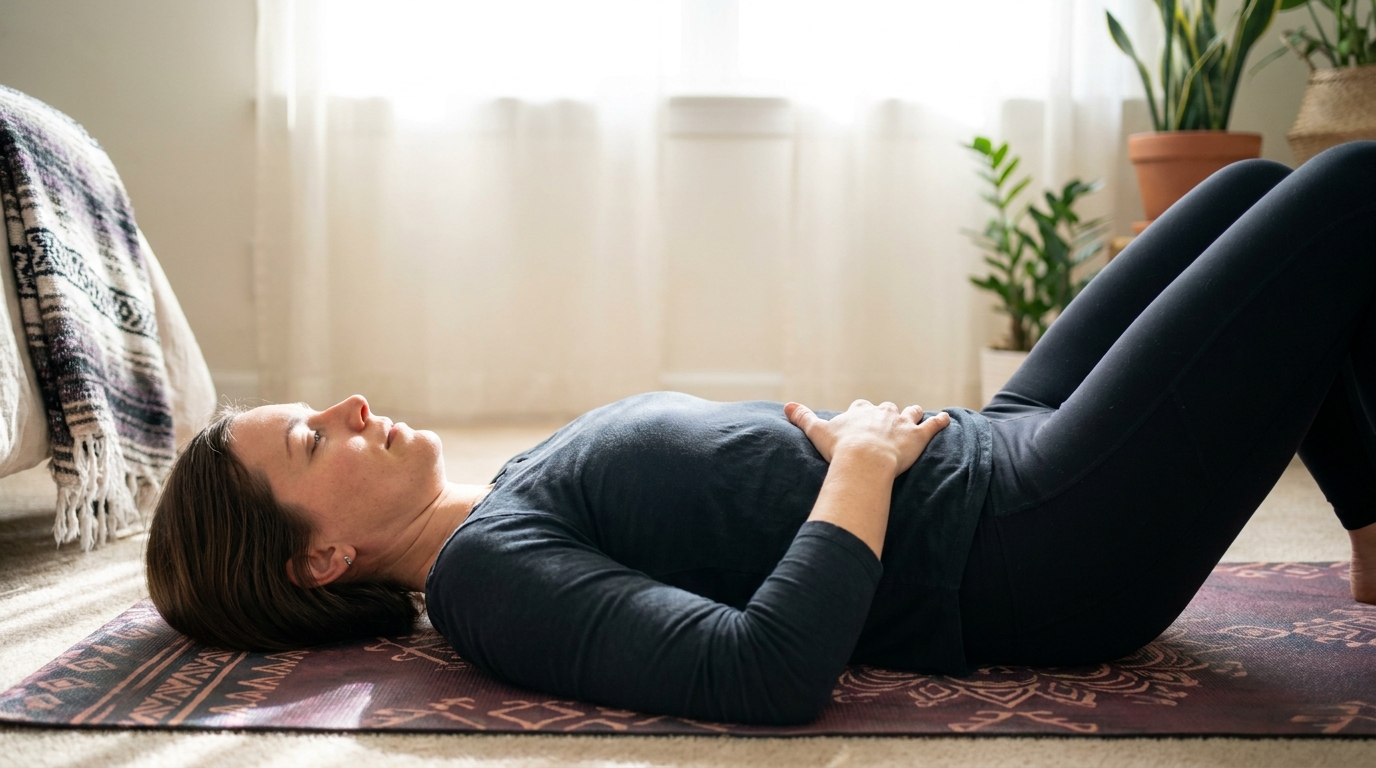
1. Lie on your back on a flat surface with your knees bent and feet flat on the floor 2. Place your fingertips horizontally just above your belly button, palm facing your face 3. Lift your head and shoulders very slightly off the floor (a small crunch, not a full sit-up) 4. Press your fingertips gently into your belly along the midline 5. Feel for a gap or soft area between the two columns of muscle on either side
What you are looking for:
- 0 to 1 finger gap: normal, no diastasis
- 1 to 2 finger gap: mild diastasis, usually heals with consistent gentle rehab
- 2 to 3 finger gap: moderate, definitely worth physio input
- 3+ finger gap: significant, needs specialist physio input and may benefit from longer rehabilitation
Also feel for depth. A shallow gap with firm tissue underneath is better than a deep gap where your fingers sink in and you cannot feel resistance. Depth matters as much as width.
Check above, at, and below the belly button. The gap can be wider in different places.
If the gap is more than 2 fingers wide, if you can feel a bulge or dome when you crunch up, or if you have pain, see a women's health physiotherapist. In the UK you can self-refer to NHS physio in many areas, or pay for a private postnatal-specialist physio for faster access.
The healing window most women miss
The first 8 weeks postpartum is when the connective tissue is most responsive to gentle rehabilitation. After that, healing slows down, though it is still very much possible.
In those first 8 weeks, the things that help the most are not exercises. They are everyday movement patterns:
- Roll to your side before sitting up in bed (do not do a sit-up from flat, ever, for the next 12 months)
- Push up using your arms, not your stomach, to get out of bed or off the sofa
- Brace before lifting the baby, the car seat, anything heavier than a kettle (more on bracing below)
- Exhale on effort: any time you lift something, exhale as you lift, not hold your breath
- Watch posture during feeding: no slumping forward, support your back, bring baby to you rather than hunching down
Breathing well matters too. Deep diaphragmatic breaths (where your belly rises on the inhale and falls on the exhale) gently activate the deep core muscles. Shallow chest breathing does the opposite.
The exercises that actually heal diastasis recti
These are the standard postnatal physio progression. Start with the basics for 2 to 4 weeks before moving on. None of them require a gym or any equipment.
Stage 1: Reconnection (weeks 0 to 4 of starting)
Diaphragmatic breathing. Lie on your back. Hand on belly. Inhale slowly, feel belly rise. Exhale slowly, feel belly fall. 10 breaths, twice a day.
Transverse abdominal (TVA) activation. Same position. As you exhale, gently draw your belly button toward your spine, like you are zipping up tight jeans. Hold for 3 to 5 seconds. Release. 10 reps, twice a day. This is the foundational exercise for everything else.
Stage 2: Strengthening (weeks 4 to 8)
Heel slides. Lie on your back, knees bent. Engage TVA. Slowly slide one heel down the floor until the leg is straight. Slide back. Repeat with the other side. 10 reps each side.
Pelvic tilts. Same position. Engage TVA. Gently flatten your lower back into the floor by tilting your pelvis up slightly. Hold 5 seconds. Release. 10 reps.
Glute bridges. Same position. Engage TVA. Push through your heels to lift your hips off the floor. Squeeze your glutes. Lower slowly. 10 reps.
Stage 3: Integration (weeks 8 onwards)
Modified planks (on knees, never full plank yet). Hold for 15 to 30 seconds.
Standing core work: standing TVA holds, single-leg balance, gentle squats with proper bracing.
By 3 months of consistent practice, most mild and moderate diastasis cases see significant improvement.
The exercises that make diastasis recti worse
Just as important. Avoid these for at least 3 to 6 months postpartum, and longer if your diastasis has not closed:
- Crunches and sit-ups (push the muscles outward, widening the gap)
- Full planks (too much pressure on the connective tissue)
- Russian twists and any rotation-heavy core work
- V-sits, leg raises from flat on your back
- Heavy lifting without proper bracing
- High-impact exercise (running, jumping, HIIT) before the core is reconnected
- Yoga poses that involve deep backbends (upward dog, wheel) without supervision
If you are seeing a doming or bulging line down the centre of your belly during any movement, stop that movement. Doming means the pressure is being pushed against the gap rather than supported by the muscles.
The breath, brace, lift sequence
This is the single most useful skill for daily life. Use it for lifting the baby, lifting the car seat, lifting anything.
1. Breathe in, expanding your belly outward 2. Brace: gently activate your TVA (belly button toward spine) and your pelvic floor at the same time 3. Exhale as you lift
Once you have done this 50 times it becomes automatic. The bracing protects the gap while you do the unavoidable lifting of new motherhood.
When to see a specialist
Most diastasis recti improves with the home approach above. Some situations need professional input:
- Gap of 3 fingers or more after 8 weeks postpartum
- Visible doming or bulging when you cough, lift, or sit up
- Lower back pain that limits daily activities
- Pelvic floor problems (leaking when you sneeze, lift, run, jump)
- A feeling that your core is "missing" or you have no control
- You can feel a soft hole or hernia at the belly button or above
- You are 6+ months postpartum with no improvement despite consistent home work
A women's health physiotherapist will assess your gap, your function (how the muscles work together), and your pelvic floor. They will give you a personalised programme. In some cases they may refer you for ultrasound assessment or, very rarely, to a surgeon for severe cases that do not respond to rehabilitation.
What about belly binders, splints, and shapewear
Postnatal binders and splints can provide some comfort and proprioceptive feedback (helping you feel where your core is) in the first 8 weeks. They do not heal diastasis recti on their own. Used alone without exercise, they can even weaken the muscles further because the binder is doing the support work the muscles should be doing.
If you use one, treat it as a short-term support during the early weeks, not a long-term solution. The actual healing comes from breathing, movement patterns, and the exercises above.
Related reading
- Postpartum Recovery: The First 6 Weeks Nobody Warns You About
- Pregnancy Back Pain That Will Not Quit: What Actually Works
- Foods to Avoid in Pregnancy
What to tell yourself in the bathroom mirror
Your postpartum belly is doing what it is supposed to be doing. It carried a baby. The fact that it is still soft, that the muscles have moved apart, that the shape is not what it was at 25 is not a failing of your body. It is evidence of the biggest physiological feat your body has ever done.
The gap heals. The shape returns, often not identical to before, but recognisable and functional. The lower back stops aching. The core comes back online. Most of the women I know who did consistent gentle rehab for 3 to 6 months saw most of their diastasis close.
You do not need to be at the gym at 6am. You need to be able to do diaphragmatic breathing while feeding the baby and TVA activations during a TV show. That is enough at the start. The body responds to consistency, not intensity.
You have time. Your belly has time. Be gentle with both.