
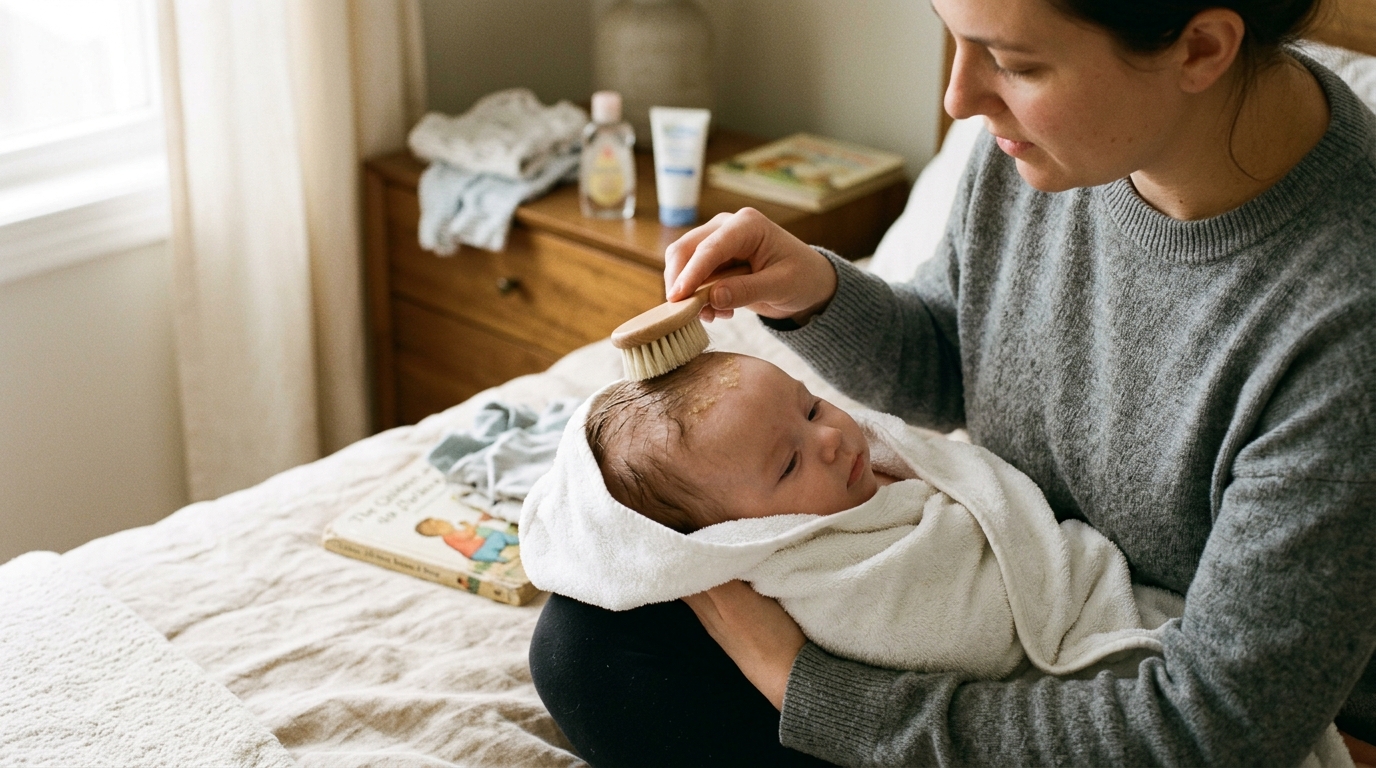
My daughter was about three weeks old when I noticed it under the nursery lamp during a 2am feed. A patch of yellowish, greasy flakes right at her hairline, sort of crusted into her thin baby hair. My first thought was that I had done something wrong. Maybe I was not washing her hair enough, or too much, or the wrong way. I sat there with a milk-drunk newborn on my chest and quietly panicked about a bit of flaky scalp.
If you have found the same thing and felt that small drop of worry, I want to walk you through it, because the answer calmed me right down. Cradle cap is one of the most common and most harmless things you will see on a newborn. In this post I will cover what cradle cap actually is, what causes it, the gentle cradle cap treatment that genuinely works, the things to avoid that can make it worse, and the point where it is worth a call to the doctor.
What cradle cap actually is
Cradle cap is the everyday name for infantile seborrheic dermatitis. That is a long term for a simple thing. It shows up as yellow or brownish flakes, sometimes greasy and crusty, sometimes drier and scaly, usually across the top of the scalp. Some babies get just a small patch. Others end up with most of the scalp covered.
Here is the part that took the fear out of it for me. Cradle cap does not hurt your baby. It does not itch the way eczema does, it is not contagious, and it has nothing to do with how clean your baby is or how good a parent you are. It is incredibly common in the first few months, and most cases show up between two weeks and three months old.
It can look a bit alarming, especially the thick yellow crusts. But your baby will not even notice it is there. This is a cosmetic thing for the most part, not a health problem.
Cradle cap looks worse than it is. Your baby feels nothing, and it almost always clears on its own.
What causes cradle cap
Nobody can point to one single cause, but the leading explanation is pretty reassuring. While your baby was growing, your pregnancy hormones crossed over to them. After birth, those hormones are still floating around in your baby's system for a while, and they nudge the oil glands in the scalp to work overtime.
That extra oil, called sebum, makes old skin cells stick to the scalp instead of flaking away quietly the way they do on the rest of us. So they pile up into those greasy yellow patches. A common, harmless yeast that lives on everyone's skin, called malassezia, may also play a part in some babies.
So when you put it together, cradle cap is basically overactive oil glands plus skin cells that are slow to shed. That is it. Not an allergy, not poor hygiene, not anything you ate while breastfeeding. Once I understood that, the whole cradle cap treatment felt less like an emergency and more like a gentle little routine.
The gentle cradle cap treatment that works
The good news is that a calm, low-effort approach clears most cases. You do not need special products or aggressive scrubbing. Patience is doing most of the work here. This is the cradle cap treatment routine I used, and the one most pediatricians will hand you.
Loosen it with oil
An hour or so before bath time, massage a small amount of oil into the scaly patches. Plain baby oil works, and so do natural options like coconut oil or almond oil. Just a thin layer, gently rubbed in with your fingertip. Let it sit for fifteen minutes to an hour. This softens the crusts so they lift away instead of being forced off.
Brush softly
After the oil has done its job, use a soft baby brush or a very soft toothbrush and make slow, light strokes over the scalp. You are not scrubbing. You are coaxing the loosened flakes to let go. Go in one direction, take your time, and stop the second the skin looks pink or your baby seems fussy. A lot of flakes will come free at this stage, and it is oddly satisfying.
Wash with a mild shampoo
Then wash the hair with a gentle, tear-free baby shampoo to lift out the oil and the freed-up flakes. Massage it in softly, rinse well, and pat dry. If the cradle cap is stubborn, your doctor might suggest an anti-dandruff shampoo with a low dose of active ingredient, but only ask before using one of those on a newborn.
- Oil first, wait, then brush, then shampoo. That order matters.
- Do it two or three times a week, not every single day.
- Rinse thoroughly so no oil is left sitting on the scalp.
- Expect it to take a few weeks. Slow and steady wins here.
What not to do
This is the part I wish someone had said to me out loud, because the instinct to fix it fast is strong. The single biggest mistake is picking at the crusts with your fingernails. I get the urge, believe me. But scratching at it can break the skin, and broken skin can get infected. Let the oil and the soft brush do the loosening.
A few more things to steer clear of:
- No harsh scrubbing. Rough rubbing irritates the scalp and makes redness worse.
- No adult dandruff shampoos or medicated products without your doctor's okay. A newborn scalp is delicate.
- No peeling off a crust that is not ready. If it does not lift with gentle brushing, leave it for next time.
- No panic-buying every cream you see online. Most cradle cap needs oil, a soft brush, and time, nothing fancier.
If you are building out your whole newborn care routine and want a simple daily rhythm to follow, my newborn daily care checklist walks through bath time, skin, and the rest without the overwhelm.
When to see the doctor
Most cradle cap is a wait-it-out situation that clears up on its own by the time your baby is around six to twelve months old. But there are signs that mean it is worth a quick chat with your pediatrician instead of handling it at home.
Call the doctor if you notice:
- The patches spreading beyond the scalp to the face, neck, armpits, or diaper area
- Redness, swelling, warmth, or the skin looking angry rather than just flaky
- Any weeping, oozing, pus, bleeding, or crusts that smell off, which can point to infection
- Your baby seeming genuinely bothered, scratching, or clearly uncomfortable and itchy
- Cracked or broken skin, or patches that keep getting worse no matter what you try
- Hair falling out in the affected areas, or cradle cap that has not budged at all after several weeks of gentle care
Cradle cap that shows up alongside a wider rash or a fussy, unsettled baby can sometimes be eczema or another skin condition rather than plain cradle cap, and those are worth a professional eye. A doctor might prescribe a mild antifungal or steroid cream for tougher cases, and that is a normal, safe next step when home care is not enough.
One more thing worth keeping separate in your mind. Cradle cap flakes are not the same as a yellow tint to your baby's skin or eyes, which is a different thing entirely. If your newborn's skin or the whites of their eyes look yellow, that points toward jaundice, and my post on newborn jaundice and when to call the GP covers exactly what to watch for there.
The bottom line
Cradle cap looks like a problem and feels like a problem when you are a tired new parent staring at it under a lamp at 2am. But it is one of the gentlest things your newborn will go through. A little oil, a soft brush, a mild shampoo, and a good dose of patience is the whole cradle cap treatment for most babies.
My daughter's cleared up completely by around four months, and honestly it faded so gradually that I did not even notice the day it was gone. Yours will get there too. Go easy on that little scalp, and go easy on yourself while you are at it.