
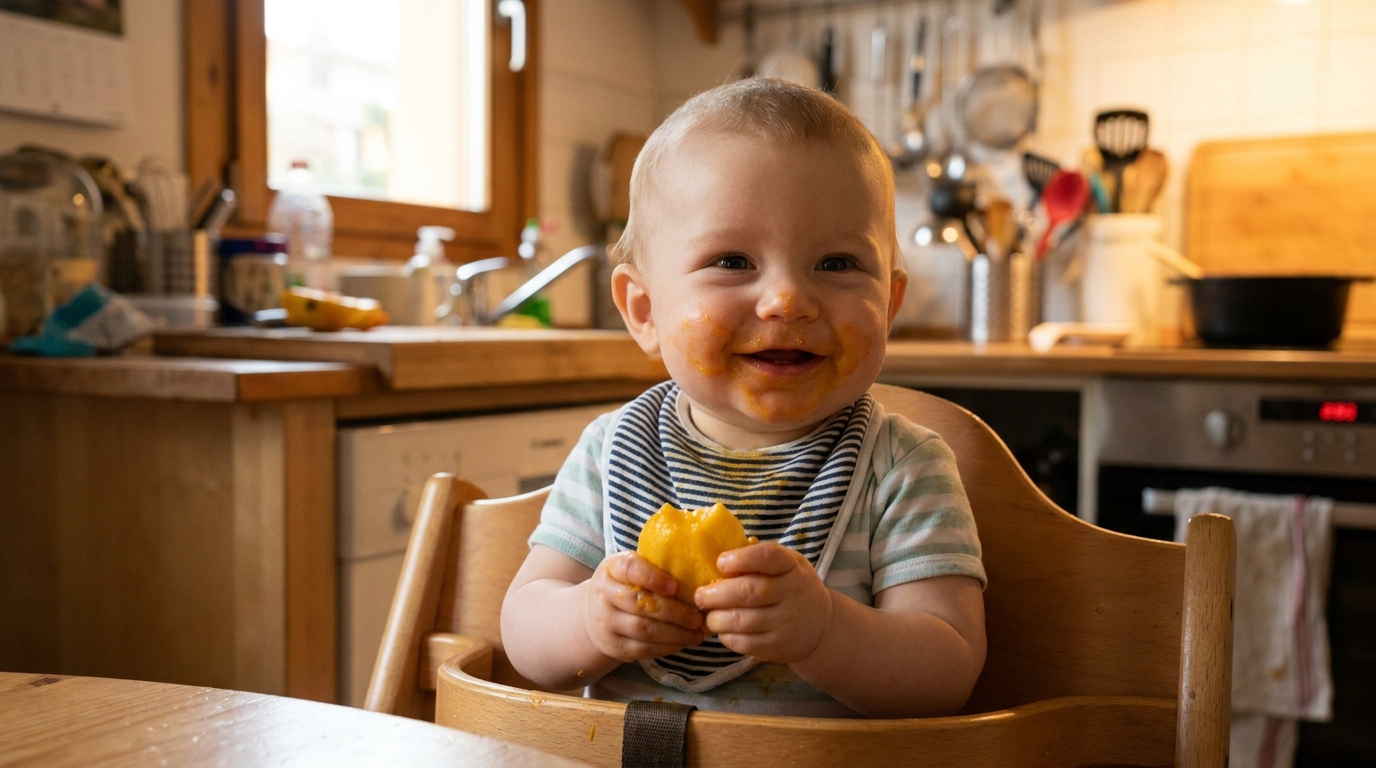
With my first baby I went hard on baby-led weaning. Hand-cut steamed broccoli stems at 6 months. The whole approach. I read the books, joined the Facebook groups, learned what a gag versus a choke looks like, and watched her smear butternut squash through her hair for six months.
With my second I started with purees. Sweet potato mash on a spoon, calm, predictable, less mess. Then around 7 months I introduced finger foods alongside.
Both kids eat well. Both will eat curry, olives, raw red pepper, and a frankly absurd amount of edamame. The difference between the two methods turned out to matter much less than the internet had told me, and the things that actually matter never got mentioned. Here is what I learned by doing both.
What the two methods actually are
Baby-led weaning (BLW) means skipping purees entirely and going straight to soft finger foods that the baby picks up and feeds themselves. Started no earlier than 6 months. The baby is in control of what enters their mouth, how much, and how fast.
Traditional weaning (purees) means starting with smooth spoon-fed purees at around 4 to 6 months and gradually progressing to mashed, lumpy, and eventually finger foods over weeks or months. The parent is in more control of what and how much the baby eats.
Combined approach means using both. Some purees on a spoon. Some finger foods at the same meal. Most families end up here regardless of where they started.
The honest comparison
Both approaches lead to healthy eaters when done well. The differences below are real but small.
Where baby-led weaning wins
- Self-regulation. Babies decide when they are full, which may set up better appetite control later.
- Variety exposure. Babies eat what the family eats, which often means more flavours and textures from the start.
- Family meals. No separate cooking. The baby joins the family at the same food.
- Motor skills. Picking up food trains the pincer grip, hand-to-mouth coordination, and chewing earlier.
- No spoon-rejection later. Some puree-fed babies refuse the transition to lumpy textures around 9 months.
- Less work for the parent. Once you trust the method, dinner does not require pre-prep beyond cutting the right shape.
Where purees win
- Easier to track intake, especially for iron and other key nutrients in the first 8 weeks of solids.
- Lower visible mess, at least at the start.
- Easier in childcare settings where staff may not be trained to supervise BLW.
- Better for premature babies or those with feeding concerns who need more careful early intake monitoring.
- Easier for older relatives to participate without panicking about choking.
- Easier to introduce highly allergenic foods (peanut, egg) in small controlled amounts at first exposure.
Where the methods are roughly equal
- Choking risk. Despite the BLW reputation for being scarier, the choking rate is the same with both methods when safety rules are followed. The difference is what foods are dangerous. With BLW the risk is wrong shapes (whole grapes, raw apple chunks). With purees the risk is feeding too thick too fast.
- Allergy outcomes. Both methods support the current recommendation to introduce allergens early (around 6 months) and frequently.
- Long-term eating attitudes. Studies that have tried to find lasting differences between the methods have not found much. Children raised both ways become children who eat a range of foods if exposed to a range of foods.
The honest truth is that the method matters less than the principles underneath. Offer variety, allow self-regulation, sit at the table together, expose repeatedly to foods that get rejected, do not force.
The safety rules nobody mentions
These apply whether you are doing BLW, purees, or both. The single most important safety rule is supervision: the baby is sitting up, in your line of sight, never lying back, never alone with food.
Always strictly avoid before 12 months
- Whole grapes (cut lengthwise into quarters)
- Whole nuts (use nut butter spread thinly on something soft)
- Hot dogs/sausages cut in coins (cut lengthwise then small pieces)
- Popcorn
- Hard sweets, marshmallows, chunks of cheese
- Raw apple, raw carrot, raw celery (steam them first or grate)
- Chunks of meat with stringy fibres
- Honey (botulism risk)
- Cow's milk as a drink (small amounts in cooking are fine from 6 months)
The shape rules for BLW
Food for a baby who is self-feeding under 9 months should be either:
- Long fingers about the size of an adult finger that the baby can grip with the palm and bite off pieces
- Or large enough to be visibly bigger than the throat so it cannot be inhaled
What you avoid: small round things (cherry tomatoes, grapes, blueberries whole), small hard things (raw nuts, popcorn), small slippery things (slippery banana coins).
Gag vs choke
This is the single most useful skill for BLW parents. A gag is loud, the baby looks startled, may turn red, may bring food back to the front of the mouth. This is normal and protective. Do not intervene. Let them do it.
A choke is silent. The baby cannot make noise. May turn blue. Needs immediate first aid.
Doing a baby first aid course before starting solids is genuinely useful regardless of method. The Red Cross and St John Ambulance run them in the UK. Local paramedics and parenting groups in the US run them. They take 2 to 3 hours and reduce a lot of the BLW anxiety.
How to actually decide
A few honest questions that often clarify which approach suits your family.
How relaxed are you about mess? BLW is genuinely messier in the first 3 months. Floor catcher mats, full-coverage bibs, and tolerance for hair-washed-in-yoghurt are part of the deal. If mess will cause you to feed less often, purees may suit you better.
Are you eating family meals already? BLW is easiest when the baby joins meals you are already preparing. If the household pattern is everyone eating different things at different times, BLW is harder to slot in.
How is breastfeeding or formula going? Solids before 12 months are about exploration and exposure, not primary nutrition. Milk is still the main calorie source. If your baby is a great feeder, you have more flexibility to be slow with solids. If feeding is a battle and you need solids to fill calorie gaps, purees may move faster.
What does your gut say? This sounds soft but matters. If BLW makes you anxious about choking and you feed your baby less because of that anxiety, BLW is not working for your family. If purees feel like extra cooking that you cannot keep up with, they are not working for your family. The best method is the one you can actually sustain.
The combined approach that most families end up using
Most families I know start with one method, try the other within a few weeks, and end up doing both. A typical week looks like:
- Breakfast: oat porridge from a spoon plus a slice of toast finger
- Lunch: hummus with strips of red pepper and pita
- Snack: a banana, half mashed, half offered as a finger
- Dinner: family curry with rice, some on a spoon, some in their hand
The baby learns both spoon and hand. The parent gets to track some intake. Family meals work without overthinking. Nobody is following a manifesto.
This is the version I would do if I started over.
When to talk to a feeding specialist
Most weaning, both methods, goes fine. A few signs that suggest professional input:
- Baby is gagging on every food even after weeks of practice
- Baby is refusing all solids past 8 months
- Baby is consistently not gaining weight as solids increase
- Baby has had a true choking episode
- Baby has known feeding or developmental concerns from earlier
- Baby is showing signs of food refusal anxiety (turning head, crying at sight of the high chair)
A paediatric speech and language therapist (in the UK), a feeding therapist, or an experienced health visitor can assess. Early input is much easier than waiting.
Related reading
- Why Your Toddler Refuses Every Meal You Cook
- 10 Foods Picky Eaters Actually Eat
- How to Introduce a Bottle to a Breastfed Baby
What to tell yourself when the high chair looks like a war zone
Whatever lands on the floor was offered. Offering counts even when nothing is eaten. Babies learn to like food through exposure (often 10 to 20 exposures before a food is accepted), not through forcing.
Your job is not to make her eat. Your job is to put a range of safe food in front of her, sit with her, eat your own meal alongside her, model enthusiasm, and clean up the chaos afterwards. Her job is to decide what and how much.
That division of responsibility is the single biggest predictor of a confident eater at age 4. Not the method. Not the recipes. Not the brand of high chair.
Whichever method you pick, you are doing it right. The mess is the work, not a sign you got it wrong.