
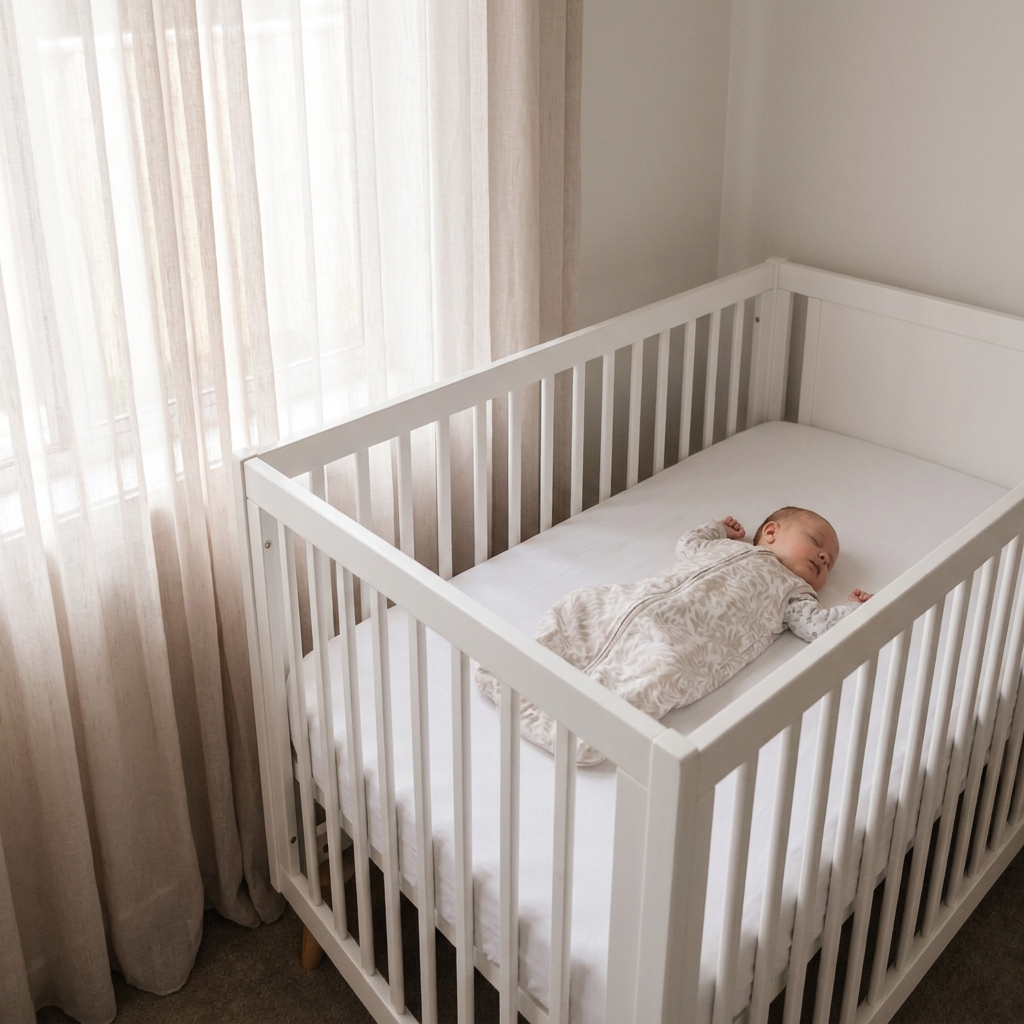
She slept five hours. Six hours. Once, on a Tuesday, almost seven. You started telling people about it. You almost felt human again. You bought yourself a pair of jeans that aren't elasticated.
Then she turned 16 weeks old and the wheels fell off.
Now she wakes every 45 minutes. She's overtired by 9am. She fights every nap. You are back to where you were in week three, except this time you thought you were past it, which somehow makes it worse.
This is the 4 month sleep regression. It's the most universally disruptive sleep change in the first year. And unlike the witching hour, this one isn't temporary fussing. Her sleep has permanently changed.
What actually happened to her sleep
Until around 16 weeks, babies sleep in two simple stages: deep and light. They drift between the two without much architecture. That's why you can transfer a newborn from your arms to a cot without waking her.
Somewhere between 12 and 20 weeks, her brain rewires sleep to match adult patterns. She now has four sleep stages, with brief wake-ups between each cycle. Every 45 to 50 minutes, she surfaces to almost-awake, checks her surroundings, and either falls back asleep or doesn't.
This isn't a phase she grows out of. Adult sleep works the same way. The "regression" isn't a step backwards. It's a permanent forward step that happens to land in the worst possible week of your life.
Why this version is so much harder than the others
The 4 month regression hits different because:
1. She has no skills yet. A 7-month-old who wakes between cycles can self-settle if she's been given the chance to learn how. A 16-week-old can't, because that skill is still months away from being developmentally available. 2. Every wake is real. Before this, half her wakings were just noise. Now every wake is a fully conscious "where am I, where is my person, why is it dark." 3. It comes with a leap. Around the same time her brain is also working on neck control, social smiling, and recognising voices. Big leap, big sleep mess.
What works (and what doesn't)
There's no magic fix because there's no problem to fix. Her sleep is now permanently more like ours. But there are five things that help her ride it out.
1. Front-load daytime sleep
A 4-month-old still needs 14 to 17 hours of total sleep per 24, with 4 to 5 of that during the day. Overtired babies do not sleep well at night. Counterintuitive but real. If she's only napping in 20-minute bursts, work harder on the nap, not the night.
2. Watch the wake windows, not the clock
At this age, awake time between sleeps is around 90 minutes to 2 hours. Past that and her cortisol spikes, which makes the next nap and the night much harder. The clock doesn't matter. The wake window does.
3. Start a real bedtime routine
Even at 4 months. Bath, feed, song, dark room, white noise. Same order, same place, every night. She's not too young. Her brain is now wired for pattern recognition, and a consistent sequence tells her body that sleep is coming.
4. Don't introduce sleep crutches you'll later need to remove
This is the controversial one. Rocking, feeding, holding her all the way to sleep are fine when you're surviving. But anything she falls asleep with, she will need to fall back asleep with at every wake. If you're rocking her for 40 minutes at midnight, that's a sign the rock is now a sleep association rather than a comfort.
Lay her down drowsy but awake when you can. Even if it doesn't work yet. You're not sleep training. You're laying the groundwork for the skill she'll learn around month six.
5. Stop tracking the wakes
The sleep tracking apps will ruin you in this stretch. You will count five wake-ups, sigh, count six, sigh louder, and lose another half-hour of your own sleep just to log it. Stop. The number doesn't change what you do next. Put the phone face down.
When the regression actually ends
Most babies move through the 4 month regression in two to six weeks. By month five or six, she'll start linking her sleep cycles more reliably. By seven to eight months, with consistent routines, most babies sleep meaningful stretches.
She is not broken. Her sleep is not broken. Her brain just upgraded its operating system overnight and didn't tell you.
What you actually need to hear
This is the worst stretch of new-baby tiredness, and you're allowed to admit it. Your partner is allowed to admit it. Your mum is allowed to admit it. There is no version of this that feels okay while you're inside it.
But you are still doing it. You're feeding her, comforting her, walking her, holding her. She's getting everything she needs. The fact that you haven't slept four hours in a row in three weeks doesn't mean you're failing. It means you're parenting a 4-month-old.
It ends. Not tonight. Probably not this week. But before her half birthday, you will sleep again. And one Wednesday you'll wake up and realise it's been five hours and she's still in the cot, and you'll cry a little, and then you'll go check on her because you can't actually believe it.
That morning is coming. Tonight, you survive. That's the whole job.