
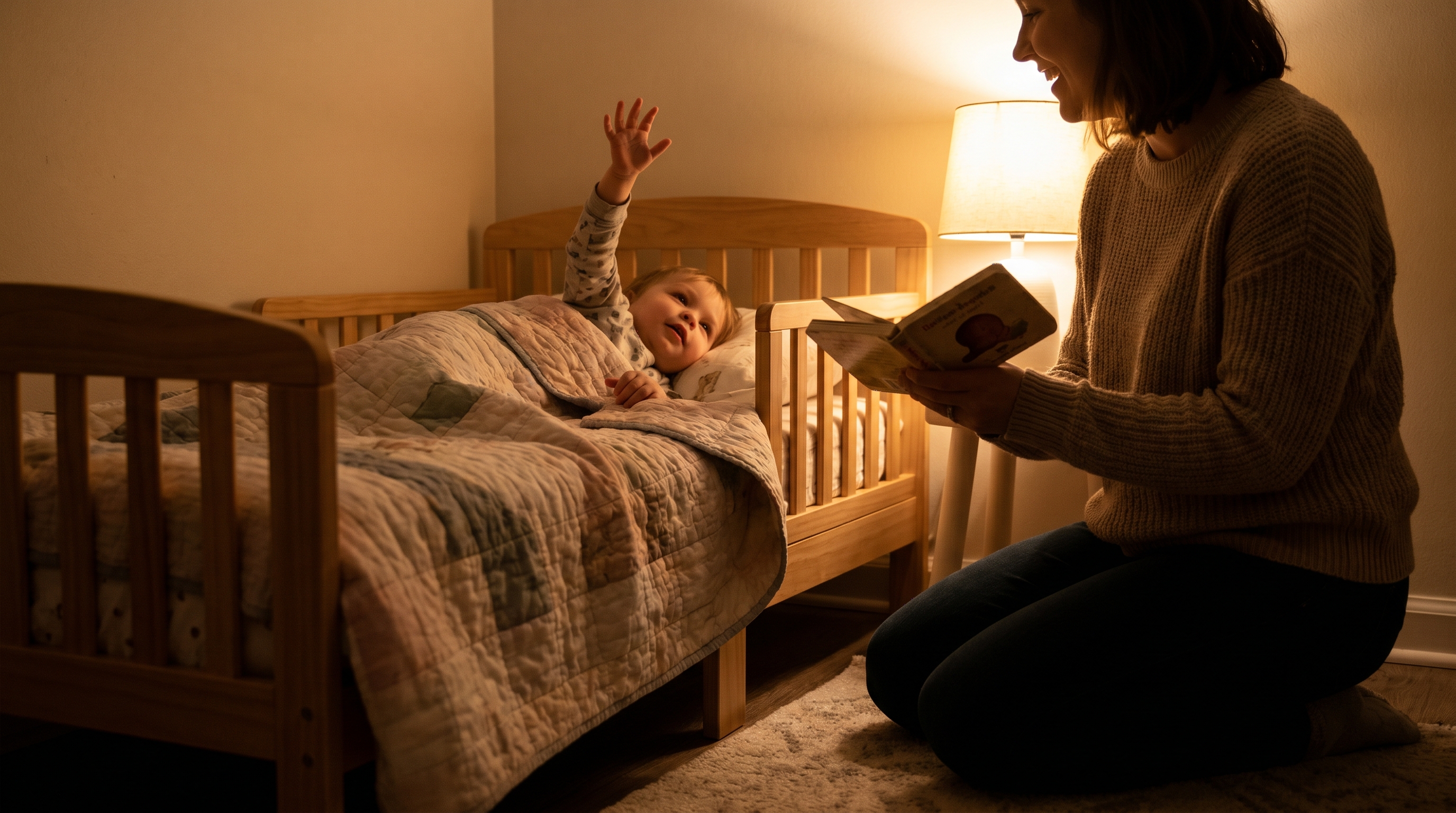
She had been a textbook sleeper for a year. 7pm down, 7am up, no fuss, no calls in the night. The kind of sleeper other mums quietly resented at toddler group.
Three weeks after her second birthday, she started getting out of bed. By week two she had figured out how to climb out and walk to our bedroom. By week three I was lying on the floor of her room at midnight trying to get her to sleep so I could sneak out. Bedtime had gone from twenty minutes to two hours.
I assumed I had done something wrong. I had not. She was hitting the 24 month sleep regression, which is one of the bigger ones, and almost nothing in the parenting books had prepared me for it.
Here is what is actually happening and what works to get through it.
What the 24 month sleep regression actually is
The 24 month regression is one of the most disruptive of the toddler sleep regressions. It typically lasts 4 to 6 weeks (longer than the 12 month version), and unlike the earlier regressions, it is mostly driven by emotional and cognitive development rather than physical growth.
Three big things are happening at the same time around the second birthday:
1. Massive language explosion. Many 2-year-olds go from 50 words to 500 in a few months. The brain is processing language overnight, which disrupts sleep. 2. Separation anxiety wave 2. The first wave happens around 8 to 10 months and is mostly soothed by repeated reassurance. The second wave at 2 is more sophisticated. The child can now imagine you not being there and worry about it in advance. 3. Imagination and fears. Around 24 months, children start developing an internal imaginative life. They can think about monsters, the dark, things under the bed, scary characters from books, in a way they could not before. Many night-waking episodes at this age are fear-based.
Add in any of these and sleep falls apart:
- Climbing out of the cot
- Transition to a toddler bed
- Starting nursery or having a new childminder
- A new sibling or pregnancy in the family
- A house move
- Potty training underway
The 2-year-old nervous system handles change by regressing to behaviours that previously got support. Night-waking is one of those.
The signs of the 24 month regression
The clearest signs:
- Sudden bedtime resistance after a previously easy bedtime
- Repeated stalling tactics: one more story, one more drink, one more wee, one more cuddle
- Calling out for you repeatedly after lights out
- Climbing out of the cot, or getting out of bed if already in a toddler bed
- Refusing the nap, or shortening it dramatically
- Waking at night and wanting you to lie down with them
- New fears at bedtime that were not there before (monsters, dark, being alone)
- Crying at the start of the day for no apparent reason
Daytime mood often shifts too. More clingy. More tantrumming. More "no" to everything. The brain is overwhelmed and you see it everywhere, not just at sleep.
What is different from earlier regressions
The thing that surprised me most about the 24 month version was that the strategies that worked at 4 months and 8 months stopped working. Letting her cry it out, even briefly, escalated her. Quick boring resettling did not register because she was old enough to negotiate, plead, and follow me out of the room.
The 24 month regression needs a different approach: more connection, more clear boundaries, less re-training. The goal is not to teach her something new. The goal is to maintain the existing rules with extra reassurance while she rides through the developmental wave.
What actually helps
After two of these (one with each kid), here is what consistently works.
Move bedtime earlier, not later
Overtired children at this age are nearly impossible to settle. If your child has been going to bed at 7:30pm and bedtime is now taking 90 minutes, try 7pm. If still hard, try 6:45pm for a fortnight. They are not less tired, they are more tired because they are processing more. Earlier bedtime gives the body more time to wind down.
Add one specific reassurance to the bedtime routine
This is the single most useful addition. Pick one small new ritual that addresses the fear or anxiety driving the resistance, and do it identically every night.
Examples that work:
- "Monster spray" (water in a spray bottle, sprayed under the bed and in the wardrobe each night, "now your room is safe")
- A specific torch by the bed she controls and can turn on if she wakes
- A photo of you in a small frame she can hold
- A line you say at every goodnight: "I love you. I am downstairs. I will check on you when I go to bed. See you in the morning."
The point of the ritual is that it is identical every night so the brain stops needing to question it.
Hold the boundary, calmly
Every parent of a 2-year-old eventually does the thing where they lie down in the child's room until they fall asleep, then sneak out, then the child wakes at 2am realising they are alone, then it gets worse.
If you can avoid getting into that pattern, do. The boundary that works: cuddle, song, kiss, leave the room while she is still awake. If she gets out of bed, lead her back without conversation. If she calls out, brief calm reassurance from the doorway, no entering the room.
This is hard. It works within 5 to 10 days for most children. The alternative (staying in the room) often extends the regression to months.
Cap the negotiations
Toddlers at this age are master negotiators. Books are the most common stalling tactic. Set the number before bedtime starts.
"Two books tonight. You pick one and I pick one. Which one is your one?"
When the second book ends, close it firmly. Same with water, weeing, cuddles. Pick a number. Stick to the number. The negotiation closes when you stop negotiating.
Use an OK-to-wake clock
These are clocks that change colour at a set time. Red until 6:30am, green at 6:30am. Children at this age understand colours and can be taught the rule.
The clock works for both early morning waking and middle-of-night waking. The child learns: red means stay in bed, green means come and find me. It removes you from the negotiation. The clock is the rule, not you.
Hatch Rest+, Gro-Clock, and several other brands all do this. Around £30 to £60 each.
Address the daytime triggers
Sleep regressions at this age are often downstream of daytime stress. Check the obvious:
- Is she just starting nursery? The settling period commonly triggers sleep regression. (We covered this in Starting Nursery.)
- Is there a new sibling or one on the way?
- Has the family routine changed recently?
- Is she watching anything before bed that might be feeding into the night fears?
- Is the nap still happening when it should not, or not happening when it should?
Many 2-year-olds are in the middle of dropping the nap or shifting it earlier. A child who naps until 3pm and is being put to bed at 7pm often is not actually tired enough at 7pm any more.
What does not work at 24 months
A few approaches I have seen fail:
- Punishment or threats ("if you don't sleep, no story tomorrow"). Worsens fear.
- Reasoning extensively at bedtime. Engages the negotiating brain at the wrong time.
- New rewards every night ("if you sleep, you get a sticker"). Sets up reward dependency for the basic skill of falling asleep.
- Letting them stay up later thinking they will be more tired. Backfires consistently.
- Cry it out. May have worked at 6 months. At 2 years it creates fear and erodes trust.
- Co-sleeping for the first time without intention. Becomes the new normal hard to undo later.
The methods that work at 6 months mostly do not work at 24 months. The child is now too cognitively complex.
How long it lasts
Most 24 month regressions last 4 to 6 weeks with consistent boundaries and the reassurance approach above. Without consistent boundaries, they can stretch to 3 to 6 months. The single biggest predictor of duration is the parent holding the line.
By the end of the regression, sleep typically returns to its pre-regression pattern, often with the addition of the new bedtime ritual (which becomes a permanent feature of the routine).
When to talk to your GP or health visitor
Most of the regression is normal and resolves. Some situations need professional input:
- Severe anxiety at bedtime that includes crying for over an hour every night
- The child appears terrified or has hallucination-like fears
- Loud snoring, gasping, or restless breathing in sleep (possible sleep apnoea)
- Wetting the bed after months of being dry
- Daytime behaviour changes that go beyond the usual 2-year-old tantrumming
- Persistent regression beyond 8 weeks with no improvement
A quick conversation often clarifies whether something else is happening.
Related reading
- Toddler Bedtime Battles: The 3-Step Routine That Ends Them in a Week
- Nightmares vs Night Terrors: How to Tell Which One You Are Dealing With
- Toddler Refusing Nap: The Real Reason and What to Do
What to tell yourself in week three
Your child is not broken. You did not undo all the work. This is what 2-year-old brains do, and the same brain that is keeping you up at midnight is also the brain that just said its first proper sentence and can now name colours.
The settled sleeper returns. It returns in about 4 to 6 weeks of you holding the routine, holding the boundary, adding one small reassurance, and not panicking.
You will not remember this regression in six months. Your child will not remember any of it. The current version of bedtime is temporary even though it feels endless. Hold the line, leave the room, trust the process.
You have done this before. You can do four more weeks.