
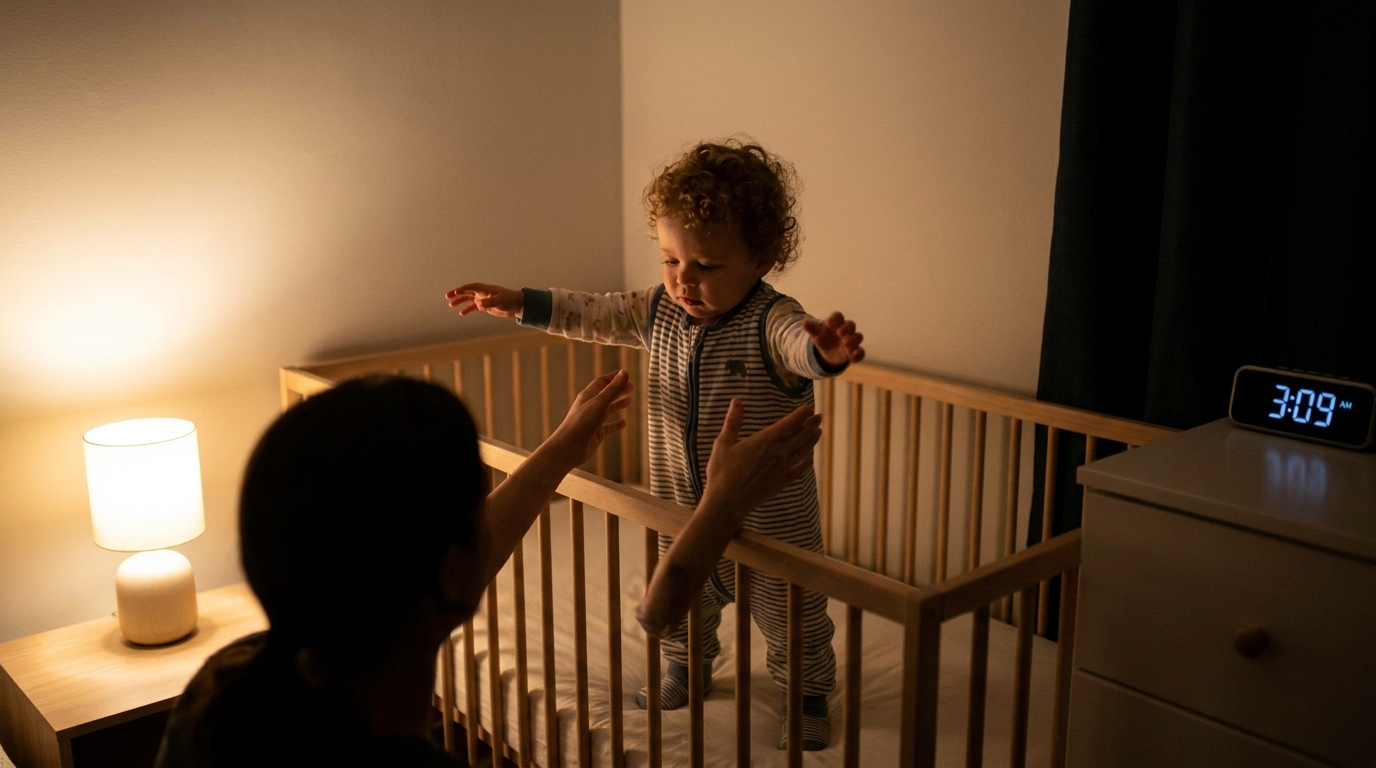
She turned one on a Tuesday. By that Friday she was waking at 3am every night and refusing her afternoon nap. By the following Tuesday I was crying into my coffee at 7am, googling "12 month sleep regression real or fake," and finding articles with completely contradictory answers.
The truth, after going through it twice with two kids, is that the 12 month sleep regression is real, but it is also often confused with something else happening at exactly the same age: the first molars cutting through. The two look almost identical from the outside, but they need different responses.
Here is how to tell them apart and what actually helps.
What the 12 month sleep regression actually is
A sleep regression is a period where a previously settled sleeper suddenly stops sleeping well. The 12 month version is less talked about than the 4 month or 18 month versions, and many babies skip it entirely. The ones who get it usually show some combination of:
- Sudden waking in the night after weeks of sleeping through
- Refusing one or both naps that were previously reliable
- Bedtime resistance after a settled bedtime routine
- More clingy and wanting comfort at night
- Shorter naps when they do happen
The biological reason: at around 12 months, the brain is going through a major cognitive leap. New skills are landing fast (walking, words, social awareness, separation understanding). The same surge of brain development that produces those skills also disrupts sleep, because the brain is processing during the night what it learned during the day.
For the babies who do get it, the 12 month regression usually lasts 1 to 3 weeks. Longer than that and you are probably looking at something else.
What is happening with teething at the same age
Around 12 to 18 months, the first molars (the big back teeth) start cutting through the gums. These are the most painful teeth to come in. Unlike the front teeth that broke through one at a time months earlier, molars often come in pairs or quartets, with multiple teeth pushing through at once.
The classic signs:
- One or both cheeks visibly redder than usual
- Drooling more than normal
- Chewing on fingers, fists, or toys with the back of the mouth (not the front)
- Refusing food that needs chewing but accepting purees or yoghurt
- Pulling at one ear or the side of the head (the pain often radiates to the ear)
- Slight low-grade temperature (under 38 degrees C; higher than that is illness, not teething)
- Waking at night with a sharp distinct cry, not the usual fussy whimper
If you can feel a hard ridge in the back gum when you run a clean finger along it, that is a molar pushing up.
How to tell which one you are dealing with
This is where most parents get stuck. The two conditions overlap so much that telling them apart in the first few nights is genuinely hard.
The clearest distinguishing features:
| Feature | 12 Month Regression | Molar Teething | |---|---|---| | Cry type | Frustrated, calling for you | Sharp, pained, sudden | | Soothes with cuddle | Yes, often | Briefly, then returns | | Soothes with painkiller | No difference | Settles within 30 minutes | | Daytime mood | Often newly clingy, separation-anxious | Often miserable when bite pressure is on | | Drooling | Normal | Excessive | | Cheeks | Normal | Often red, often one side | | Time of waking | Multiple times, often early morning | Often at the same time each night | | Lasts | 1 to 3 weeks | 3 to 7 days per tooth |
The single most useful test: give a dose of infant ibuprofen or paracetamol at bedtime for two consecutive nights. If sleep dramatically improves both nights, you are dealing with teething pain. If sleep is roughly the same, you are dealing with a regression.
Sometimes the answer is both at once. That is the version most parents I know actually face.
What helps if it is a regression
The single most important rule of any sleep regression: do not create new sleep habits in week one. The waking is temporary. Whatever you do for three nights becomes the new expectation.
- Keep the existing bedtime routine identical. Same bath, same books, same song. The familiar pattern reduces the brain disruption.
- Resettle in the cot, not by bringing the baby to your bed. (Unless co-sleeping was already your normal pattern.)
- Resist the urge to add a feed back if you had dropped the night feed. Babies of this age very rarely need calories at night.
- Maintain wake windows during the day. A 12 month old needs about 5 to 6 hours of total daytime sleep awake between sleeps, split across one or two naps. Pushing them past their window makes night sleep worse, not better.
- Get sunlight on them in the morning. 15 minutes of bright light within the first hour of waking helps reset their circadian rhythm.
- Stay calm during night-waking. Quick, boring, minimal-talk resettling. Drama at 3am extends regressions.
If your baby is still on two naps and the regression includes nap refusal, that may be the trigger. Some babies drop the morning nap at 12 to 14 months. If the morning nap has gone from 1 hour to 15 minutes for a week or more, try dropping it and moving to one longer afternoon nap. Sometimes that fixes the night-waking on its own. (We covered this transition in detail in Dropping the Morning Nap.)
What helps if it is teething
Different toolkit entirely.
- Painkiller before bed. Infant ibuprofen or paracetamol at the correct weight-based dose lasts about 6 to 8 hours. Give the dose 30 minutes before bedtime so it kicks in before the first waking.
- Cold teething aids. A teething toy from the fridge (not the freezer) for 15 minutes before bed numbs the gums.
- Wet flannel from the freezer. Tie one corner of a clean flannel, wet it, freeze it. The wet end becomes a teething chew that babies of this age can grip and chew on.
- Cold food before bed. Yoghurt, smoothies, frozen breastmilk pops, anything cold reduces gum inflammation.
- Massage the gums. Wash your hands, then gently massage the bulging gum with a finger before bed. Many babies actively appreciate this.
- Avoid teething gels with benzocaine (not safe in babies). Some other gels are fine. Ask your pharmacist.
Do not assume every night-waking around 12 months is teething. Some parents reach for painkillers every night for months. If painkillers do not help, the cause is not teething.
When to call your GP
Most 12 month sleep disruption is biological and resolves. A few situations warrant a GP:
- The "regression" has lasted more than 3 weeks with no improvement
- The baby has a fever over 38 degrees C, pulling at the ear, or other signs of infection
- Sleep is disturbed alongside reduced feeding, weight loss, or significant behavioural changes
- Loud snoring, gasping, or pauses in breathing (could indicate enlarged tonsils or sleep apnoea)
- You suspect a urinary tract infection (very common cause of mystery night-waking in toddlers; smelly urine, fewer wet nappies, irritability)
- You are concerned about anything else
A quick GP appointment can rule out simple things in 10 minutes. Worth doing if the sleep disruption is not following the typical curve.
Related reading
- Dropping the Morning Nap: The Real Signs She is Ready
- The 4 Month Sleep Regression
- The 8 Month Sleep Regression Is Real
What to tell yourself at 3am holding a screaming toddler
You did not break her sleep. You did nothing wrong. This phase has a biological cause and will resolve in days or weeks, not months.
The version of your child you had a week ago will return. The walking and the new words and the social leap are the price of the regression. By the time her sleep is settled again, she will probably be doing something new that she could not do before the regression started.
Until then. Same routine. Quick boring resettling. Painkiller if molars are involved. Earlier bedtime if she is showing tired signs. Sunlight in the morning. Patience for two more weeks.
You can do two more weeks. You have already done a year of this.