
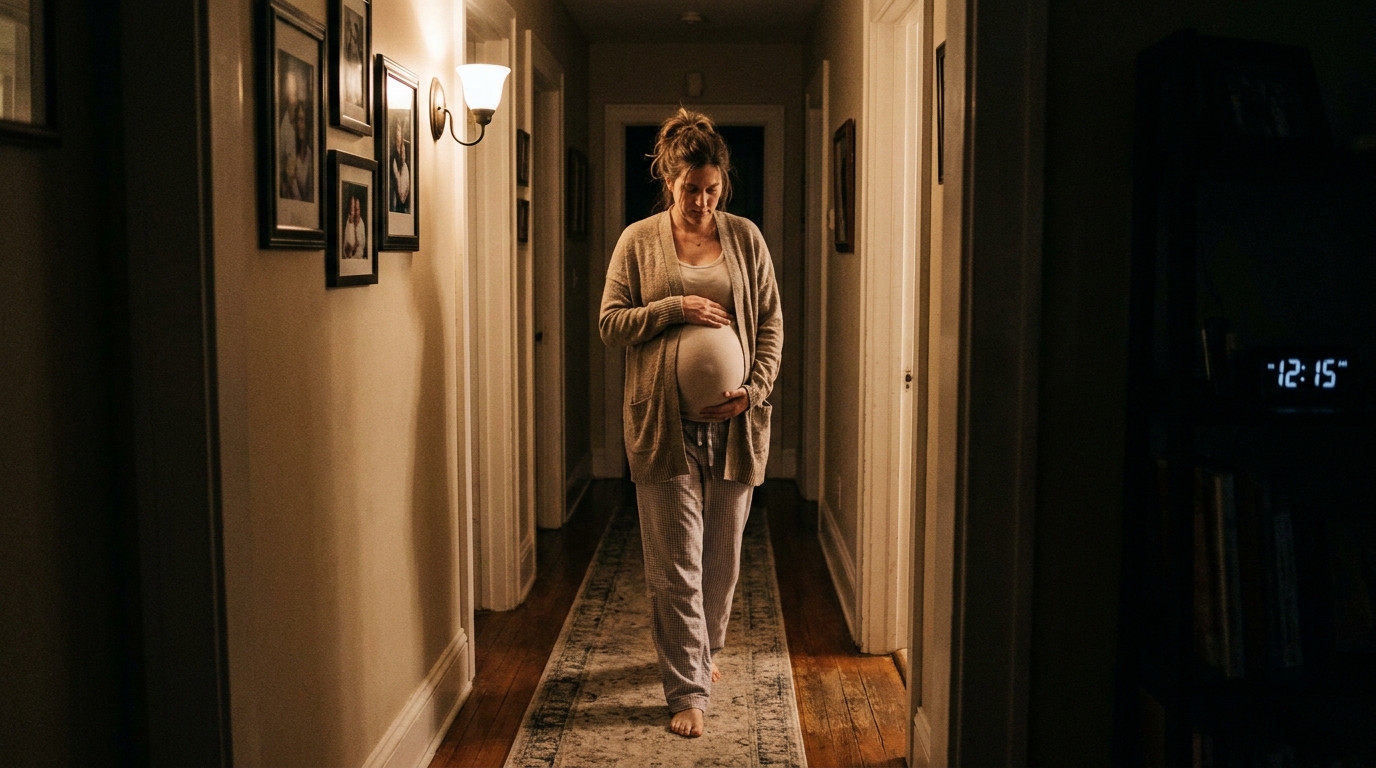
Around 1am I started getting period cramps. Not bad. Just the dull ache I usually get the night before my period starts. I made a cup of tea, sat on the sofa, and decided this was probably a sign that the baby was getting close, but not tonight.
By 4am I was on my hands and knees on the kitchen floor breathing in a way that scared the cat. By 11am I was in hospital. By 8pm she was on my chest.
The thing nobody could quite tell me beforehand was what contractions actually felt like. The leaflets said "tightening sensations." My mom said "like really bad period cramps." My prenatal teacher said "your body will know." None of those prepared me for what it was actually like, hour by hour. So this is the version I would have wanted to read at 36 weeks: what do contractions feel like at each stage, in plain words, from someone who has done it twice.
The early sensation that nobody describes well
The very first sensation of true labor contractions is usually not what you expect.
For me, both times, it was a deep low ache that sat across the front of the bump just above the pubic bone, plus a tightening that I could feel as a hard ridge when I put my hand on the lower bump. It did not really hurt. It just kept happening every 10 to 20 minutes, getting slightly longer each time.
Other women describe the first sensation differently:
- Sharp lower back pain that comes and goes (especially if the baby is back-to-back)
- Cramping like the first day of a heavy period
- An achy tight band wrapping from the back to the front
- A sense that the bump is pulling itself into a different shape
- For some women, surprisingly, no pain at all in early labor, just hardness
If you are feeling any of these in a pattern that repeats every 10 to 30 minutes, you are probably in early labor. The body knows what it is doing even when the brain has not caught up.
How to tell contractions apart from Braxton Hicks
This is the first thing every pregnant woman wants to know. Braxton Hicks (also called practice contractions, where the uterus tightens to prepare for real labor) feel very similar to early real contractions, which is genuinely confusing.
The difference, in practice:
| Braxton Hicks | Real contractions | |---|---| | Irregular, no pattern | Regular pattern that gets tighter together | | Stop when you change position or have a glass of water | Keep going regardless of position | | Last 15 to 60 seconds | Get longer, 30 to 90 seconds | | Not painful for most women | Become uncomfortable, then painful | | Do not get stronger over time | Get noticeably stronger over hours | | Often happen in evening after a long day | Often start at night during sleep |
The simple test most midwives suggest: if you can talk through them comfortably, they are probably Braxton Hicks. If you have to stop talking, breathe through them, and lose your train of thought, you are in early labor.
The stage-by-stage timeline of what contractions feel like
Labor has three stages, and contractions feel completely different at each.
Stage 1: Early labor (cervix dilating to 6cm)
This is the longest stage, usually 6 to 12 hours for a first baby (sometimes much longer), and can be hours shorter for a second.
What contractions feel like here:
- Period cramp intensity, growing slowly
- 30 to 45 seconds long
- 5 to 30 minutes apart at first, gradually closer
- Manageable with breathing, walking, leaning, swaying
- You can still talk between them
- You can usually still eat, drink, watch TV, sleep between them
- Sleep is genuinely the best thing if it is the middle of the night, because the contractions often pause when you doze
This is the stage where most women stay at home. The 5-1-1 rule (contractions 5 minutes apart, lasting 1 minute, for 1 hour) is the standard signal that early labor is shifting into active labor, and that is when most hospitals want you to come in. We covered the timing rules in The 5-1-1 Rule for Contractions.
Stage 1: Active labor (6cm to 10cm dilated)
The shift from early to active labor is usually obvious. You suddenly cannot watch TV. You cannot really talk during contractions any more. You are vocalising, moaning, swaying.
What contractions feel like here:
- A wave that builds, peaks, and fades
- Usually starts low in the back, wraps around to the front
- 60 to 90 seconds long
- 3 to 5 minutes apart
- Strong enough that you need a coping technique (breath, sway, vocalise, water)
- Recovery between contractions is shorter
- You may feel hot, sick, or shaky between contractions
- For many women this is when the request for pain relief or the move to hospital happens
This is the stage to go to hospital or call your midwife (for a home birth). It usually lasts 2 to 6 hours but varies hugely. (If you are debating when to leave home, see How Long Can You Stay Home During Early Labor.)
Stage 1: Transition (8cm to 10cm)
Transition is the shortest, most intense part of labor and the part most women are not warned about. It usually lasts 30 minutes to 2 hours.
What transition contractions feel like:
- The most intense pain of the whole labor for most women
- 90 seconds or longer, sometimes nearly back-to-back with no break
- A feeling that you cannot do this any more (this is actually a sign you are nearly there)
- Shaking, vomiting, panic for many women
- A sense that the baby is finally moving down
- Some women describe pressure rather than pain (especially if they had an epidural)
The phrase "I cannot do this" is so reliably transition that experienced midwives often respond by saying "you are nearly there." Because you usually are.
Stage 2: Pushing (10cm to baby out)
Pushing contractions feel completely different from labor contractions. They are not painful in the same way. Most women describe them as:
- A huge, uncontrollable urge to bear down
- Pressure low in the bottom, "like needing the biggest poop of your life"
- A burning sensation as the baby crowns (called the ring of fire)
- The contractions are shorter and less frequent than transition
- You are doing something with each one, which makes them feel productive rather than just painful
This stage can be 20 minutes for a second baby or 2 to 3 hours for a first. Most women feel relief at this stage even though it is physically intense, because the work is finally moving toward something.
Stage 3: Delivering the placenta
A few small contractions about 5 to 20 minutes after the baby is born. Often barely noticed because you are looking at a baby on your chest. Done.
Back labor specifically
If your baby is in the back-to-back position (called occiput posterior, where the baby's spine is against your spine), contractions feel very different.
- The pain is mostly in the lower back, not the front
- Between contractions, the back pain often does not fully go away
- Heat, counter-pressure on the lower back, and being on hands and knees help significantly
- Back labor often takes longer because the baby has to rotate before being born
Around 1 in 10 babies stays back-to-back into active labor. If yours does, it is harder, but it is still possible to have a vaginal birth in most cases. The team will encourage positions that help the baby rotate.
What helps when contractions hit hard
What got me through (and what most experienced doulas and midwives confirm):
- Breathing: slow in through the nose, longer out through the mouth, especially during the peak
- Movement: walking, swaying, slow dancing, leaning on something
- Position: avoid lying flat on your back, which intensifies pain. Side-lying, all-fours, leaning forward all help.
- Water: a deep warm bath or shower in active labor is sometimes called "the natural epidural" for a reason. It can take the edge off contractions dramatically.
- Vocalising: low moaning, not high screaming. Low sounds keep the throat and pelvic floor relaxed.
- Counter-pressure: someone pressing firmly on your lower back during contractions (especially for back labor)
- Heat or ice packs: on the lower back
- A familiar smell: lavender, the dressing gown you brought from home, something grounding
If pain relief is needed, the options range from gas and air (Entonox) to opioids (pethidine, diamorphine) to epidural. None of them is failing. They are tools available for a reason. (For the doula conversation on labor support choices, we wrote a whole separate piece.)
When to call the hospital
The standard advice for a first baby:
- Contractions 5 minutes apart, lasting 1 minute, for at least 1 hour
- Or your waters break (see How Long After Your Water Breaks Before Labor Starts)
- Or reduced fetal movements at any point
- Or any bleeding (other than a small bloody mucus show)
- Or anything that feels wrong to you
For a second or subsequent baby, things often move much faster and the hospital will usually want you in sooner. Trust your instinct over the 5-1-1 rule if your body is telling you to go.
What to tell yourself at 2am with the first real contraction
This is it. The thing you have been preparing for is starting. It will take hours, probably more hours than you expect, and it will not look like the films. But you are doing it, and your body knows the steps even when your mind does not.
The contractions are going to get harder. They are also going to get faster, which sounds bad but means they are doing the actual work of opening the cervix and moving the baby down. Each one is one closer to the end.
You do not have to be brave. You can vocalise, you can complain, you can ask for the epidural, you can change your plan. Birth is not a performance. It is a physical event you are getting through, and getting through it however you can is the win. By tomorrow night, the contractions will be a memory and the baby will be on your chest. That part is closer than it feels right now.