
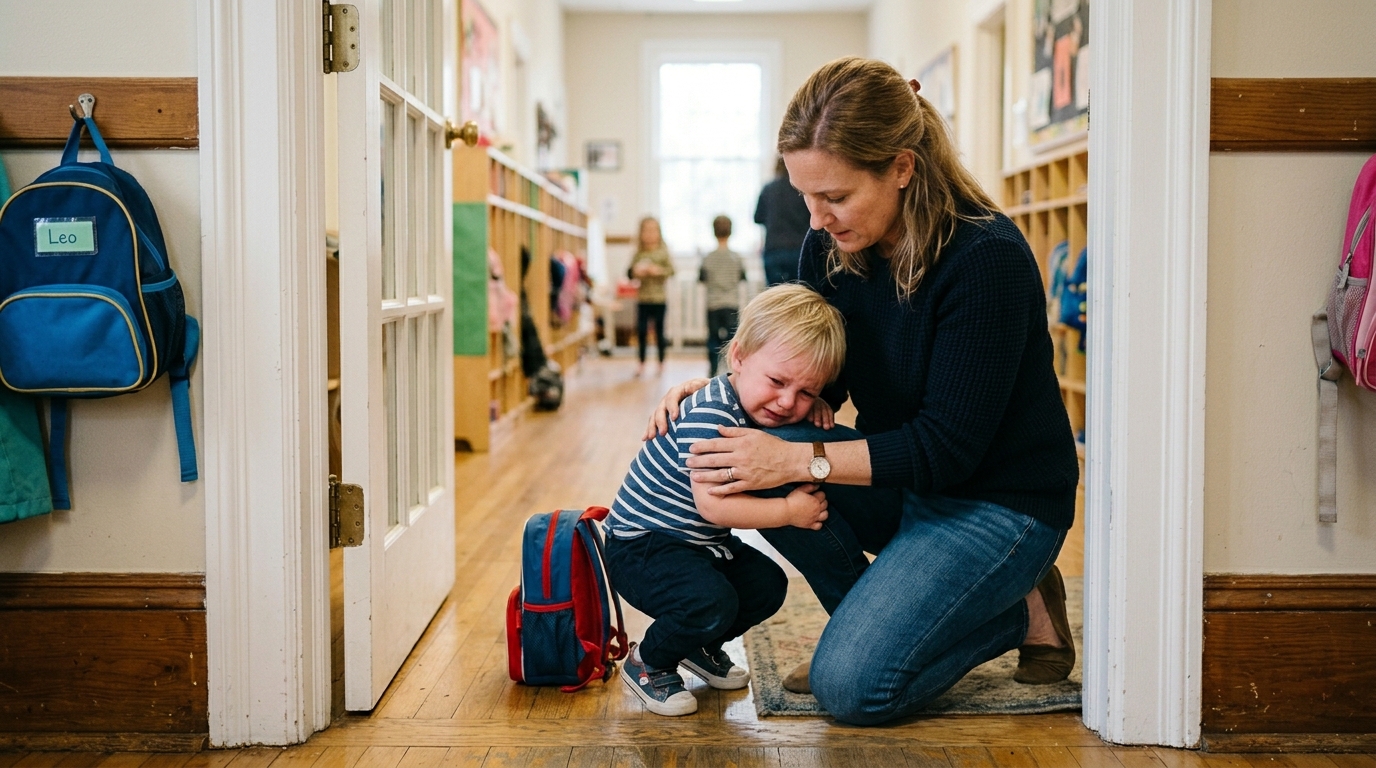
My daughter went through a phase at about 14 months where she could not bear to be in a different room from me. If I walked to the kitchen to refill my water, she screamed. If I sat on the sofa and she was 2 feet away, she scrambled into my lap. If I closed the bathroom door, she banged on it with both fists.
I had no idea if this was normal. The internet said yes and no. The books said it was a developmental phase. My mom said I was being too soft. My pediatrician at the 15-month check said it was completely typical and not a problem. By 18 months it had eased significantly.
If you are in the thick of toddler separation anxiety and trying to figure out whether what is happening is normal, here is the real picture. The actual ages and stages of toddler separation anxiety, what is normal versus what is something else, and what genuinely helps move through it.
What separation anxiety actually is
Separation anxiety is the developmental stage when a child has the cognitive maturity to understand that you exist even when she cannot see you, but not yet the emotional maturity to feel safe about that fact.
A 6-month-old has not yet developed "object permanence" (the understanding that things exist when out of sight). When you leave the room, you essentially disappear from her experience. There is no reason to fear your absence because the concept of your absence does not exist yet.
Around 7 to 9 months, object permanence develops. Now she knows you continue to exist when she cannot see you. The first version of separation anxiety appears.
Around 14 to 24 months, a second wave hits. She now understands that you could come and go anywhere, anytime, that she has no way to predict or control it. The anxiety often peaks here.
A third wave can happen around 3 to 4 years, often triggered by daycare, preschool, or a new sibling.
Each wave is biology. None of them is your fault, and almost none of them require professional intervention.
The stages of toddler separation anxiety
The honest age-by-age picture.
6 to 9 months: The first wave
- Babies start crying when handed to grandparents
- They reach for you with a worried face when a stranger approaches
- They cry when you leave the room
- Wakings increase at night
- They may cry at the babysitter's drop-off for the first time
What is happening: object permanence has just kicked in. They know you exist beyond their sight, but they have not yet built the trust that you reliably return.
9 to 14 months: The "stranger danger" peak
- Babies actively reject unfamiliar people
- They hide their face against you when someone new arrives
- They scream at the doctor or the new childminder
- They are clingy at family gatherings
- Drop-offs become harder again
What is happening: social development means they now categorize people into "safe" and "unknown." Your face is the home base.
14 to 24 months: The follow-everywhere phase
- They cannot bear to be in a different room from you
- They follow you to the bathroom
- They wake up at night calling for you
- Sleep onset becomes harder
- They protest when their other parent takes them so you can rest
- They are calm with you and meltdown without you
What is happening: cognitive development now lets them imagine your absence in advance. They worry about it before it happens. (For more on the broader 2-year-old picture, see The 24 Month Sleep Regression.)
2 to 3 years: The transition phase
- Daycare or preschool drop-offs become difficult
- They develop new fears (dark, monsters, the toilet)
- They want very specific rituals at bedtime
- They have a hard time when one parent leaves for work
What is happening: imagination is developing. They can now think about scary scenarios that have not happened, including being separated.
3 to 4 years: The reasoning phase
- They can negotiate about goodbyes
- They want to know when you will be back, where you are going, why
- They have new specific fears
- They may regress temporarily during big life changes
What is happening: language and logic are catching up with their emotions. They can now talk about the anxiety, which sometimes makes it look bigger than it is.
What is normal versus what is something else
Most separation anxiety is biology. Some is a signal worth listening to.
Normal separation anxiety
- Lasts a few weeks to a few months at each stage
- Improves with consistent goodbye rituals
- Does not stop the child from playing or engaging when you are present
- Does not include other behavioral or developmental concerns
- Eases between the stages
- Does not include physical symptoms (vomiting, severe sleep disruption, food refusal)
- The child is fine when settled (cries at goodbye, calms within minutes)
Concerning separation anxiety
- Persists at the same intensity for more than 4 to 6 months
- Causes the child to refuse food, sleep, or play even at home
- Includes physical symptoms (vomiting, fainting, refusing to eat)
- Includes other behavioral changes (regression, aggression, withdrawal)
- Started suddenly after a specific event (worth investigating)
- The child remains distressed all day at daycare, not just at drop-off
- Includes panic-like symptoms (chest tightness, fear of going outside)
The line between normal and concerning is usually the duration and the intensity together. A child who has had intense separation anxiety for 18 months without easing may have a more significant anxiety disorder that benefits from professional support.
What actually helps with toddler separation anxiety
The strategies that genuinely make this phase manageable.
1. Practice short separations in safe contexts
Before a big separation (daycare start, return to work), practice short ones at home.
Walk to the kitchen and back ("Mommy is right back"). Step outside for 30 seconds. Go upstairs for 2 minutes. Each time, narrate it: "I am leaving. I am coming back."
The brain learns that your leaving is followed by your returning. The pattern reduces the anxiety.
2. Build a consistent goodbye ritual
The single most useful intervention. Same words, same actions, every goodbye.
A typical good ritual:
- A short hug
- A kiss on the cheek
- A specific phrase ("Bye sweet pea, I love you, see you after lunch")
- A small wave from the door
- Leave without lingering
Lingering goodbyes are harder than brief ones. The ritual creates predictability, which reduces anxiety.
3. Never sneak out
This is a critical rule. When you sneak out to avoid a meltdown, your child learns that you can disappear without warning at any time. The anxiety increases significantly.
Even if she cries when you say goodbye, say goodbye. The crying lasts for minutes. The trust you build by being reliably present at goodbyes lasts forever.
4. Use transitional objects
A specific comfort object that "holds" you while you are gone. A small piece of cloth that smells like you. A small photo of the two of you. A keychain with a photo on it. Your t-shirt that she sleeps with.
These objects are not babying her. They are tangible reminders of the connection during the separation, which helps her self-regulate.
5. Communicate with the other caregiver
If the separation involves a daycare or childminder, make sure they know:
- What works to calm her
- The goodbye ritual you use
- Any specific words or phrases she finds comforting
- What activities she enjoys
A caregiver who can immediately offer her favorite book at drop-off helps significantly.
6. Use a clear "see you later" instead of "goodbye"
Some toddlers respond better to "I will see you after lunch" than to "goodbye." It is more concrete. It tells her there will be a reunion, not just an ending.
7. Stay calm at goodbye
Your nervous system speaks to hers. If you are tearful, anxious, or hesitant at drop-off, she reads that as "this is a dangerous moment."
Practice your calm face in the mirror if you have to. Whatever you feel inside, perform calm at the goodbye moment. Cry in the car after, if you need to.
(For the specific case of daycare goodbyes, see How to Stop Feeling Guilty About Leaving Your Baby at Daycare.)
8. Reconnect at reunion
How the reunion goes matters as much as the goodbye. When you come back:
- Stop what you are doing
- Get down to her level
- Make eye contact
- Hug her or touch her warmly
- Give her your full attention for at least 5 minutes
- Resist the urge to rush into the next activity
A good reunion deposits emotional credit that smooths the next goodbye.
9. Read books about it
Books that name and normalize separation anxiety help toddlers process it. Recommendations:
- "Llama Llama Misses Mama"
- "The Kissing Hand"
- "Owl Babies"
- "When You Need Me, I Will Come"
Reading these regularly during this phase helps her language her own feelings.
10. Address the bedtime version
Separation anxiety at bedtime is a special version. (Covered in detail in Toddler Bedtime Battles: The 3-Step Routine.)
Specific tools for bedtime:
- A consistent bedtime routine she can predict
- A specific reassurance ("I am downstairs. I will check on you when I go to bed.")
- A small light or comfort object
- An OK-to-wake clock she can use
When to see a professional
For most toddlers, the separation anxiety stages pass with normal support. A few situations warrant professional input.
Worth a doctor or therapist visit if
- Anxiety has lasted more than 6 months at the same intensity
- The child cannot engage at school or daycare at all
- Physical symptoms (vomiting, headaches, panic) accompany the anxiety
- Other behavioral changes (aggression, regression, withdrawal) are happening
- The anxiety is affecting eating, sleeping, or basic functioning
- You suspect underlying autism, anxiety disorder, or trauma
- The anxiety started suddenly after a specific event
- You feel out of your depth and need support
A pediatric therapist or child psychologist can assess and offer specific support. Therapy at this age is play-based and often parent-coached.
What about extreme reactions to specific people
Some toddlers reject specific family members or caregivers intensely. Common targets:
- A grandparent who lives far away and visits rarely
- A non-primary parent (often dad in early years)
- A new babysitter or childminder
- A doctor
This is usually about familiarity, not the person. The strategies that help:
- Build short positive exposures gradually
- Have the targeted person bring something special (a small gift, a favorite snack)
- Spend low-pressure time near them without forcing interaction
- Praise small steps ("you said hi to Grandma, that was kind")
- Do not force interactions
Within weeks or months, most of these specific rejections resolve as the child builds familiarity.
What to tell yourself with a toddler attached to your leg
You are her safe person. That is why she is panicking when you move. The intensity of her need is the measure of her trust in you, not a problem with her or with how you have parented her.
This phase ends. Each wave passes within weeks to a few months. The 14-month-old who cannot bear you in the kitchen becomes the 2-year-old who can play independently for half an hour, who becomes the 3-year-old who asks you to leave so she can pretend to be a teacher.
In the meantime, be the calm, predictable, reliably-returning safe person she needs. The hard work you are doing now is building the kind of secure attachment that will support her for decades.
The toddler clinging to your leg is going to be the teenager you trust to call you when something goes wrong, because she learned at this age that you are the one who comes back. Both are the same story, told in different chapters.
You are doing it.