
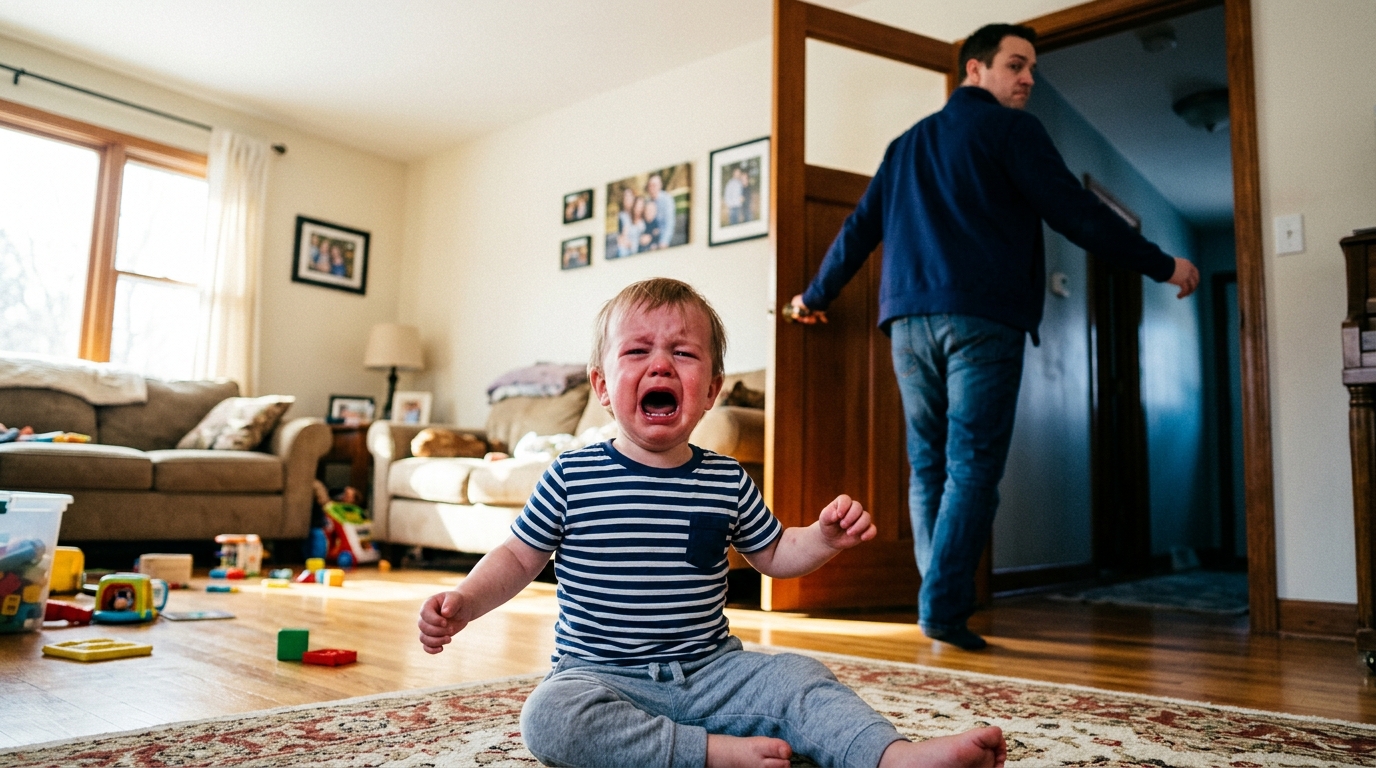
At 16 months my son developed a new skill: identifying the exact moment my left foot crossed any threshold in the house. The bathroom door, the kitchen archway, the back door, the stairs. The instant I was about to be out of his sight, he started screaming as if I were leaving forever.
I tried sneaking. He cried. I tried explaining. He cried louder. I tried bringing him with me everywhere. I peed with him on my lap for three weeks. Eventually I realized that the only way out of this phase was through it, and the question was not how to prevent the screaming but how to respond to it in a way that built her trust rather than ours.
If your toddler screams every time you leave the room and you are looking for a real strategy, here is the version that worked for me, what is biologically going on, and the 7 specific things that genuinely helped move us through this phase.
Why your toddler screams when you leave the room
The room-to-room scream is one of the most predictable phases of toddler development. The cause is biological.
Around 12 to 24 months, two things are happening in your toddler's brain at the same time.
Object permanence is fully developed. She now understands that you continue to exist when she cannot see you. The 8-month-old version of her did not have this understanding, which is why she was usually fine when you walked away.
Emotional regulation is not yet developed. The part of her brain that handles "stay calm even though something uncomfortable is happening" (the prefrontal cortex) does not finish developing until early adulthood. At 16 months, it is barely online.
So her brain knows you are leaving. Her brain knows you might not come back immediately. Her brain has no way to soothe itself about that fact. The scream is the only tool she has.
This is not manipulation. It is not spoiled behavior. It is a 16-month-old brain doing exactly what a 16-month-old brain does. The intensity is uncomfortable but the behavior is on-track. (For the bigger picture, see Is My Toddler's Separation Anxiety Normal.)
What this phase looks like in real life
The signs you are in the room-to-room scream phase.
- She screams when you leave any room, not just at bedtime or daycare
- She follows you to the bathroom and bangs on the door if you close it
- She cannot play independently for more than a few seconds
- She wakes at night calling for you specifically (not the other parent)
- She is calm and engaged when you are present
- She does not have the same intense reaction to her other parent
- She is happy when you return, like nothing happened
- The phase started in the past few weeks or months
If this matches your situation, you are in the standard phase. It typically peaks between 14 and 24 months and eases significantly by 30 to 36 months.
What does not work
A few approaches that consistently fail.
Sneaking out
Some books recommend slipping out while the toddler is distracted. This is one of the worst things you can do.
The brain reads "she disappeared without warning" as proof that you might disappear anywhere, anytime, without notice. The anxiety gets worse, not better.
Long explanations
A 16-month-old cannot process a 3-paragraph explanation of why you need to use the bathroom. The talking calms you, not her.
Punishing the scream
The scream is not a behavioral choice. Punishing it is like punishing a baby for crying. The scream is the body's only response to a difficult feeling at this age.
Caving completely
Some parents stop ever leaving the room. Within weeks, the toddler now cannot tolerate any separation at all. The world shrinks. The dynamic gets harder, not easier.
The goal is to leave the room with her cry as evidence that the separation is happening but not as a vetoing force.
Comparing to other kids
Your friend's toddler is happily playing alone for 45 minutes at 18 months. Yours is screaming after 30 seconds. The comparison helps no one.
Toddlers vary hugely in temperament. Some are deeply attached and intense. Some are more independent. Both are normal. Yours is just on the more intense end of this phase, which says nothing about your parenting.
The 7 things that actually helped
The strategies that genuinely moved us through this phase.
1. Always announce the leaving
Even if she will scream anyway, say it. "Mommy is going to the bathroom. I will be back in 2 minutes."
This builds the pattern in her brain: announcement, leaving, return. Over weeks, she learns the pattern even when she still screams in the moment.
The opposite of sneaking. Always narrate. Always tell her.
2. Always announce the returning
Equally important. When you come back: "Mommy is back. I am here." Make eye contact. Touch her.
The pattern of "I told you I would come back and I did" repeats hundreds of times. The brain eventually learns to trust it.
3. Use a consistent phrase
Pick the same words every time. Mine was: "Mommy is going to the kitchen. I'll be right back. Bye sweet pea."
The repetition gives her brain something familiar to anchor on. By month 2 of the consistent phrase, she would say "bye sweet pea" back to me, sometimes still through tears. The phrase had become part of how the leaving worked.
4. Practice short safe separations
When she is calm and content, do tiny separations on purpose. Walk to the kitchen and back. Step outside for 30 seconds. Go upstairs for 2 minutes.
Each one builds the pattern. After 2 weeks of daily practice, she can usually tolerate slightly longer separations without escalating.
5. Build "safe person" trust with the other parent
If you are the primary parent, the partner doing daily caregiving is important. Even when she protests, the time she spends with the other parent helps her build trust that there is more than one safe adult.
Have your partner do specific things:
- Bath time alone
- Solo morning routine on certain days
- Solo bedtime once a week
- Pickup from daycare or activities
The first few sessions are hard. By the third or fourth, she usually adapts.
6. Get a baby gate strategy
Sometimes you genuinely need to leave the room and the toddler cannot come with you (cooking with a hot stove, working, basic safety). A baby gate that lets her see you while keeping her safe is a useful middle ground.
She can be in the next room with toys, still seeing you, while you do what you need to do. Most kids accept this much better than being in a completely separate space.
7. Wait it out
The honest truth is that some of this phase is just time. She is 16 months old. She is not going to be developmentally able to handle long separations until she is closer to 3.
What you are doing during this phase is building the foundation for those longer separations later. The trust you build now with the calm goodbyes, the return ritual, the predictability all becomes the basis for her ability to separate at 3, at 4, at 5.
You are not failing. You are doing the work that will pay off in 2 years.
How to handle the bathroom specifically
The bathroom situation is its own special challenge. A few specific strategies.
Option 1: Bring her with you
If she is at the worst of the phase, just bring her into the bathroom. Sit her on the bath mat with a toy. Pee with her right there. This phase ends and the privacy returns.
Option 2: A small play area outside the door
If you cannot bear bringing her in, set up a tiny play space outside the bathroom door with her favorite books or a sensory bin. Door open if you can.
Option 3: The other parent
If your partner is available, they take the toddler while you use the bathroom. This is a small but real form of help.
Option 4: Time it
Most toddlers can tolerate 60 to 90 seconds without you. Try to time bathroom trips for moments she is engaged in something interesting. You may have 90 seconds before she notices.
What about night waking
If she is also waking at night calling for you specifically, the same separation anxiety wave is fueling it. (Full picture in The 24 Month Sleep Regression.)
The strategies that work for daytime separation also work for nighttime:
- Consistent bedtime routine
- A specific reassurance phrase
- A small comfort object
- A predictable response if she wakes (brief reassurance, then back to bed)
Avoid starting new sleep habits during this phase that you will need to undo later (parent in the bed, multiple feeds, hours of resettling). Calm consistency is the goal.
When the screaming is more than separation anxiety
Most room-to-room screaming is normal. A few signs that suggest something else is going on.
Worth a doctor visit if
- The phase has lasted unchanged for more than 6 months
- She is also not engaging well during your presence
- She is not making eye contact or responding to her name
- Other developmental concerns are present
- She seems generally anxious all the time, not just at separations
- She is not sleeping at all
- She has stopped eating well
- The intensity is escalating instead of easing
- The behavior started suddenly after a specific event
These warrant a conversation with your pediatrician or a child psychologist.
What to tell yourself with a toddler screaming on the other side of the bathroom door
You are not damaging her. You are not creating a clingy child. You are not failing because she cries when you leave.
What you are doing is being a present, predictable, available parent during a developmental phase that is hard for both of you. The version of her in 2 years will be the version of her who can confidently say goodbye at preschool because the foundation you built at this age told her that you reliably come back.
Use the bathroom. Wash your hands. Come out. Say "Mommy is back. I am here." Pick her up. Hug her. Do the next thing.
The phase ends. Sometimes more slowly than you hope, but it ends. By her 3rd birthday she will be running off to play with her cousins without looking back. The intensity of right now is not who she will always be. It is who she is for this developmental window.
You are doing it. The screaming is not the measure of your parenting. The calm response is.