
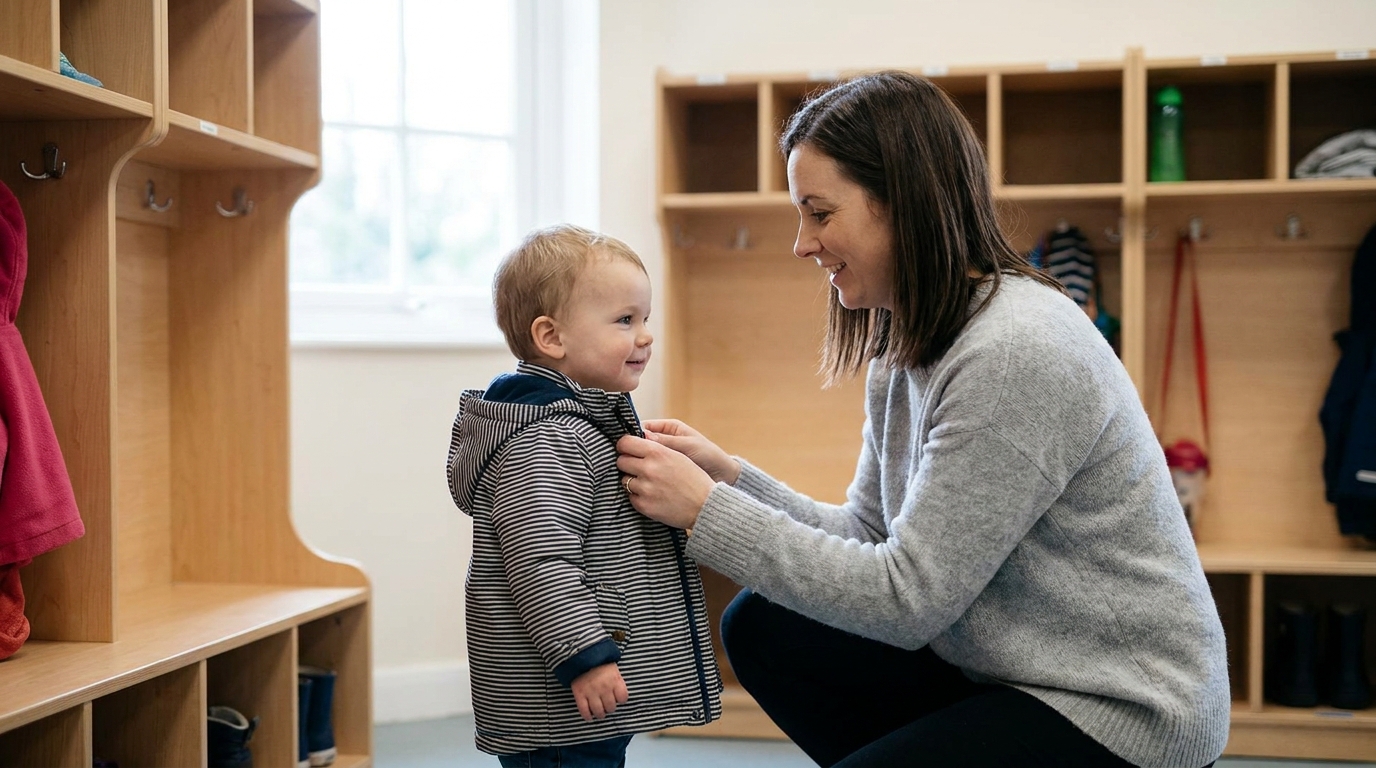
The first incident report was for hitting. The second was for biting. By the fourth note in the parent app I had stopped reading them straight away because they all said the same thing in slightly different language. "He had a difficult moment today. We separated him from the other child. He calmed down after a few minutes."
What none of the notes told me was: why was this happening every day at this nursery when it had never happened at the previous one? Was he the only one doing it? What were they actually doing about it? Were they about to ask us to leave?
If you are getting incident reports about toddler aggression at nursery and you are getting nowhere with vague summaries, here is what is actually going on under the surface and what conversations to have to fix it.
Why toddlers hit and bite at nursery specifically
Most toddler aggression peaks between 18 months and 3 years, and it almost always happens in three predictable situations:
1. Transition moments. Coming inside from outdoor play. Mealtime queues. Going from free play to circle time. Anything where one activity ends and another begins. 2. Resource conflicts. Toy sharing. Snack time. The favoured chair. The single fire engine. 3. End-of-day exhaustion. The 2pm to 3pm window when toddlers have used up the energy from morning and the nap window is past or unsatisfying.
Underneath all of these is the same thing: the child has a big feeling and no words for it. At 2 years old, a toddler may have 50 to 200 words. The number of feelings they have is closer to the number an adult has. The gap is enormous. When the feeling is bigger than the language, the body does the speaking. Hitting, biting, throwing, pushing, screaming.
This is developmental, not character. It is not because your child is aggressive by nature. It is because at this exact age, the bridge between feeling and language is not built yet.
Why it usually happens at nursery and not at home
This catches many parents off guard. The child is fine at home. They hit at nursery. The mum starts to wonder if the nursery is causing it.
Three reasons the nursery environment specifically triggers it:
- More other children. At home there is one or two children in the room. At nursery there are 10 to 20. More potential for resource conflict, more sensory overload, more competition for adult attention.
- Less adult attention per child. The keyworker ratio is good (often 1 adult to 4 toddlers in the UK). But the child still has a fraction of the adult connection compared to home.
- More overwhelm by 2pm. The nervous system has been managing inputs for 5 to 6 hours straight by mid-afternoon. The reserves are depleted.
A child who is sweet and gentle at home and aggressive at nursery is usually not a different child. They are the same child in two different environments with different demands on their nervous system.
This is also why aggression at nursery usually does not predict longer-term behavioural issues. The vast majority of children who hit and bite between 18 months and 3 years are completely settled at it by age 4.
The conversation to have with the nursery
The vague incident report is not enough. The conversation that gets you somewhere has specific questions:
1. What time of day does it usually happen? If it is always at 2pm, that is overtiredness or hunger. If it is always at the transition from free play to circle time, that is a transition problem. Specific patterns point to specific fixes.
2. What is happening just before the hit/bite? Was he denied a toy? Was another child too close? Was he being touched without warning? Was he in the middle of focused play that was interrupted?
3. Who is around him in the 30 seconds before? Is there a specific child he conflicts with repeatedly? A specific staff member he is less settled with?
4. What does he do after? Does he go to a quiet corner? Does he keep escalating? Does he look distressed himself?
5. What strategies has the nursery tried? "We separated him" is not a strategy. The strategy you want is: redirection before the moment of aggression, modelling specific language, coaching during conflict, calming techniques the staff use consistently.
6. What is the plan for the next two weeks? A good nursery will have a plan. A vague one will say "we will keep an eye on it."
If you get vague answers across the board, ask for a meeting with the room leader and the nursery manager. Bring specific questions. The conversation should move from "this is what happened" to "this is what we are going to do differently."
The response at home that helps
The home response is not punishment. It is connection plus skill-building. Both matter.
Build the language
The single biggest predictor of when aggression stops is when language comes online. You can speed this up by giving him the words.
Throughout the day, narrate his feelings: "You look frustrated because the tower fell down." "You are mad that the bath time is finishing." "It is hard to wait for your turn."
Teach him the phrases nursery aggression actually needs: "Stop." "I do not like that." "I want a turn." "Move please." "I am mad." Practice them when he is calm, not in the middle of a meltdown.
Even if he is not using these words at nursery yet, the input lays the groundwork. Within weeks he starts saying them in the moment.
Practice the alternatives
When he is hitting at nursery because another child took his toy, the alternative he needs is not "use your words." He needs a specific action. Three that work:
- "Stop, that is mine" while holding a hand up
- Walk to a teacher and say "help"
- Hold the toy more tightly with both hands rather than letting go
Practice these at home, gently. "If Daddy took your truck, what would you say?" Run little role-plays. He will not use them the first 10 times. He will use them on the eleventh.
Address the daily load
A toddler who is overtired, overstimulated, or hungry at 2pm is significantly more likely to hit. Look at the day:
- Is he getting enough sleep at home? If bedtime has crept later, fix that first.
- Is the nap window happening or being missed?
- Is he eating a substantial breakfast that lasts him through the morning?
- Is the journey to nursery too long or too rushed?
- Are weekends very different from weekdays in routine?
Small changes to the daily load often reduce nursery aggression dramatically within a fortnight.
Connect after pickup
A child who has been holding it together at nursery for 7 hours releases everything when he sees you. The pickup tantrum is real and normal. So is the silence and clinginess.
Give him 15 minutes of focused, phone-down attention as soon as you collect him. Just sit on the floor with him. Let him lead the play. Do not ask about his day yet. The connection refills his nervous system and reduces the next day's aggression.
What does not work at this age
A few approaches that consistently fail with toddler aggression:
- Telling him biting is wrong in long sentences. He cannot process the lecture mid-meltdown.
- Time-out away from the parent for a 2-year-old. Increases distress, does not teach the alternative.
- Asking him to apologise. A forced apology is not a real apology. Better to model: "Can you check if she is ok? She seems sad."
- Comparing to other children. Worsens self-image and does not change behaviour.
- Threats ("we will not come back to nursery"). Loaded with anxiety, no behavioural mechanism.
- Hitting him back to "show him how it feels". Models aggression. Teaches the lesson you do not want.
The current behavioural science is consistent. What works at this age is calm boundaries, explicit alternatives, and lots of connection.
When toddler aggression is something else
For most toddlers, the hitting and biting fades between 2 and 3 with the right home and nursery response. A few situations are worth a GP or health visitor input:
- The aggression is paired with significant developmental concerns (very limited speech, no social interest, rigid routines)
- It happens at home as well as nursery, intensely and frequently
- The child seems to enjoy hurting others, with no remorse
- It involves significant harm (biting through skin, drawing blood repeatedly)
- The child is also self-harming, banging head, hitting themselves
- It started suddenly after a specific event and has not improved with calm response
These are uncommon but worth flagging early so a paediatric assessment can rule out underlying causes.
Related reading
- Why Your Toddler Hits and What Actually Works
- How to Handle a Toddler Who Bites Without Losing Your Mind
- Starting Nursery: How to Help Your Toddler Settle In
What to tell yourself after the fifth incident report
The nursery is not asking you to leave because they have not asked. They are telling you because they have to. Most nurseries see toddler aggression in 1 in 3 children at some point during the 18-month to 3-year window. It is in their daily routine, even if their incident notes make it sound dramatic.
Your child is not broken or bad. He is in the exact developmental window where the gap between feeling and language is biggest. The gap will close. Most children who hit at 2 are completely calm and verbal by 4, and many of them turn out to be the most emotionally articulate kids in the class.
For now: get the specific conversation with the nursery. Build the language at home. Address the daily load. Connect after pickup. Trust that this is a phase that ends, often faster than you fear.
You are not raising a violent child. You are raising a 2-year-old whose body is currently doing the talking. Give him the words and the wait, and the body will calm.