
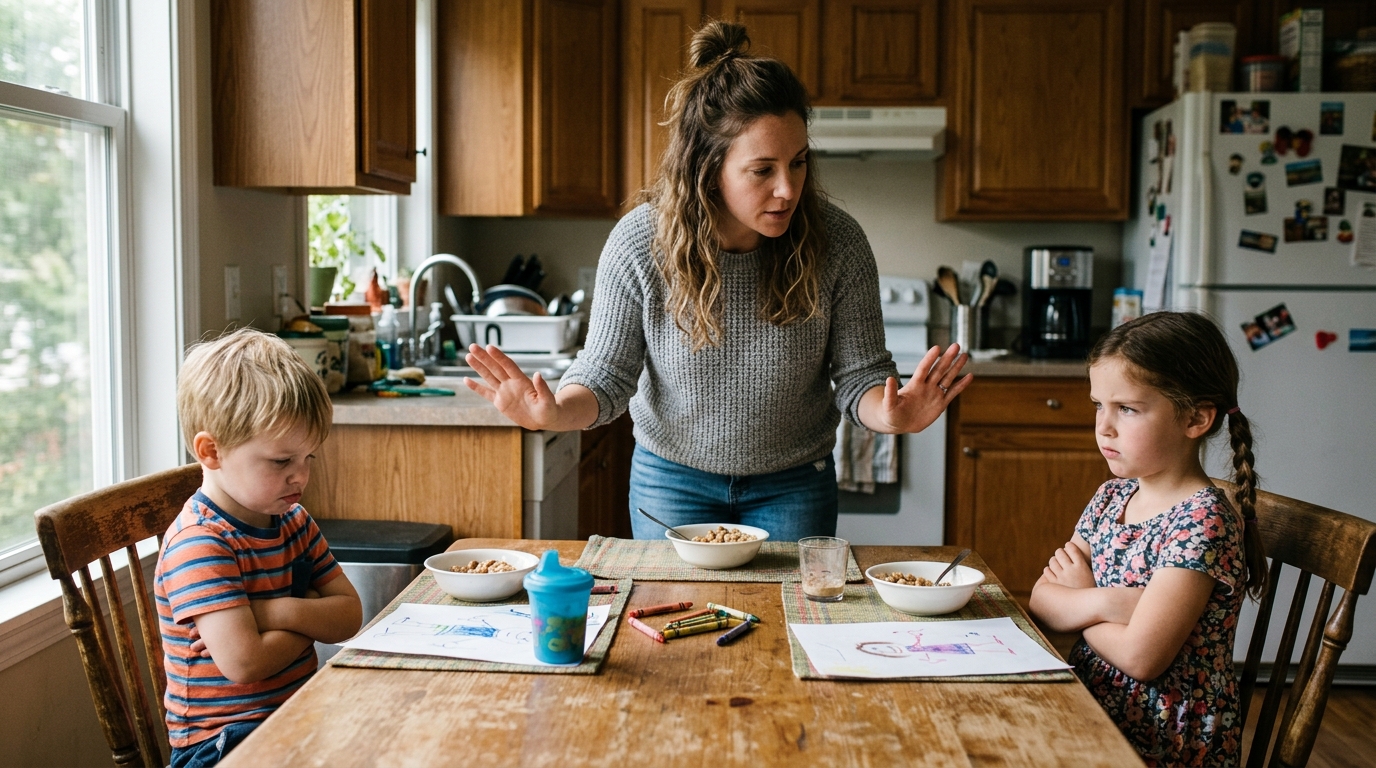
By the third week of my older son systematically targeting his little sister, I had stopped thinking it was a phase. He waited for her to start playing with something, then took it. He told her she could not sit on the sofa where she was sitting. He made up rules to specifically exclude her from his play. When she cried, he looked at me with a small satisfied expression and said "she always cries."
Sibling rivalry is normal. What he was doing did not look or feel like rivalry. It looked like a 7-year-old conducting a small daily torture of a 4-year-old. I started reading about the difference between sibling rivalry and sibling bullying because something had crossed a line and I needed to understand what.
If you are watching your kids interact and getting a bad feeling that this is more than normal sibling tension, here is the honest guide to telling the difference between sibling rivalry vs bullying, what to do for each, and when to bring in professional help.
The basic difference
Sibling rivalry is mutual conflict between roughly equal participants over real disagreements. Both kids are engaged in the fight. Neither is consistently the victim. Power shifts back and forth.
Sibling bullying is one child repeatedly targeting another with deliberate harm. The power is uneven. The same child is usually the target. The behavior is aimed at causing distress, not at resolving a disagreement.
The difference is real and meaningful. Treating bullying like rivalry leaves the targeted child unprotected. Treating rivalry like bullying creates anxiety in normal kids learning to navigate conflict.
The 7 signs that distinguish them
How to tell which one you are looking at.
Sign 1: Mutuality
Rivalry: Both children participate in the conflict. They argue, escalate, both get angry, both make demands. Sometimes one wins, sometimes the other.
Bullying: One child is consistently the aggressor. The other consistently absorbs, hides, or withdraws. The roles do not switch.
If your kids are fighting about who got the last cookie and both are loudly demanding it, that is rivalry. If one is silently watching the other take the cookie because she has learned not to bother trying, that is something else.
Sign 2: Power balance
Rivalry: Roughly equal power. The older child may be physically bigger, but the younger one has emotional currency, parental attention, or other advantages. Both have ways to push back.
Bullying: The power imbalance is significant and one-sided. The aggressor consistently controls the dynamic. The target has limited or no way to push back.
A 6-year-old and a 4-year-old fighting over a toy is rivalry. A 10-year-old systematically excluding a 5-year-old from every shared activity is closer to bullying.
Sign 3: The pattern
Rivalry: Fights happen in specific situations (sharing, attention from parents, competition). They have a beginning and end. Both kids eventually return to neutral or positive interactions.
Bullying: The same dynamic repeats day after day, sometimes for weeks or months, without resolving. The target's mood is consistently affected. The aggressor's behavior is consistent regardless of the situation.
Sign 4: The intent
Rivalry: The intent is usually about getting something (the toy, the seat, parent attention). Hurting the sibling is incidental.
Bullying: The intent is more often about causing distress to the sibling specifically. The aggressor seems satisfied when the target cries or withdraws. There is sometimes a smile or a "she always cries" comment.
This is the hardest sign to be sure about. Children, even older children, do not always understand their own motivations. But the satisfied look at distress is a real and concerning sign.
Sign 5: The emotional aftermath
Rivalry: After a fight, kids move on. They play together later. The relationship continues. They are not afraid of each other.
Bullying: The targeted child shows signs of ongoing fear. She tenses when the sibling comes in the room. She avoids being alone with them. She has changes in sleep, appetite, or mood. She may stop asking for things she used to enjoy.
The targeted child's emotional state outside the fight moments is the clearest indicator.
Sign 6: The escalation
Rivalry: The intensity stays roughly stable. Some days are worse than others, but the overall pattern is steady.
Bullying: The behavior escalates over time. Verbal becomes physical. Occasional becomes daily. What used to be small jabs becomes consistent targeting.
If you can compare to 3 months ago and see clear escalation, this is worth taking seriously.
Sign 7: The presence of an audience
Rivalry: Kids fight whether or not someone is watching. The behavior is similar in front of parents, alone, in front of other kids.
Bullying: The aggressor adjusts behavior based on who is watching. They may behave well in front of parents and badly when no adult is present. The targeted child may try to report this, but the aggressor denies it convincingly.
If your younger child says her sibling has been doing things you have not seen, and the older sibling denies it, take the younger child seriously. The hidden version of behavior is a strong indicator of bullying patterns.
What to do if it is rivalry
For normal sibling rivalry, the parenting move is teaching conflict resolution while not over-involving yourself.
Stay out of small conflicts
If the kids are arguing but not in danger, let them work it out. Stepping in every time prevents them from learning to resolve conflict.
The exception: if one of them is much younger or being physically hurt, intervene.
Model conflict resolution
Use your own conflicts (with your partner, on the phone, in stories) as teaching moments. "Mommy and Daddy disagreed and we had to talk about it until we figured out a fair plan."
Kids learn conflict skills more from modeling than from instruction.
Avoid taking sides
When you have to intervene, focus on what both can do differently, not on who was right. "You both wanted the same thing. We need a plan that works for both of you."
Create separation when needed
If both kids are overstimulated, give them physical space. "You guys have been together for 3 hours. Go to different rooms for 20 minutes."
This is not punishment. It is regulation.
Acknowledge feelings
"You are mad that he took the truck. Of course you are. Let's figure out how to use it together."
Naming the feeling reduces its intensity.
Build in connection time
Many sibling fights are downstream of competition for parent attention. Building in 1-on-1 time with each child reduces the fighting overall.
What to do if it is sibling bullying
This is a different parenting move. The dynamic is unhealthy and requires more direct intervention.
Take the target seriously
If the younger or targeted child is reporting behavior you have not seen, believe her. Do not minimize or rationalize. Children rarely make up bullying patterns.
Have direct conversations with the aggressor
Not in the moment of an incident, but in calm moments. Specifically.
"I have noticed that you have been treating your sister differently lately. You are taking her things, telling her she cannot play, and making her cry. I want to understand what is going on."
Listen. Often there is a real underlying issue (the older child is struggling with feelings of replacement, school stress, social difficulties) that is being acted out on the sibling.
Address underlying causes
Sibling bullying is often a symptom of:
- The older child feeling displaced by the younger
- School stress or social difficulties
- A response to a major family change
- Mental health struggles in the older child
- A learned behavior from peer dynamics
Treating the underlying cause is more effective than just punishing the behavior.
Set clear boundaries and consequences
The behavior has to stop. Specific clear consequences.
"In this family, we treat each other kindly. The taking, the excluding, the telling her she cannot play, those will stop. If they continue, the consequence will be [specific consequence appropriate to age]."
Then enforce the consequences consistently.
Protect the target
While you work on the dynamic, physically protect the target.
- Do not leave them unsupervised together for now
- Give the target safe spaces (her room, time with you, time at a friend's house)
- Make sure she knows she can tell you anything
- Let her express her feelings without being dismissed
Increase connection with the aggressor separately
The bullying child often needs more connection, not less. Increase 1-on-1 time with that child, focused on what they are struggling with, not on the sibling behavior.
Watch for changes in the target
If the targeted child shows ongoing signs of distress (sleep issues, anxiety, withdrawal, changes in school performance), get her professional support too. The effects of sibling bullying can be significant.
Consider professional help
If the pattern does not improve with direct intervention over 4 to 8 weeks, see a family therapist. Sibling bullying patterns can be deeply entrenched and benefit from outside guidance.
When sibling dynamics suggest something bigger
Some patterns warrant immediate professional attention.
See a professional now if
- Physical violence is involved (not just play wrestling)
- Sexual elements are present in the dynamic
- One child is being humiliated or degraded systematically
- The aggressor shows little remorse and continues despite consequences
- The targeted child is showing signs of trauma (regression, nightmares, dissociation, eating changes)
- You see the aggressor's behavior with peers and notice similar patterns
- There is a history of trauma, neglect, or significant family stress
- You feel out of your depth
A family therapist, child psychologist, or pediatric counselor can assess and offer specific support. Most large insurance plans cover this and many cities have free or sliding-scale options.
What about ADHD and sibling dynamics
Children with ADHD often have sibling conflict patterns that look like bullying but have different roots.
The ADHD child may:
- Struggle with impulse control around the sibling
- Get easily overstimulated and lash out
- Have difficulty reading the sibling's emotional cues
- Apologize sincerely after incidents but repeat the behavior
The pattern looks similar to bullying but the intent is different. The intervention is also different: emotion regulation skills, ADHD treatment, and structured family routines often help more than consequences alone.
If you suspect ADHD or other neurodevelopmental issues in the older child, get an assessment. The right diagnosis changes the right intervention.
What if your gut says it is more than rivalry
Sometimes you cannot point to a specific sign but you feel that something is wrong. Trust that instinct. Parents are usually right when they sense something is off, even before they can articulate it.
The cost of investigating and finding nothing is small. The cost of dismissing it and being wrong is large.
A conversation with your pediatrician or a family therapist about your concerns is a useful step even when you are not sure.
What to tell yourself watching them at the kitchen table
You are paying attention. The fact that you are reading this article and trying to discern the pattern is the difference between a family where sibling bullying continues unchecked and a family where it stops.
If what is happening is normal rivalry, your kids will work through it with calm guidance. If it is more, you are now in a position to intervene before it does deeper damage.
Either way, you are doing the hard work of seeing your children clearly, including the parts that are uncomfortable. That is the actual job of parenting older kids.
Your kids' relationship is not fixed yet. The version of how they treat each other now can change. The brother who is targeting his sister at 7 can become the brother who is her closest friend at 17, if the right course corrections happen at the right time.
You are in a position to make those corrections. The fact that you noticed is the start.