
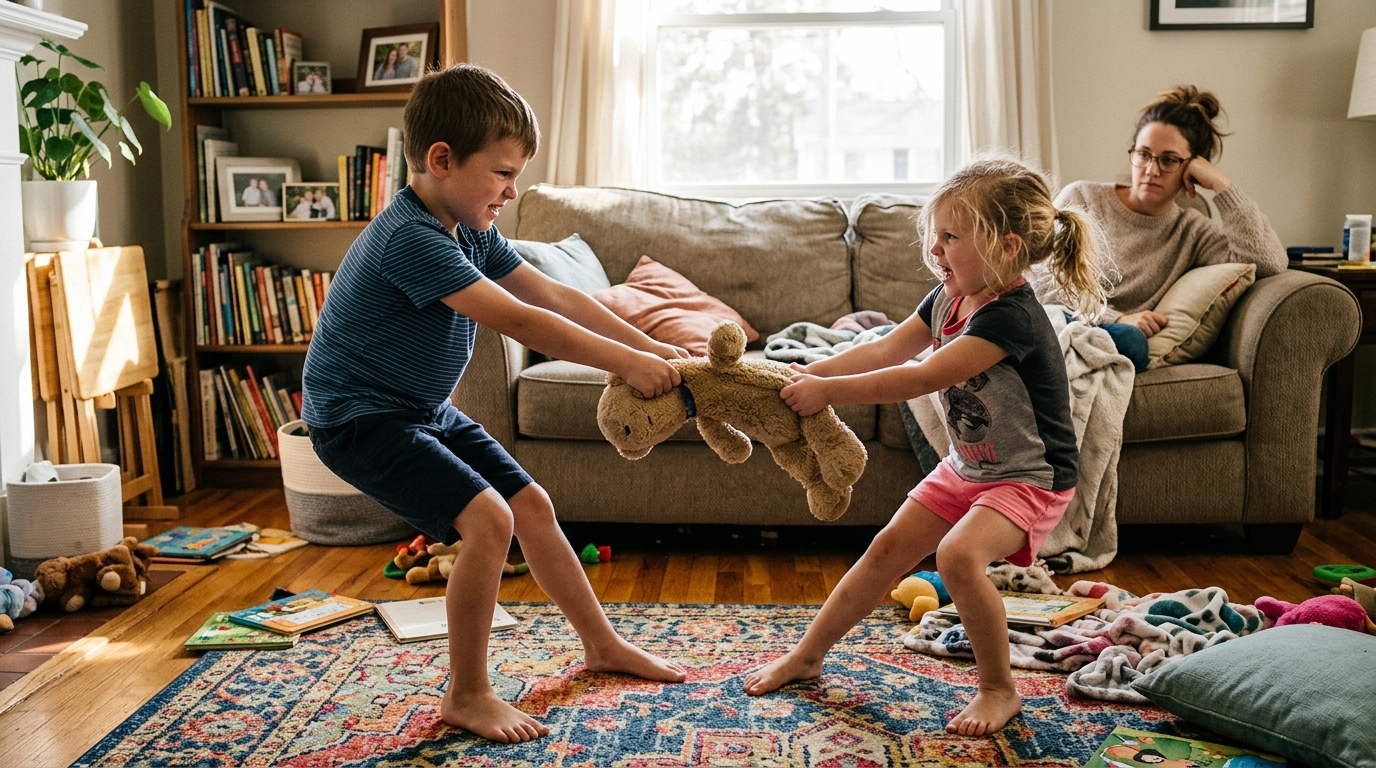
Three weeks into the summer holidays I sat at my kitchen table and added up the times I had intervened in a fight between my two kids that day. The answer was 38 by 2pm. They had fought about the iPad. The remote control. Who pressed the elevator button. Who got the blue cup. Who could sit on which sofa cushion. Whether one of them had "looked" at the other. The fights ranged from 30 seconds to 25 minutes.
By bedtime I was so exhausted I could not finish a sentence. By the next morning the same pattern restarted. The internet kept telling me to "let them work it out" and "encourage cooperation" and "model conflict resolution." None of it was working at this volume.
If your kids are fighting every single day and you are looking for actual practical strategies rather than parenting platitudes, here is what genuinely reduced the fighting in our house. Not eliminated it. Reduced it dramatically.
Why kids fight so much
The honest reasons.
They are stuck in close proximity for too long without enough space. Most daily sibling fighting peaks at home during long stretches with no external structure. School days have fewer fights than weekends and holidays.
They are bored. Boredom plus a sibling equals fighting. The sibling is the most stimulating thing in the room.
They are over-stimulated. Too much going on, too much screen time, too little movement also produces fighting.
They are tired or hungry. This is true at any age. A tired or hungry kid will fight about anything.
They are competing for resources. Time, attention, toys, the front seat, the iPad. The list is long.
They are competing for parental attention. Often the loudest fights happen when you are busy with something else.
They are practicing relationship skills. Sibling conflict is the most accessible practice ground for negotiation, sharing, and emotional regulation. It is supposed to happen. Just maybe not 38 times a day.
They are different ages and developmental stages. A 4-year-old and a 7-year-old want different things, need different things, and play in different ways. Conflict between them is structurally likely.
The dynamic has set in. Once a pattern of fighting establishes, it can become a habit independent of any specific cause.
What does not work (or works less than the internet says)
A few approaches that consistently underperform.
Saying "stop fighting"
It does not work. The kids cannot stop fighting on command. The instruction is met with each kid blaming the other and escalation continues.
Asking "who started it"
You will get two different answers and a fresh fight about the answers themselves. Drop this question entirely.
Trying to determine "who is right"
Both kids are usually partially right and partially wrong. Trying to adjudicate makes you the constant referee, which exhausts you and prevents them from learning to manage their own conflicts.
Reasoning at the height of the fight
A 5-year-old in the middle of a meltdown cannot process a logical conversation about sharing. The reasoning has to wait for calm moments.
Punishments for fighting
Generic punishments ("no iPad for an hour") rarely reduce the underlying pattern. They sometimes work briefly but the fighting returns.
Telling them to "be nice"
This phrase is vague and has no behavioral mechanism. Kids do not know what "be nice" looks like in the specific moment. Give them specific actions instead.
"Cooperative" activities
The internet loves cooperative games to "build sibling connection." In real families, these often turn into another fight about how the cooperation is going wrong.
What actually works (the 8 strategies)
After 6 months of trying everything, these were the strategies that genuinely moved the needle.
1. More separation, not more togetherness
This is counterintuitive. The advice everywhere is to encourage togetherness. In real life, fighting siblings often need more space, not less.
Implementation:
- Designate "alone time" periods (e.g., after lunch, each kid in a different room for an hour)
- Different bedrooms if possible
- Different scheduled activities at least some days
- Separate snacks at separate times
The fighting often drops significantly when each kid has reliable solo time built into the day.
2. Address the underlying causes systematically
Before working on the fighting itself, address what is driving it.
- Hunger: are they getting meals and snacks every 2 to 3 hours?
- Tiredness: are they getting age-appropriate sleep?
- Movement: have they had at least 60 minutes of physical activity today?
- Screen time: is daily screen time within a reasonable amount? (See How Much Screen Time Is Actually Okay for Toddlers)
- Outdoor time: have they been outside today?
If any of these are off, fix that before working on the sibling dynamic. Most fighting reduces significantly when the basic needs are reliably met.
3. Pre-empt the predictable fights
Most families have 5 to 10 fights that happen daily in predictable situations. Identify yours and put structure around them in advance.
Common predictable fights:
- Who sits where in the car
- Who gets to choose the show
- Who presses the elevator button
- Who uses the iPad first
- Who gets the better cup
- Who chose the breakfast last time
- Who closes the door
The solution: build a system. Alternate days. Use a coin toss. Set a rule. Anything that takes the daily negotiation off the table.
Example: "Mondays, Wednesdays, and Fridays, your brother chooses. Tuesdays, Thursdays, and Saturdays, you choose. Sundays, mom chooses."
This sounds rigid. It dramatically reduces fighting.
4. Build connection time with each child separately
Many sibling fights are downstream of competition for parent attention. The fastest way to reduce them is to make sure each child gets reliable focused time with you.
Implementation:
- 15 minutes per child per day of phone-down focused time
- Their choice of activity
- Phone in another room
- Genuine attention
This is the single highest-leverage intervention for reducing sibling conflict.
5. Teach specific skills in calm moments
The skills they need to manage conflict cannot be taught in the middle of a fight. They have to be practiced when everyone is calm.
What to teach:
- "Stop, I do not like that"
- "I want a turn"
- "I am feeling mad because..."
- "Can we share?"
- "I need a break"
Practice these phrases when everyone is regulated. Use role play, books, or stories. By the third or fourth practice, kids can use them in real moments.
6. Step in only when needed
Most sibling fights resolve without parental intervention if you wait. The constant intervening sometimes maintains the fighting because it creates a dynamic where:
- The kids escalate to bring you in
- Each kid is performing their case for you
- Neither kid is practicing resolution
Wait it out for the small fights. Intervene for safety, escalation that is clearly bullying, or when the same fight has lasted more than 10 minutes.
(If the dynamic is escalating beyond normal sibling fighting, see Sibling Rivalry vs Bullying: How to Tell.)
7. Use a specific calm intervention when you do step in
When you do step in, have a specific protocol.
1. Separate them physically (different rooms, different sides of the room, different couches) 2. Acknowledge feelings without taking sides ("You both are upset. I can see that.") 3. Give each a brief moment to cool down (2 to 5 minutes) 4. Help them name what they wanted ("You wanted to use the iPad. You also wanted to use the iPad.") 5. Coach them through a resolution ("How can we figure this out?") 6. Walk away once a plan is in motion
This is more work upfront but it teaches the resolution skill rather than just stopping the fight.
8. Build in "do-overs"
Kids learn from doing the right thing, not from being scolded. After a fight that ends, offer a do-over.
"That did not go well. Let's try it again. He was using the iPad. You wanted a turn. What could you say?"
Practice the right behavior. Praise the practice. Walk away.
This works much better than dwelling on what they did wrong.
What to do during long boring days
The hardest stretches are weekends, holidays, and long days at home. Specific strategies for these.
Plan transitions
Boredom plus siblings equals fighting. Plan activities so there is always a "next thing" coming.
A typical structured day:
- 8am breakfast together
- 9am separate quiet activity (independent play, books)
- 10am outdoor time
- 11am parallel play (both kids same room, different activities)
- 12pm lunch
- 1pm rest time (in different rooms, books or quiet activity)
- 2pm activity together with parent
- 3pm separate screen time
- 4pm snack and outdoor time
- 5pm prep dinner together
- 6pm dinner
- 7pm bath and books
- 8pm bed
This is structured but it reduces conflict because each kid has predictable space and predictable togetherness.
Get out of the house
Long days at home increase conflict. Even 30 minutes at a playground reduces fighting for hours afterward.
Use parallel screen time strategically
Both kids on screens at the same time (different devices or shows) gives everyone a quiet break. This is not failure. It is using the tool that exists.
Plan one-on-one time with each parent
If you have a partner, split the kids for an hour. Each parent with one kid, doing something fun.
This is the single fastest fix for a tense morning.
What about age-appropriate expectations
Some sibling fighting is just developmental. Realistic expectations.
Ages 2 to 4
Toddlers and young preschoolers cannot share well. They are biologically not yet capable of sustained sharing. Expect frequent disputes over toys and constantly redirect.
Ages 4 to 7
Kids in this range fight over fairness ("she got more"), turn-taking, and personal space. They can learn conflict resolution skills with coaching.
Ages 7 to 10
Conflict shifts toward more verbal sparring, exclusion, and competition. Kids in this range can handle more direct conversations about their dynamic.
Ages 10+
Older kids can have meta-conversations about how they treat each other. They can be part of finding solutions. The conflicts are sometimes more complex but also more solvable through conversation.
When kids fighting becomes a real problem
Most daily sibling fighting is annoying but normal. A few signs that suggest it has crossed into something worth professional attention.
See a therapist if
- One child is consistently fearful of the other
- Physical violence happens regularly
- The aggression is one-sided and escalating
- A child is being humiliated or degraded systematically
- The dynamic is affecting school performance or mental health
- You have tried the strategies above for 2 to 3 months without improvement
- You feel out of your depth
A family therapist can assess and offer specific guidance. Many large insurance plans cover this.
What to tell yourself with 39 interventions logged for the day
You are not failing. Your kids are not unusually combative. They are kids living in the same house, sharing the same resources, with overlapping developmental needs.
The fighting will reduce. With consistent application of the strategies above (especially the separation, the connection time, and the predictable fight pre-emption), the daily count drops significantly within 2 to 4 weeks.
You will not get to zero fighting. The goal is not zero. The goal is a level where you can function and where the kids are practicing real skills instead of being stuck in a feedback loop.
By the time your kids are in their teens, the relationship they have will not be defined by the fighting at age 4 and 7. It will be defined by the underlying connection you helped them build and by what they learned about resolving conflict.
You are doing one of the hardest parts of parenting more than one child. The fact that you are still trying at 4pm on a long day is the evidence that you are doing it right. Take a break. Drink water. Lower the bar for the rest of the evening. Tomorrow you start again.
You are not alone. Almost every parent of two or more is fighting some version of this same fight today. You are doing it.