
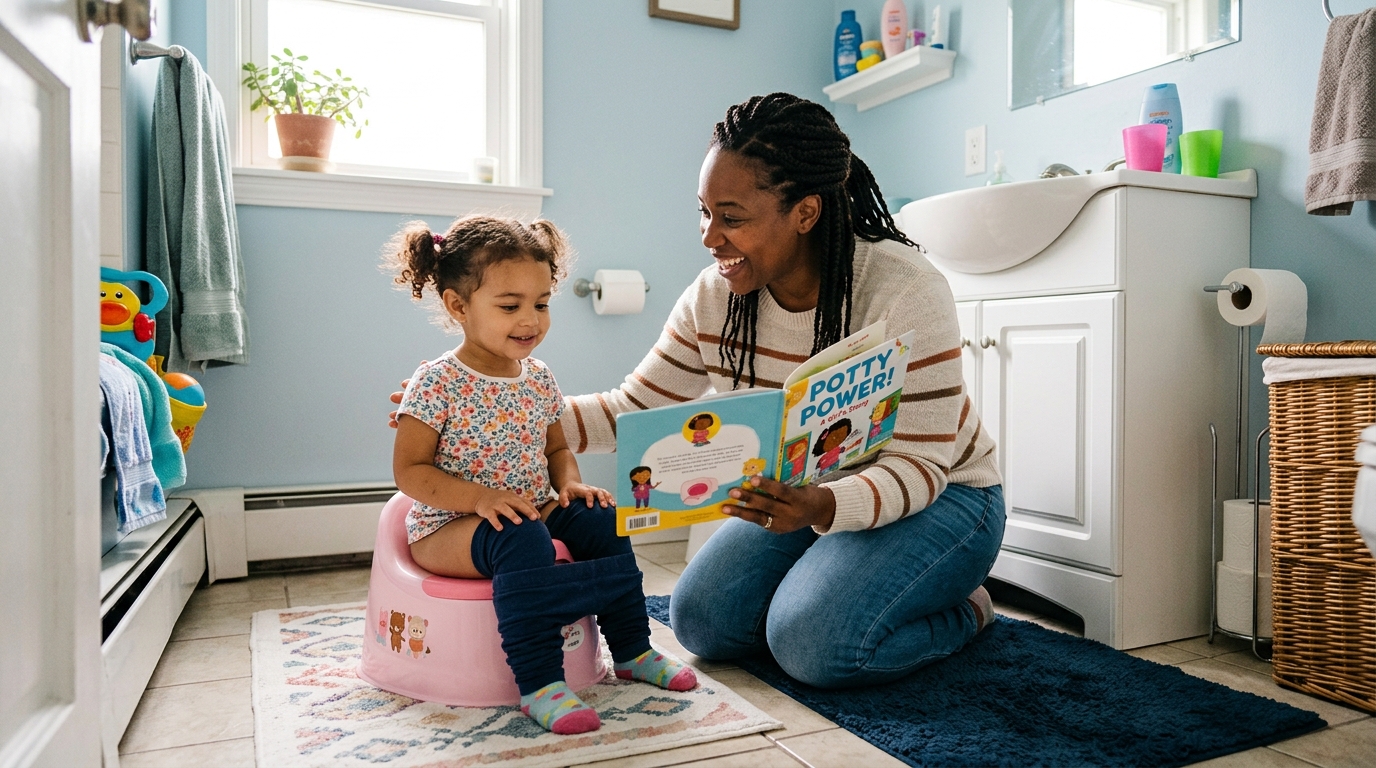
The first day I tried to potty train my daughter, I had grand plans and a pack of tiny underwear with rainbows on them. By 11am she'd had three accidents on the rug, I'd stepped in one of them in socks, and she looked up at me with this wobbly lip like she'd broken something. I said "it's okay" in a voice that very much did not sound okay, and she burst into tears. We both did, honestly.
If you've had a morning like that, or you're dreading having one, come sit with me. I've now potty trained a girl the hard, panicky way and then the calm way, and the calm way worked in about a week. So let me walk you through how to potty train a girl with a gentle 7-day plan that leaves room for accidents, teaches the wiping part properly, and doesn't turn your bathroom into a battleground.
Is She Actually Ready? Readiness Signs First
Here's the thing nobody told me the first time around: the calendar doesn't decide when to start, your child's body and brain do. Most girls show readiness somewhere between 22 months and 3 years, and girls often get there a little earlier than boys. But the age matters far less than the signs.
Look for a cluster of these, not just one:
- She stays dry for two hours or more, which means her bladder can hold on
- She tells you when she's weeing or pooing, or hides to do it
- She's curious about the toilet and wants to watch you
- She can pull her own leggings up and down, roughly
- She follows simple two-step instructions
- A wet or dirty diaper bothers her now when it didn't before
If you're seeing four or five of these, she's ready. If you're seeing one or two, wait a few weeks. Starting too early is the single biggest reason potty training drags on for months. I learned that the expensive, rug-cleaning way.
Before Day One: Set the Stage
Give yourself a clear week with not much on the calendar. You want to be home, relaxed, and not clock-watching for the school run or a birthday party.
Grab these before you start:
- A floor potty she can get onto herself, or a toddler seat that clips onto your toilet plus a sturdy step stool
- Around 10 pairs of cotton training underwear, ideally ones she chose
- Loose, easy trousers or just bare-bottom time at home
- A calm plan for the first poop, because that one often comes with nerves
Let her pick the underwear. That small bit of ownership does more than any sticker chart. My daughter chose ones with strawberries and suddenly did not want to get strawberries wet. Whatever works.
The Gentle 7-Day Plan, Day by Day
This is the heart of how to potty train a girl without the drama. The pace is deliberately soft.
Days 1 and 2: Bare bottom at home
Take the diaper off and let her go bare-bottomed around the house. Without a diaper, she feels everything, and that feedback is what teaches her. Offer the potty every 45 minutes or so, calmly, no big song and dance. Keep drinks flowing so there are plenty of chances to practice. Expect accidents. This is the puddle stage and it's supposed to be.
Days 3 and 4: Add the underwear
Now put on those chosen underwear. They feel more like a diaper, so she may need reminding that wee doesn't just disappear into them. Keep the every-45-minutes rhythm but start asking her to tell you first. Praise the trying, not just the success. "You noticed and you sat down, that's the whole job" goes a long way.
Days 5 and 6: Leave the house briefly
Short outings now. A ten-minute walk, a quick shop. Take a potty in the car or know exactly where the loo is. Go to the toilet right before you leave, every single time. This is where she learns that potty skills travel, not just live in your bathroom.
Day 7: Settle into the rhythm
By now you're prompting less and she's telling you more. Keep the routine steady, keep celebrating quietly, and don't relax the before-we-leave-the-house trip for a good while yet. Seven days rarely means fully finished, but it usually means the corner is turned.
Progress in potty training is not a straight line, it's a wobbly line that trends upward if you stay calm.
Teaching Front-to-Back Wiping
This is the one part of potty training a girl that's genuinely different and genuinely important, so don't skip it. Girls need to learn to wipe from front to back, always, to keep bacteria from the bottom away from the urethra and prevent urinary tract infections.
At the start, you'll do the wiping for her, and you narrate it. "We always wipe from the front to the back, like this." Make it a little rhyme if that helps it stick. As she gets more able, usually a bit later than the weeing itself, let her try with you checking. For a good while you'll still be the one doing the proper clean after a poop, and that's completely normal well into age three and beyond.
Teach her to wipe gently and to wash her hands every time. Poop wiping is a skill that lags behind wee training by months for a lot of girls, so keep helping without making it a thing.
Handling Accidents Without Shame
This is where I went wrong the first time, so hear me on it. Accidents are not misbehavior. A wet floor is not defiance, it's a small body still wiring up a brand new signal. How you react in that moment teaches her more than any praise for a success does.
When she has an accident:
- Keep your face and voice neutral, even boring. "Oops, wee goes in the potty. Let's get dry."
- Never scold, never say "ugh," never make her feel gross
- Get her involved in the cleanup gently, but not as a punishment
- Move straight on
Shame is the thing that causes kids to start holding it in, and holding it in causes constipation, and constipation causes more accidents. It's a miserable loop and it starts with a parent sighing too loudly. I know because I was that parent, and it took a few days of me deliberately keeping my voice flat to undo it.
If she's had a stretch of doing well and then suddenly slides backward, especially after a big change like a new sibling, that's a known thing and not your fault. I dug into exactly that in our post on potty training regression after a new baby, because it caught me off guard the second time.
Night Training Comes Much Later
Please don't stack nights on top of days. Staying dry overnight depends on a hormone that tells the body to make less wee while sleeping, and that hormone matures on its own timeline, often long after daytime is sorted. Many kids aren't reliably dry at night until 4, 5, or even older, and that's within normal.
So for now, keep a diaper or pull-up on at night without any guilt about it. Watch for consistently dry morning diapers as your sign to try nights. Until then, day and night are two separate projects, and pushing nights early just steals sleep from everyone.
Most of this maps onto boys too, by the way, with the wiping being the main difference. If you've got one of each coming up, our 7-day plan for potty training boys covers the small tweaks that matter for them.
When to Pause and Try Again
Sometimes the readiness signs are there but it still isn't clicking, and everyone's miserable. That's your cue to pause, not to push harder. Take a break of a few weeks, go back to diapers with zero drama, and try again later. A pause is not failure. It's you reading your child and respecting where she actually is.
Talk to your doctor or health visitor if you notice any of these:
- Pain, crying, or straining when she wees, or wee that smells strong, which can point to a urinary tract infection
- Very hard poop, or fewer than three poops a week, which suggests constipation that needs sorting before training can work
- No progress at all after starting close to age 4
- She's holding wee or poo for very long stretches on purpose
Those are worth a professional's eyes, not because anything is necessarily wrong, but because a quick check can clear the path.
Learning how to potty train a girl gently is really just learning to slow down and follow her lead. The rug survives. The tears pass. And one ordinary afternoon she'll trot off to the bathroom on her own, and you'll realize you both figured it out.