
I called the hospital at 9pm with contractions 8 minutes apart. The midwife on the triage line said the same thing every midwife in the country says: "Stay home as long as you can. Have a bath. Try to sleep. Call us back when contractions are 5 minutes apart for an hour."
By 11pm I was leaning over the kitchen table making sounds I had not made before. By midnight I was in the car. By 12:30am I was being wheeled into the labor ward at 8cm dilated. The midwife took one look at me and said, "you cut that fine."
If you are pregnant and trying to figure out how long you can safely stay home in early labor, here is the honest answer from someone who has done it twice and got the timing right the second time.
Why hospitals want you to stay home
The instinct of most first-time moms is to head to the hospital the moment contractions start. The hospital instinct is the opposite. Here is why staying home longer is actually better for you.
Early labor is long. For a first baby, early labor (from the first real contraction to about 6cm dilated) averages 6 to 12 hours. Some women have early labor that lasts 24 hours. Spending most of that time in a hospital is exhausting, boring, and slows your labor down.
Hospitals slow early labor. The lights, noise, monitors, IV cannula, and unfamiliar bed all trigger an adrenaline response that pauses oxytocin (the hormone that drives contractions). Many women arrive in active labor, get admitted, and find their contractions slow down within an hour.
Home is biologically optimal. Your own bed, your own sofa, your own bath, and the people you live with all support the calm parasympathetic state where labor progresses fastest.
You can move freely. No monitors, no IV pole, no narrow hospital bed. You can lean, sway, walk, eat, get in the bath, and change position whenever you want.
This is why every hospital triage line says "stay home as long as you can." They mean it.
How long is "as long as you can"?
The honest answer depends on three things: how far you live from the hospital, whether this is your first baby, and how your body is handling the contractions.
For a first baby
The general rule: stay home until your contractions hit the 5-1-1 pattern. That is contractions 5 minutes apart, lasting 1 minute each, for at least 1 hour straight. By this point you are usually in early active labor (around 4 to 6cm), and the hospital is the right place to be.
Most first-time moms spend 6 to 10 hours at home before this point. Some spend longer.
The signs you are entering active labor and should leave:
- Contractions consistently 4 to 5 minutes apart for an hour
- You cannot talk through a contraction any more
- You are vocalizing (low moaning, not screaming) through each one
- You want to focus deeply between contractions, not chat
- Your breathing has shifted to slow deep breaths
If those four are happening, get in the car.
For a second or subsequent baby
This is where the standard rule breaks down. Second babies are dramatically faster. Most second labors are 50 to 70 percent shorter than first labors, and the speed-up usually happens at the end.
For a second baby, do not wait for 5-1-1. Most hospitals will tell you to come in when:
- Contractions are 7 to 10 minutes apart and getting stronger
- You feel that this is starting to feel "serious"
- You had a fast first labor (under 8 hours) and this one seems on the same track
Trust your instinct over the timer. If your body is saying go, go.
For longer travel times
If you live more than 30 minutes from the hospital, you cannot wait until 5-1-1. By the time the pattern is established for an hour and you have driven in, you may be in transition.
The rough scale:
- 30 to 45 minute drive: aim to leave at 7-1-1 (contractions 7 minutes apart)
- 45 to 60 minute drive: aim to leave at 8-1-1
- Over 60 minutes: phone the hospital earlier, around 10-1-1, and plan the timing carefully
What to actually do at home in early labor
Staying home does not mean sitting on the sofa watching the clock. The way you spend early labor affects how it progresses. The things that genuinely help.
Eat and drink while you still can
Eat something with slow-release energy. Toast and peanut butter, banana, yogurt, oatmeal, a sandwich. You may not get another chance for hours, and you need the calories for what is ahead.
Drink water and a sports drink (or electrolytes in water). Dehydration slows labor and makes everything harder.
Sleep if it is night
This sounds impossible but matters more than anything. If your early labor starts at 11pm and you are 6 hours from active labor, every hour of sleep you can bank is an hour of energy for later.
Many first labors actually pause for sleep. The contractions slow down or stop entirely when you doze off, then pick up again in the morning. This is normal and good. Sleep through the early bit if your body will let you.
Move and change position
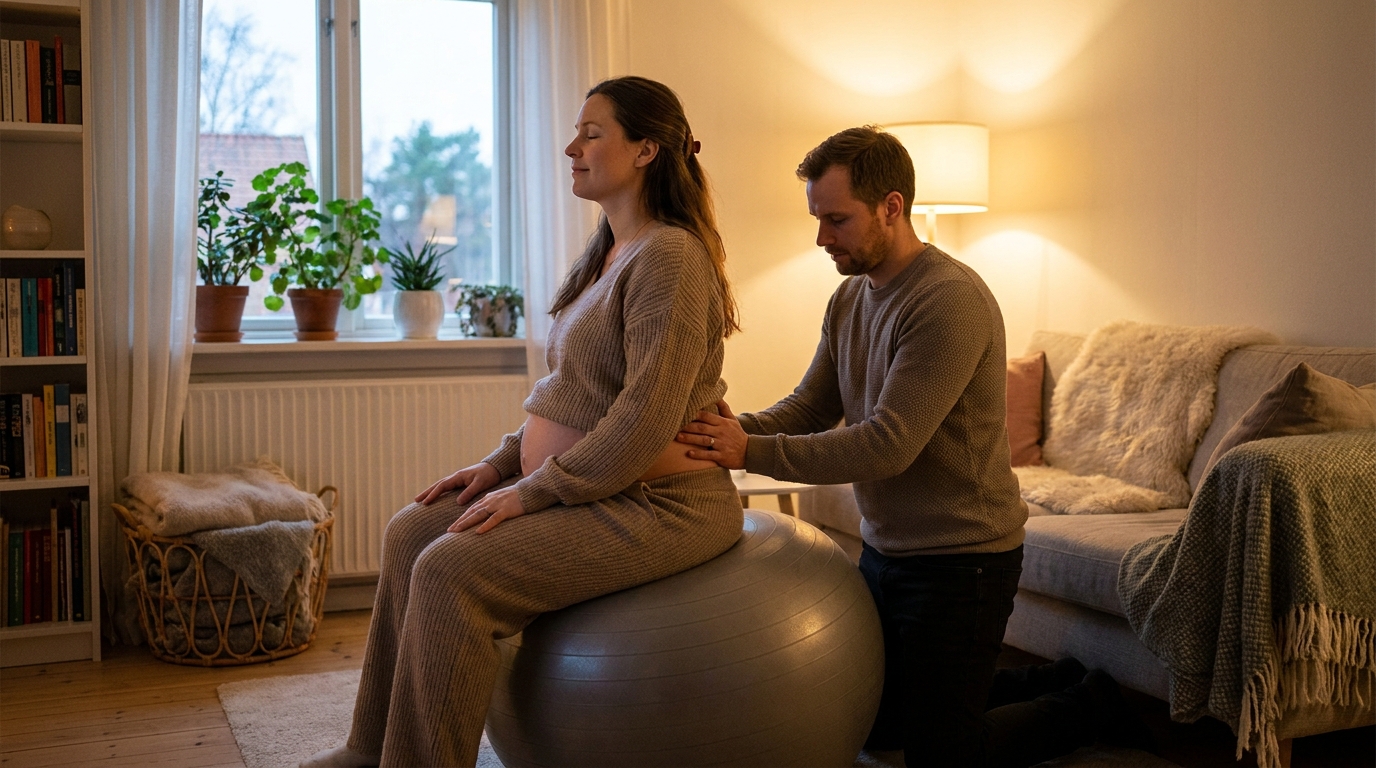
When you are awake, move. Walking, swaying, leaning forward, hands and knees, on a yoga ball. Movement helps the baby descend and the cervix open.
Avoid lying flat on your back, which makes contractions feel worse and slows labor.
Use water
A warm bath or shower in early labor is genuinely magical. Many women describe it as the natural epidural. Stay in the bath for 30 to 45 minutes when contractions are getting harder. The water takes the edge off without slowing real labor (it does slow false labor or early prodromal labor, which is helpful for telling them apart).
The Aqua Doula (in some birth centers) or a simple deep bath at home is the right move.
Time contractions, but not obsessively
Time contractions every 30 to 60 minutes for 10 to 15 minutes at a stretch. Do not stare at the timer the whole time. Watching the clock makes labor feel longer and slower.
The free apps Contraction Timer and Full Term both work. So does a phone notes app.
Have your partner present and useful
This is not the time for your partner to be working in another room. They are part of the early labor team. Their job:
- Stay calm and confident (your body reads their nervous system)
- Bring water, food, snacks
- Time contractions when you ask
- Do counter-pressure on your lower back during contractions
- Run the bath when you want it
- Get the hospital bag into the car ahead of time, not at the last minute
- Time the drive ahead so you know how long it actually takes at 1am with no traffic
- Watch for the shift from early to active labor (you may not notice it yourself)
Avoid these mistakes
- Phoning everyone in the family to tell them you are in labor. Adrenaline goes up, labor slows.
- Sitting in a hospital car park "just in case." You are still in early labor at home.
- Watching action movies or anything stressful. Same adrenaline problem.
- Drinking caffeine or eating sugar in large amounts. Energy crashes hurt later.
The exceptions: when to go in straight away
The standard "stay home as long as you can" rule does not apply if any of these happen:
- Your water breaks (with or without contractions, phone the hospital)
- Any bleeding more than a small bloody mucus show
- Reduced fetal movements at any point
- Green, brown, or foul-smelling vaginal fluid
- Severe constant pain that is not contraction-based
- A bad headache, vision changes, or swelling (could be pre-eclampsia)
- You feel the baby coming down
- Contractions came on suddenly and are already 3 minutes apart
- You are less than 37 weeks pregnant
- You have been told you have a high-risk pregnancy
- You feel something is wrong (yes, your instinct counts)
For any of these, phone the triage line and head in. The "stay home" rule is for low-risk early labor in a healthy pregnancy.
What it actually feels like to leave at the right time
The right time to leave is usually when:
- You cannot get on top of contractions any more
- You are vocalizing through each one
- The bath is not helping enough
- You want to be where the help is
- Your partner is starting to look slightly worried
- You have a "I want to go now" feeling
That last one matters most. Most experienced midwives say women know when it is time. The 5-1-1 rule is a backup for when the gut feeling is unclear.
What to tell yourself at 11pm with contractions 6 minutes apart
You are doing this the smart way. Staying home this long is not bravery, it is biology. Every hour at home is an hour with better labor progress than an hour in the hospital corridor.
The contractions are working. They are opening the cervix and moving the baby down. Each one is one fewer between you and the moment you meet the baby.
Pack the last few things. Eat the toast. Use the bathroom. Have the partner double-check the car seat is installed. Then move at the pace your body asks for, and trust that when it is time to leave, you will know. Most women do.
Tomorrow you will look back at tonight as the strange peaceful gap between knowing and meeting. Enjoy it if you can. It does not come back.