
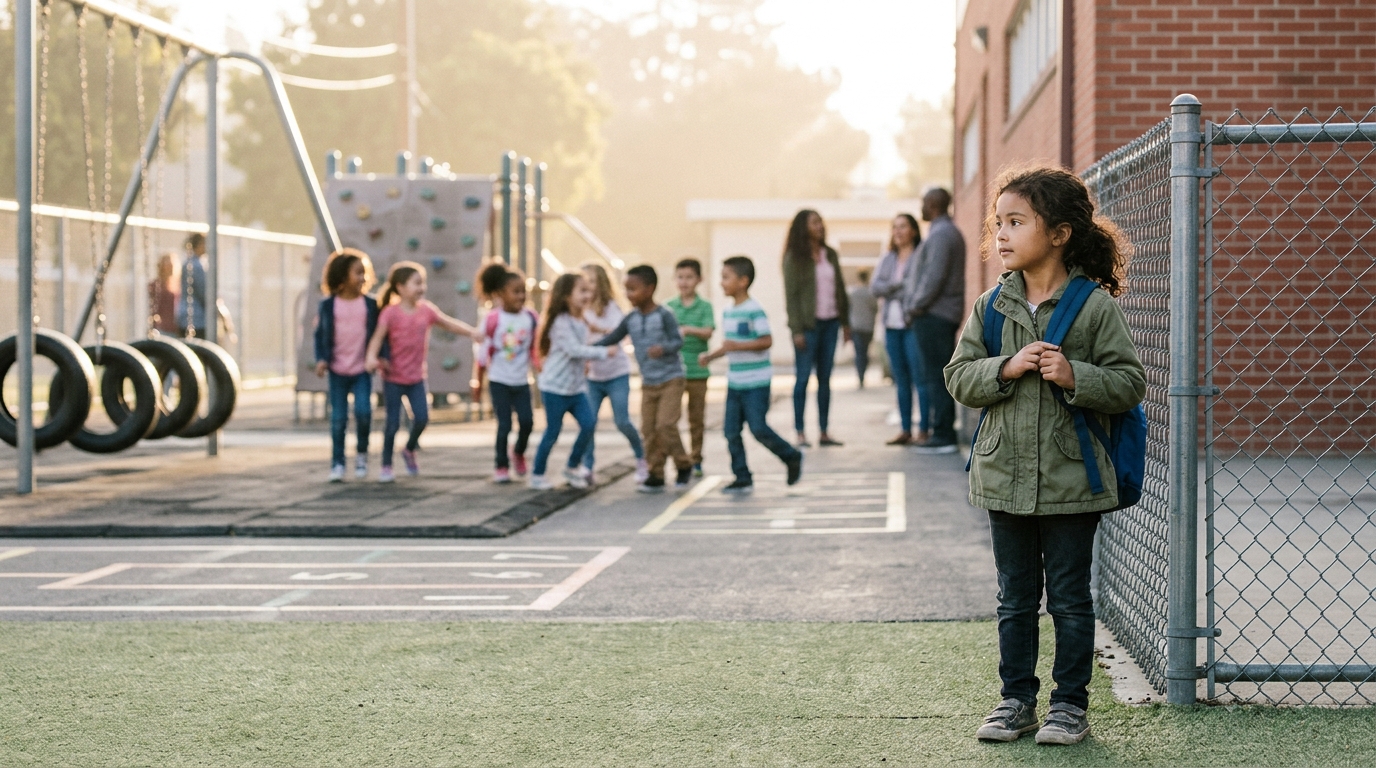
Last September I stood at the classroom door on my daughter's first day of Year 1 and watched her press her back flat against the wall while the other kids swarmed the reading corner. She had one hand wrapped around the strap of her book bag and she would not let go. A little girl walked right up and asked if she wanted to sit together. My daughter looked at the floor and said nothing. The girl shrugged and ran off. I felt that "nothing" land in my chest like a stone.
If you have watched your own child hang back at the edge of the playground while everyone else pairs off, you already know this particular ache. You are not imagining it and you are not failing. This post is what I have learned over the last two years about how to help a shy child make friends at school, the slow way, without turning your kid into a project or making them feel like something is wrong with them.
Shy is not a flaw to fix
The first thing I had to unlearn was the idea that shyness is a problem. It is a temperament. Roughly one in five kids is wired to watch first and warm up slowly, and that wiring does not go away because you want it to. My daughter is the child who studies a birthday party from my hip for twenty minutes and then, once she has mapped the room, plays happily for two hours.
When I stopped treating her quietness as a thing to cure, two things shifted. She stopped hearing "you are too shy" as a verdict, and I stopped radiating the anxiety that made her clam up even harder. Kids read our faces. If your body language says "please, please talk to that child," they feel the pressure and freeze.
So when you set out to help a shy child make friends, start by believing there is nothing broken. You are not fixing them. You are handing them a few tools and a bit of practice so the warming-up part goes faster.
Your job is not to make your child less shy. It is to help them feel safe enough to be brave in small doses.
Practise friendship one child at a time
A classroom of thirty kids is a wall of noise to a shy child. One kid on your living room floor is a completely different thing. This is the single change that moved the needle most for us.
I started inviting one classmate over at a time. Not a group. One. I kept it short, about ninety minutes, and I planned an activity that did not require constant talking. Baking, a simple craft, building something. Shared tasks give shy kids a reason to be together without the pressure of making conversation out of thin air.
Here is what I do before a first playdate:
- Ask the teacher which one child my daughter already gravitates toward, even a little.
- Keep it to my home turf the first few times, where my child feels safest.
- Set it up around an activity, not open free play, so there is a built-in script.
- Tell my daughter the plan in advance so nothing is a surprise.
- Stay nearby but not on top of them, ready to help if it stalls.
After three or four one-on-one playdates with the same child, my daughter had one real friend. And one real friend at school changes everything. It gives a shy kid a home base, a person to stand next to at lining-up time so they are not alone in the crowd.
Teach the exact words to break in
Shy kids often want to join in and simply do not know how. The gap is not desire, it is the mechanics of walking up to a group. So we practise the mechanics at home, out loud, until the words are boring and automatic.
We rehearse three simple entry phrases:
- "Can I play too?"
- "What are you building?"
- "That looks fun, can I try?"
We say them in the car. We say them to the dog. We role-play me being the group of kids at the sandpit and her walking up. It feels silly, and that is the point. By the time she needs the words on a real playground, her mouth already knows them and her brain does not have to invent anything under pressure.
I also taught her a quiet exit line for when a game is not working out, something like "I am going to go play over there now." Knowing she has a way out makes walking in far less scary. If you want more on coaching a big feeling in the moment, the way I talk my kids through a meltdown in how to stop a tantrum in public uses the same calm-scripting idea, just scaled down for littler ones.
Work with the teacher, quietly
Your child's teacher is your biggest ally and they see social dynamics you never will. Early in the term I sent a short, warm email. Not a panic message. Just "my daughter is on the shy side and takes a while to warm up, is there anything that tends to help kids like her settle?"
Good teachers do small, invisible things once they know. They pair a shy child with a kind, steady classmate for jobs. They seat them near a gentle kid rather than the loudest table. They notice who your child drifts toward and can tell you, which is gold for setting up playdates.
A lot of this echoes what helped us during the early transition into school. If your child is younger, the same slow-warming approach I wrote about in settling a child into nursery applies here too, and it pairs well with the broader readiness pieces in is your 4 year old ready for school. Continuity matters. The child who felt safe at nursery drop-off has a template for feeling safe at the school gate.
Let them see you make small talk
Kids learn social skills the way they learn everything, by copying us. So I started narrating my own tiny social moments in front of her. Saying good morning to the crossing guard. Chatting to the mum next to me in the pickup line. Introducing myself to a new neighbour.
None of it is a performance. I just stopped hiding the ordinary friendliness that used to happen out of her sight. When she watches me start a low-stakes conversation and survive it, she files away proof that this is a thing normal people do and nothing terrible happens.
I also try hard not to answer for her when someone asks her a question. My instinct is to jump in and rescue the silence. But every time I speak for her, I take away a rep she needed. Now I wait, count to five in my head, and let her find her own words even if they come out small.
When shyness tips into anxiety
Here is the part I want you to read carefully, because normal shyness and something bigger can look similar from the outside, and knowing the difference matters.
Ordinary shyness warms up. Given time, a safe person, and low pressure, a shy child edges into play and enjoys it. The reluctance is at the start, not all the way through.
What is worth a closer look is when the fear does not thaw. Watch for patterns like these over weeks, not one bad day:
- Real distress about going to school most mornings, with tummy aches or tears that do not settle.
- Complete silence at school when they talk freely at home, especially if it lasts more than a month, which can be a sign of selective mutism.
- Avoiding not just new kids but activities they used to love, because other people might be there.
- Trouble sleeping or big worries that spill into the evening about social things happening tomorrow.
- No sign of any friendship forming after a full term of gentle effort and support.
If you are seeing several of these, or your gut is quietly insistent that this is more than temperament, book a chat with your GP or health visitor. Ask for a referral to a paediatrician or a child psychologist if it is warranted. Childhood anxiety responds really well to early support, and getting help is not an overreaction. It is the same instinct that made you a good parent in the first place, just pointed at the right door.
The long game is worth it
Two years on, my daughter still hangs back at parties. She still needs to map the room from my hip. But she also has two close friends she asks to see on weekends, and last month she walked up to a new girl in the playground and asked, in her own small voice, if she wanted to play. I watched from the gate and cried a little in the car afterward.
You cannot rush a shy child into being someone else, and you would not want to. What you can do is stack up small, safe wins until brave feels possible. Go slow and trust the child in front of you. The friendships come, just on their timeline, not the playground's.