
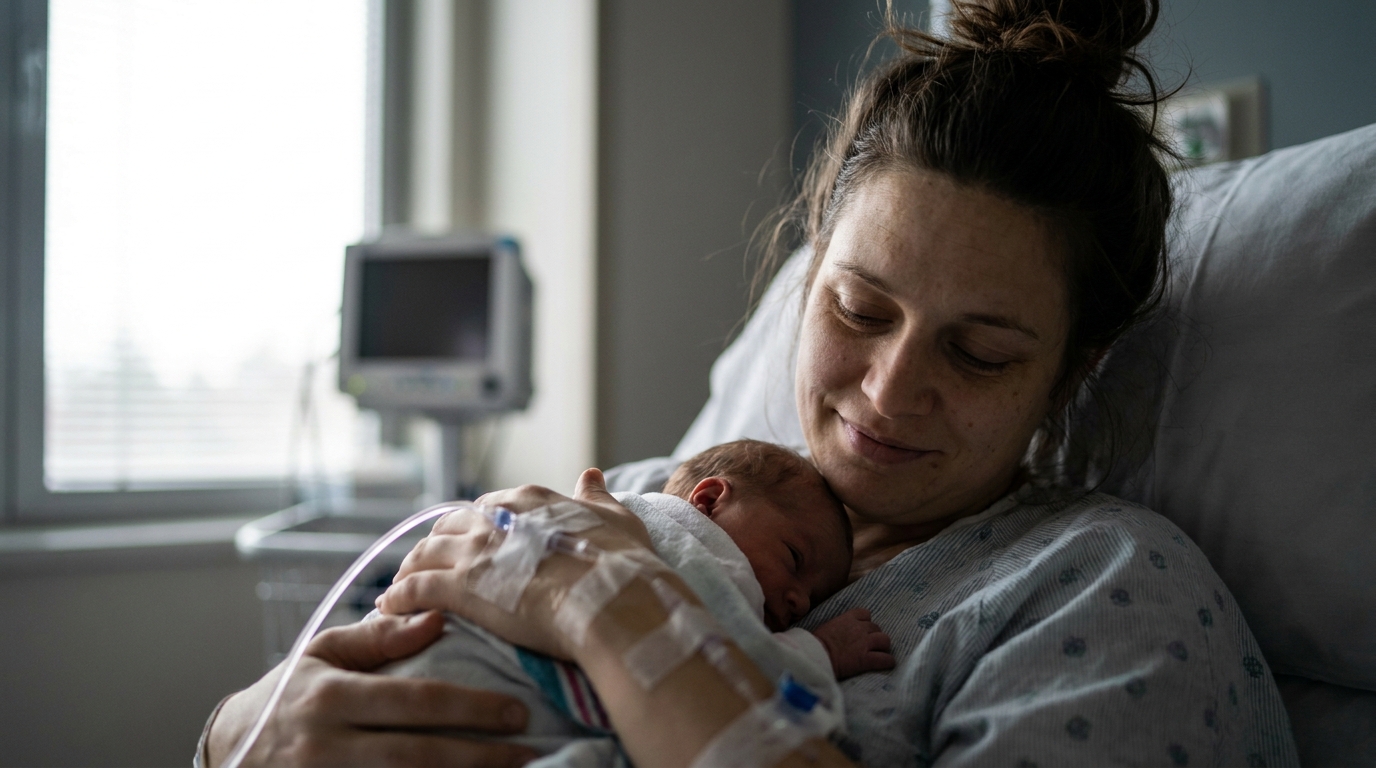
I went into hospital at 41 weeks with a clear birth plan: vaginal, mobile, gas and air, maybe an epidural if it got hard. Eighteen hours later I was being wheeled into theatre. Twenty minutes after that I was holding my daughter while a surgeon I had never met sewed me back together behind a screen.
The whole thing happened so fast that nobody had time to fully explain what was happening, only what was about to. By the time I was in recovery, I had a baby on my chest, a numb lower half, and a head full of questions nobody had answered. The biggest one was simple: why?
If you have just had an emergency C-section and you are trying to understand what actually went wrong (or whether anything went wrong at all), this is the breakdown I wish someone had given me. The 6 real reasons emergency C-section happens, what each one actually means, and the questions to ask at your debrief.
What "emergency" actually means
The first thing to know is that "emergency C-section" is a wide category. In most hospitals it is split into four grades:
- Grade 1 (true emergency): immediate threat to mother or baby. Delivery within 30 minutes. Sirens-and-running version.
- Grade 2: maternal or fetal compromise but not immediately life-threatening. Delivery within 60 to 75 minutes.
- Grade 3: no immediate threat but vaginal birth is not progressing safely. Delivery when theatre is ready.
- Grade 4 (elective): planned in advance, not emergency.
Most "emergency" C-sections are actually Grade 2 or 3. Same surgery, same scar, same recovery, but a different urgency. Knowing which grade yours was matters because it changes the answer to "could this have gone differently?"
The 6 real emergency C-section reasons
These are the real medical categories. Most emergency C-sections fall into one or two of them at once.
1. Failure to progress
The single most common reason. Labor has started but the cervix has stopped dilating, or the baby has stopped descending through the pelvis, despite hours of contractions. The medical term is "failure to progress" but it covers a wide spectrum.
The decision to move to C-section here is usually based on:
- The cervix has not opened more than 1 cm in 4 hours despite active contractions
- The baby's head has not moved down despite full dilation and 2 to 3 hours of pushing
- Mom and baby are both tired and continuing increases risk
This is one of the harder reasons to accept emotionally because it can feel like your body "failed." It did not. Sometimes the baby is simply too big for the pelvis shape (a real condition called cephalopelvic disproportion, where the baby's head cannot fit through the pelvic opening), and the body genuinely cannot complete the birth without help.
2. Fetal distress
The second most common reason. The baby's heart rate pattern on the monitoring (called CTG, or cardiotocography) shows the baby is becoming distressed, either from oxygen drop, cord compression, or general labor stress.
Specific patterns that trigger urgent C-section:
- Late decelerations (heart rate drops after each contraction and recovers slowly)
- Persistent low baseline heart rate
- Loss of variability in heart rate
- A sudden severe drop in heart rate that does not recover
These patterns mean the baby is not coping with the contractions and needs to be born now. This is the reason most Grade 1 emergencies are called. The decision is fast because the consequences of waiting are serious.
3. Cord prolapse
Rare but a true Grade 1 emergency. The umbilical cord slips down through the cervix before the baby, often after waters break. When the baby's head presses on the cord, the baby's oxygen supply is cut off.
The midwife or doctor doing the vaginal exam can feel the cord. The protocol is immediate: knees-to-chest position, hand inside to lift the baby's head off the cord, and straight to theatre. The whole pathway from diagnosis to delivery is often under 15 minutes.
(If your waters broke before labor started and the cord prolapse risk was discussed with you, the basics of that situation are covered in How Long After Your Water Breaks Before Labor Starts.)
4. Placental abruption or placenta previa bleeding
Heavy bleeding during labor often points to either the placenta starting to separate from the uterus too early (abruption) or a placenta covering the cervix that started to bleed (previa).
Both are emergencies. Heavy maternal bleeding compromises both mom's blood pressure and the baby's oxygen supply. C-section is the quickest way to deliver and stop the bleeding.
5. Baby in the wrong position
Most babies present head-down for birth. Some present:
- Breech (bottom first)
- Transverse (sideways)
- Brow (head not flexed correctly)
- Persistent occiput posterior (back-to-back, head not aligned)
Some of these can be born vaginally with the right team. Many lead to C-section, especially if discovered late in labor or if the baby is unable to rotate into a better position.
If you went into labor expecting head-down and found out at the 6 cm exam that the baby had turned, that is one of the more common surprise C-section reasons.
6. Maternal medical crisis
Less common but real:
- Severe pre-eclampsia or eclampsia (seizures from very high blood pressure)
- Severe maternal infection
- A cardiac event during labor
- HELLP syndrome (a severe form of pre-eclampsia affecting the liver and platelets)
These C-sections are called to protect the mother's life and the baby's at the same time. The baby is delivered as quickly as possible so mom can be treated.
What to ask at your birth debrief
Most hospitals offer a birth debrief appointment in the weeks after a difficult birth. If yours did not offer one, ask for it. Many parents skip this because they are too tired or do not realize it exists. It is one of the most useful things you can do for closure and for planning future pregnancies.
The questions worth bringing:
1. What grade was my C-section officially classified as? 2. What was the specific reason in my notes? 3. What was happening just before the decision was made? 4. Were there warning signs earlier that could have predicted this? 5. Was the baby in the right position throughout labor? 6. What were my CTG patterns like? 7. Could anything have changed the outcome? 8. What does this mean for future pregnancies? (Most people are eligible for VBAC, a vaginal birth after caesarean, which we cover in a separate post.) 9. Are there any specific risks I should know about for next time? 10. Do you have a copy of my full birth notes I can take home?
The debrief is your time. Bring written questions. Bring your partner if they were there. Ask everything. Most consultants are genuinely glad to walk you through it, because they know how disorienting a sudden surgical birth can be.
The recovery curve nobody mentioned
C-section recovery is real surgery. The 6 to 8 week timeline you read about online is the absolute minimum, not the realistic average. Most moms I know felt mostly themselves around 10 to 14 weeks, not 6. (The full week-by-week is in Postpartum Recovery: The First 6 Weeks Nobody Warns You About.)
Specific things about C-section recovery that often catch people off guard:
- The wound itches for months as it heals, especially weeks 4 to 12
- The numb patch around the scar can last 6 months to a year (slowly improves)
- The internal stitches (which dissolve) sometimes give a sharp twinge for weeks
- Lifting anything heavier than the baby is off the table for 6 weeks
- Coughing, sneezing, and laughing all hurt for about a fortnight
- The first poop is genuinely the worst (stool softeners from day one are the answer)
- Going up and down stairs is harder than walking on flat
- Driving is usually 4 to 6 weeks off, not because of strength but because of the abdominal reflex needed for an emergency stop
The recovery often comes with extra emotional weight too. The birth did not go as planned, the baby's first hour was not the skin-to-skin you imagined, and your body is now healing from surgery alongside the normal postpartum picture. Both grieving the birth you expected AND loving the baby you have are normal and can coexist.
Was it really necessary?
This is the question every C-section mom asks herself at 3am at some point.
The honest answer: in the vast majority of emergency C-sections, the decision was made by experienced clinicians watching real-time signs that pointed to genuine risk. The bias of modern maternity care is toward avoiding intervention when possible, not toward it. Hospitals are under pressure to reduce C-section rates, not increase them.
If you ever feel that something was rushed or wrong, the debrief is where you raise it. In rare cases, complaints procedures exist for situations where care fell below standard. But for most emergency C-sections, the answer is yes, it was needed, and the reason it felt sudden is because by the time the decision is made, the team has already been weighing the options for hours.
What to tell yourself when the scar is still raw
The version of your birth that happened is now the version of your birth that exists. Whatever it looked like, you grew that baby, you went through labor, and the surgical part at the end was the path that brought your baby safely out.
Your body did not fail. It did the work it could do, and when something needed to change, the team did the next part. Both of those count as the same act of bringing a baby into the world.
The scar fades. The story stays. By the time the scar is silver and barely visible, you will have a toddler who has no memory of the way they were born, only of how you held them afterwards. That is the bit that matters most. The birth was one day. The mothering is forever.
You are recovering from real surgery while feeding a newborn. That alone is the most demanding thing a human body does. Be gentle. Eat the food. Take the painkillers. Lie down when the baby lies down. And book the debrief. The answers help.