
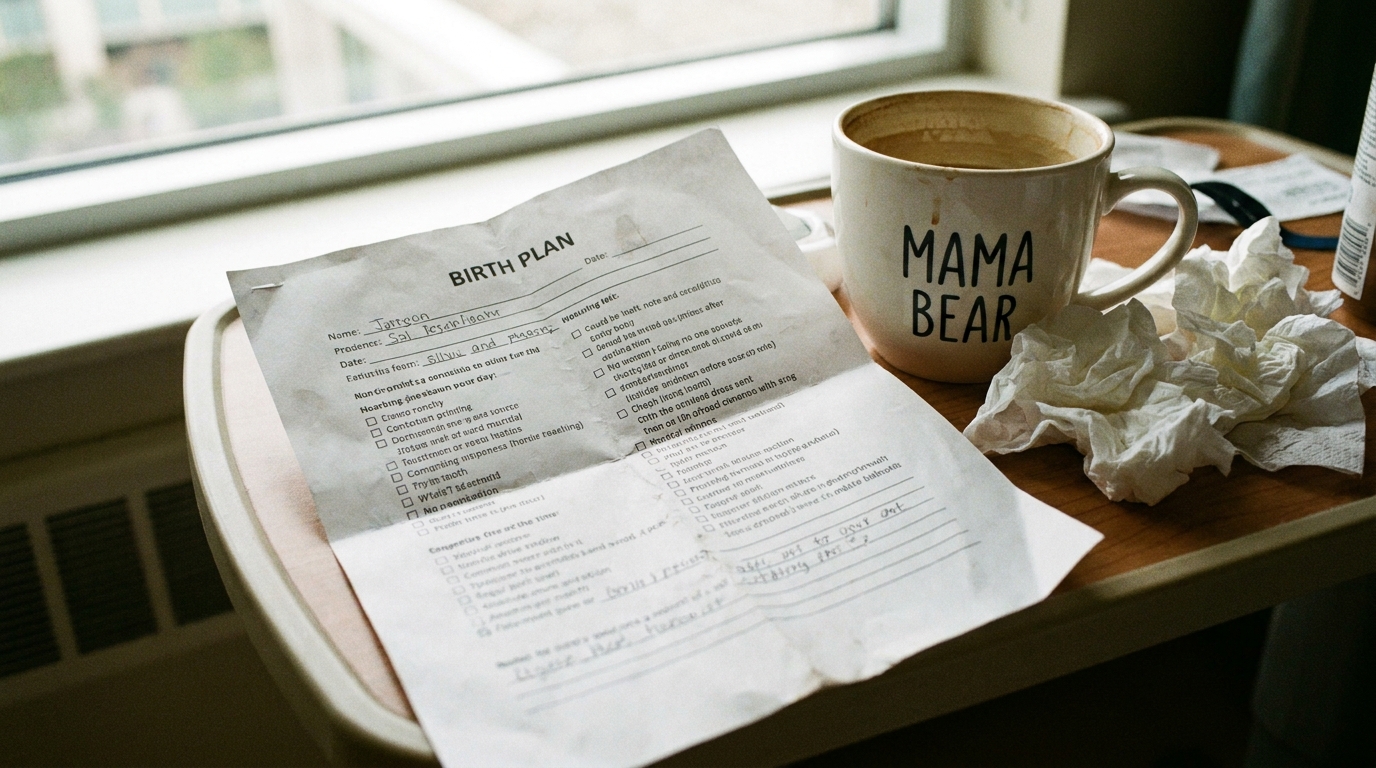
My birth plan with my first was three pages long. Laminated. Highlighted. Printed in triplicate so the midwife, the OB, and the partner could each have a copy. I had researched everything: delayed cord clamping, skin-to-skin within the first minute, no episiotomy if possible, only gas and air for pain relief, dimmed lights, a specific playlist.
Almost none of it happened. Not because the team was hostile to it (they were not). Because by the time I was 8cm dilated and the baby was showing signs of distress, the plan I had laminated at 36 weeks was not the plan that fit the body and baby I had at 41 weeks. By the time my daughter was placed on my chest, I had agreed to an epidural I had not wanted, an episiotomy I had specifically asked about avoiding, and a forceps delivery that was not in any version of my plan.
If you are writing a birth plan and wondering whether the version you are crafting will actually happen, here is the honest birth plan reality from someone who has done it twice. What is still worth planning, what to let go, and the one thing that genuinely matters more than any line on the page.
Why birth plans go off script
The plan is built on best-case assumptions. The labor is built on whatever the body and baby actually do. Those two things are rarely aligned, and when they are not, the plan has to bend.
The most common reasons a plan deviates:
Labor is longer or shorter than expected. A plan written for a 10-hour labor with planned movement, music, and bath time does not survive a 4-hour precipitous labor or a 30-hour induction.
The baby moves position. Around 1 in 10 babies stays back-to-back (occiput posterior) into active labor. This typically means slower labor, more back pain, and sometimes intervention. The plan written for a head-down anterior baby does not fit.
Pain hits differently than imagined. Many women plan for unmedicated births and ask for an epidural in transition. Many plan for an epidural and find they cope without one. The body's pain reality at 8cm is different from the body's pain imagination at 36 weeks.
The baby shows distress. CTG patterns shift. Heart rate drops. Suddenly the plan to labor in the bath becomes a plan to deliver in 30 minutes. We covered some of the reasons emergency C-sections happen in detail in a separate post.
Your water breaks before labor starts. If you have PROM, the timeline and the location of birth often shift. The home birth becomes a hospital induction. The relaxed early labor becomes a clock-watch. (Full picture in How Long After Your Water Breaks Before Labor Starts.)
The hospital is busy. Sometimes the birth pool is in use. Sometimes the room you wanted is not available. Sometimes the midwife you have built rapport with goes off shift. The variables of a working maternity unit affect every birth.
The plan does not fail because the team failed or because you failed. It fails because labor is a live event and every other live event in your life has worked the same way.
What is still worth planning
A birth plan is still useful even if it does not survive contact with labor. The right plan is short, prioritized, and treats most of itself as preferences rather than rules.
The "must" list (3 items maximum)
These are the few things you genuinely want, that you will advocate for, and that the team can almost always accommodate.
For most women, the must list looks something like:
- Skin-to-skin contact with the baby immediately after birth (if both are stable)
- Delayed cord clamping (1 to 3 minutes after birth, now standard at most hospitals anyway)
- The partner or support person staying with you throughout
Keep this list very short. The longer it is, the less likely each item is to be honored under pressure.
The "preference" list (the rest)
These are things you would like but are willing to flex on. Useful for the team to know, but not battles.
Examples:
- Preference for low lighting
- Preference for upright positions
- Preference for intermittent monitoring if possible
- Preference for no episiotomy unless medically required
- Preference for a specific pain relief order (start with movement and water, then gas and air, then epidural if needed)
- Specific music or scents
- Mirror so you can see the birth
- Photography rules
These are nice to have. They make you feel involved. The team will accommodate when they can. They will deviate when labor demands.
What not to put in the plan
A few things commonly written in birth plans that do not belong there:
- Absolute rules about what you will not consent to (better as a conversation, not a written demand)
- Long medical reasoning for your choices (the team has the same reasoning, you do not need to teach them)
- Things you cannot control (baby's position, length of labor, your blood pressure)
- Specific people the team should or should not be (you cannot pre-choose your midwife at most hospitals)
- Overly detailed timing (write "delayed cord clamping" not "exactly 90 seconds after birth")
How to write a plan that actually helps
A useful birth plan is one page. It can be read in 60 seconds by a busy team. It signals what you care about without trying to write the entire labor in advance.
The template most experienced birth educators recommend:
Top of page: Your name, partner's name, the baby's expected sex (if known), any medical alerts (allergies, GBS positive, blood type, previous birth complications).
Section 1: What is most important to me. Three short bullet points, the must list.
Section 2: My preferences if all goes well. A short paragraph of preferences, written calmly.
Section 3: If the plan needs to change. A short paragraph about how you want to be involved in decisions. Often this sounds like: "If interventions become necessary, please explain to me what is happening and why. I want to be part of the decision."
Section 4: After the birth. Anything specific about the first hour: skin-to-skin, who cuts the cord, whether you want to feed straight away.
That is it. One page, clear, calm, and honored by most teams in most births.
The conversation that matters more than the plan
The single most useful birth preparation activity is not writing the plan. It is having a conversation with your partner about three specific scenarios and what you each think you would want.
1. What if I need to consider an epidural? Discuss this calmly when there are no contractions. Decide whether your partner will encourage, discourage, or stay neutral on the request. Both options are valid. Agreeing in advance removes a fight in the moment.
2. What if the doctor suggests interventions? Agree on what counts as "we ask questions before we agree" and what counts as "we say yes immediately." Forceps versus C-section versus vacuum extractor. Continuous monitoring versus intermittent. Decide your default reactions in advance.
3. What if the birth does not go as planned and I am upset afterwards? Agree that the partner's job in the days after is not to fix the disappointment but to acknowledge it. Most mothers who have a birth that did not match their plan need to talk through it, sometimes many times. The partner who can listen without trying to make it positive helps the most.
These three conversations matter more than any line item in a plan. They prepare you for the live event in a way that paper cannot.
What to do when your birth goes off script
If you are in early labor and you can already see your plan is not going to happen the way you wrote it, here is what helps.
Name it out loud. "This is not what I planned." Saying it puts you back in the active role.
Ask one question at every decision point. "What are my options here?" or "What happens if we wait an hour?" Information helps you stay in the seat.
Choose your one focus. If the rest of the plan is dissolving, pick the one thing you can still hold onto. Maybe it is the skin-to-skin contact. Maybe it is the partner being present. Hold on to that one thing.
Let the team do the rest. When the plan is gone and the work is on, the midwives and doctors are extremely good at what they do. Trust them. Your job becomes accepting their expertise rather than directing the room.
After the birth, the debrief conversation matters. The hospital should offer one. If they do not, ask. Walking through what happened and why helps process a birth that went off plan.
What the data actually shows about birth plans
A recent review of birth plan studies showed three things consistently:
1. Women with written birth plans report slightly higher satisfaction with their care, even when the plan does not happen as written, because they felt heard. 2. Detailed birth plans (more than two pages) are associated with lower satisfaction because the gap between plan and reality is bigger. 3. The single most predictive factor for birth satisfaction is feeling respected by the team, not whether the specific plan happened.
In other words: the plan helps you communicate, but the experience depends more on the relationship than the document.
What to tell yourself at 36 weeks with a half-written plan
Your birth plan is a way to think about what matters to you, not a contract with the universe. The version you write at 36 weeks is your best guess at what your future self will want. Your future self may want completely different things at 8cm with no sleep and a baby in distress.
That is not failure. It is birth.
Write the one-page version. Have the three conversations with your partner. Pack the hospital bag. And know that whatever happens in the room, the people there will be doing their best to bring your baby out safely.
That is the only thing that actually has to happen. Everything else is a bonus.