
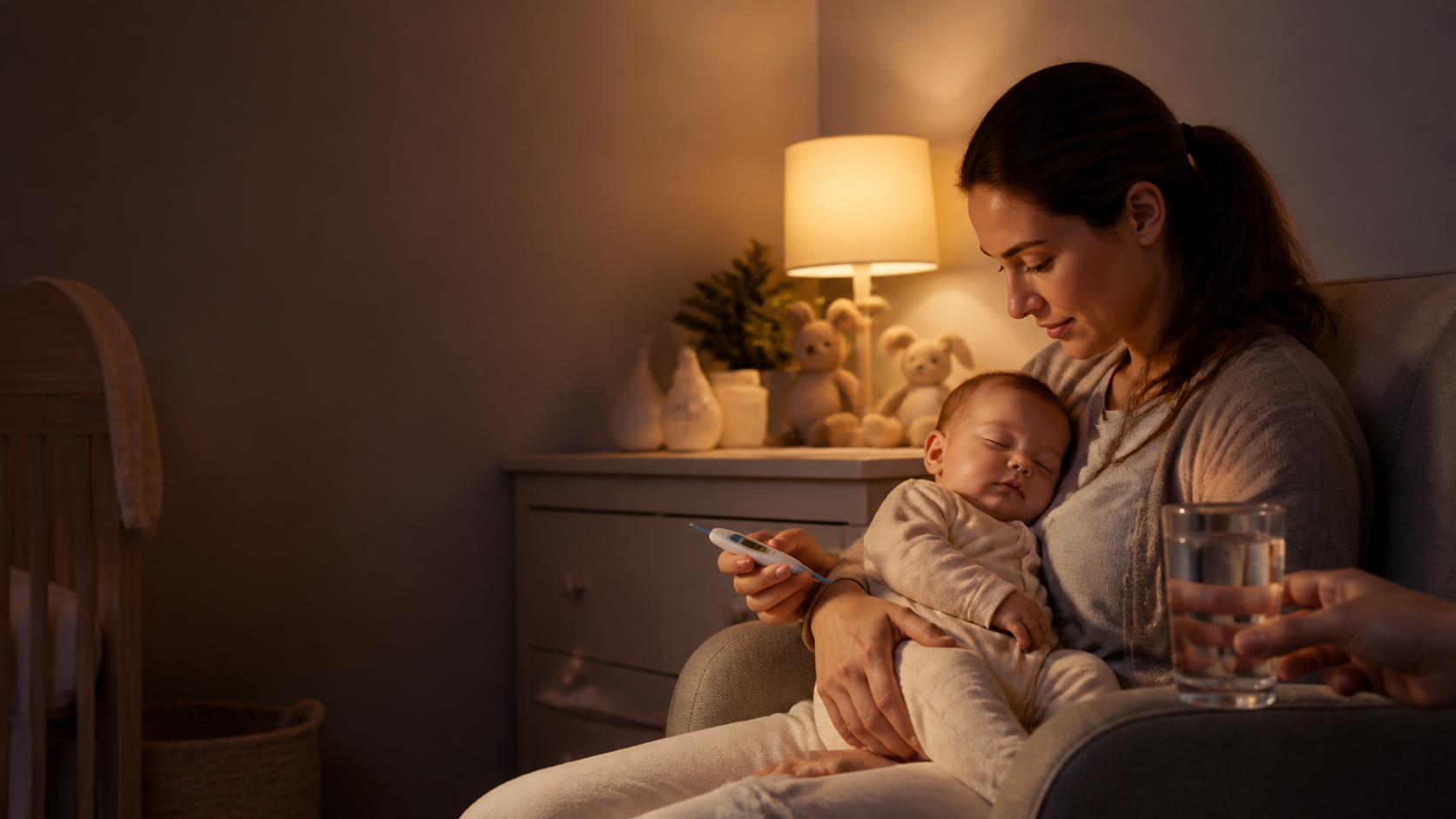
The first fever usually arrives at the least convenient time: after bedtime, when your baby feels warmer than usual and your brain has already opened twelve tabs of panic.
Take a breath, get an accurate temperature, and look at the whole child. A number matters, especially for young babies, but so do breathing, alertness, feeding and whether your child looks seriously unwell.
What counts as a fever?
The American Academy of Pediatrics uses 100.4°F (38°C) or higher as a fever. Use the method your child's clinician has recommended for their age. If you are unsure how to take a temperature correctly, call your pediatrician's office and ask. Do not guess from a warm forehead alone.
Call now for these situations
Call your child's doctor right away if a baby younger than three months has a temperature of 100.4°F (38°C) or higher. Do not wait to see whether it drops overnight.
For any age, seek urgent help if your child is struggling to breathe, is hard to wake, has a seizure, has a stiff neck, a worrying rash, repeated vomiting or diarrhoea, or looks very ill. Call emergency services if they are unconscious, having a seizure that does not stop, or have severe breathing difficulty.
Also call if the fever repeatedly reaches 104°F (40°C), if your child has a condition or medication that affects their immune system, or if your instincts are telling you something is not right. You know what normal looks like for your child.
What to do while you wait
Offer regular feeds or fluids. You are watching for hydration, not forcing a perfect bottle or meal. Keep clothing light and the room comfortable. A lukewarm bath is not required, and cold baths can make a child shiver and feel worse.
Fever medicine can help discomfort, but it is not a test of whether the illness is serious. Use only a product and dose your clinician or pharmacist has said is appropriate for your child's age and weight. Never give aspirin to a child. Do not combine or alternate medicines unless a clinician has told you exactly how.
Write down the temperature, time, method used, medicines given and other symptoms. At 2 a.m. those details disappear surprisingly fast.
The reassuring signs
It can be a good sign when a child perks up, makes eye contact, drinks, plays a little or responds normally after their discomfort settles. That does not mean you ignore new symptoms; it means you are seeing the person behind the number.
For children under two, call if fever lasts more than 24 hours. For children two and older, call if it lasts more than three days, or sooner if they are worsening. Your own clinician may give different advice based on your child's history.
Keep the rest of the house calm
You do not need to disinfect every surface while someone is ill. Wash hands, avoid sharing cups, clean up obvious messes and concentrate on rest. If you are caring for a newborn while exhausted, this newborn daily-care checklist can help you keep the basics visible. For common signs that may need a call, see newborn jaundice: when to call your GP.
This article is general information, not a diagnosis. When a baby is unwell, calling your child's own clinician is never an overreaction.